
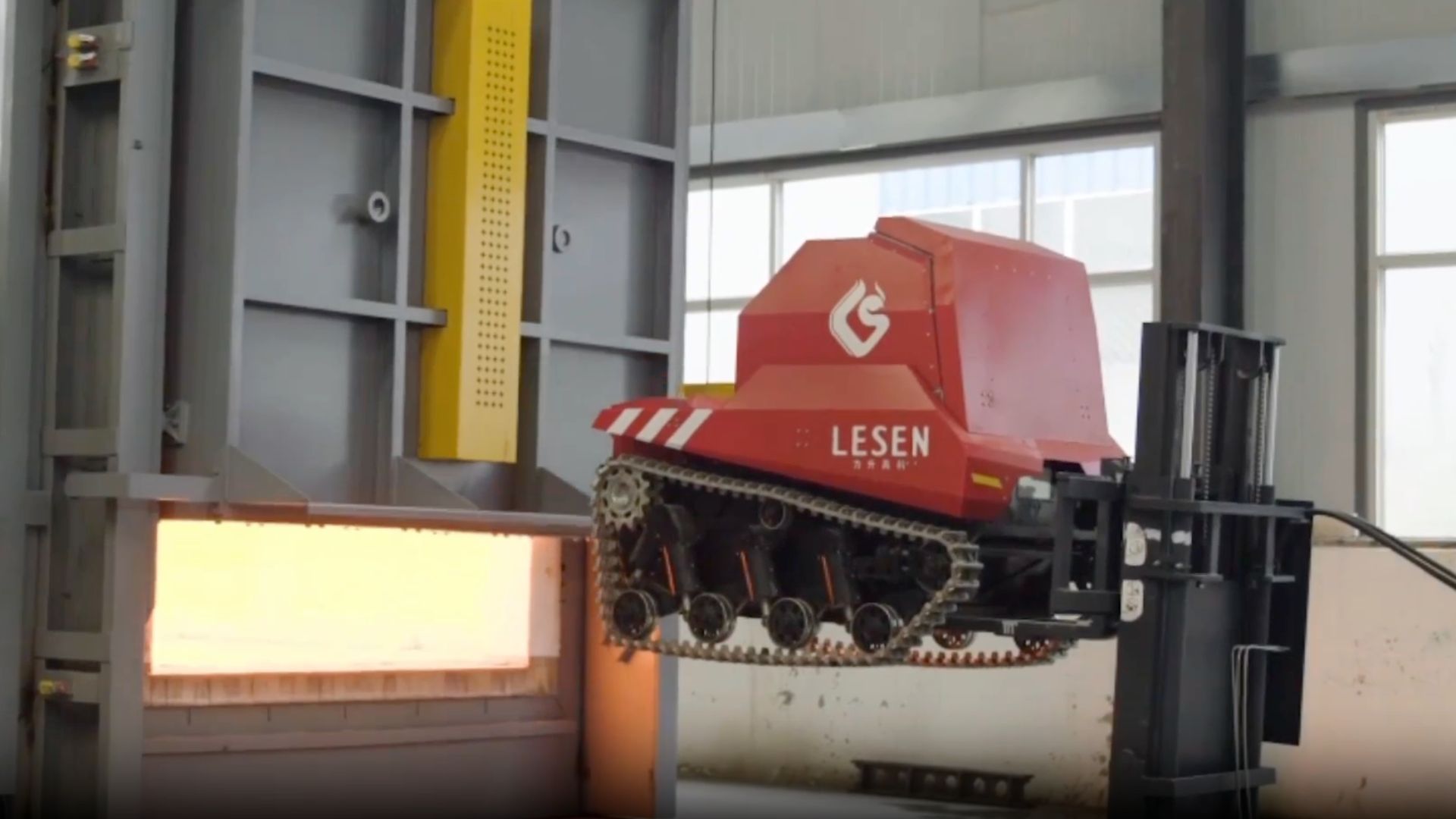
A firefighting robot developed in China has reportedly survived 30 minutes inside a furnace heated to 1,000 degrees Celsius (1,832 degrees Fahrenheit). Developed by Chinese robotics company Beijing Lesentech, RXR-M80D-AX2 remained operational after exposure to the extreme temperatures. The machine is designed to operate in high-temperature environments that would pose serious risks to human firefighters. According to its makers, the demonstration shows how specialized robotics could help emergency response teams tackle fires in hazardous industrial settings and other locations where direct human intervention is dangerous. Advanced heatproof robot Surviving temperatures of 1,000°C is particularly challenging for a mobile robot because several critical systems must remain operational simultaneously. Its electronic control units, motors, sensors, and communication equipment all need protection against thermal damage. RXR-M80D-AX2 is a high-temperature-resistant firefighting robot designed to operate continuously for more than 30 minutes in environments reaching 1,000°C (1,832°F). The 1763-pound (800-kilogram) robot uses multiple patented thermal-protection technologies to shield its mechanical and electronic systems from extreme heat. Measuring 1,750 x 1,100 x 1,200 mm, the robot carries an IP65-rated enclosure and can travel at speeds of up to 1.5 meters per second. Its mobility platform supports climbing slopes of 30 degrees, crossing trenches up to 400 mm wide, and clearing obstacles 170 mm high. It offers an operating endurance of four hours. For firefighting, the machine features a water-and-foam cannon with a maximum flow rate of 80 liters per second and a range of 85 meters. Operating at 1.0 MPa pressure, the cannon supports both concentrated jet and mist-spray modes, with horizontal rotation of 60 degrees and vertical adjustment from -15 to +75 degrees. The robot also carries sensors for detecting carbon monoxide, methane, hydrogen sulfide, and hydrogen, alongside temperature monitoring. Its imaging system combines visible-light cameras with an infrared thermal camera. Operators control the platform through a handheld joystick-based remote controller, with wireless communication reaching up to 1,000 meters in line-of-sight conditions. Firefighting’s robotic future The 30-minute furnace exposure offers an indication of the thermal resilience Lesen has engineered into the platform. However, surviving a controlled high-temperature demonstration is different from operating in an actual fire, where conditions can change rapidly and involve smoke, falling debris, unpredictable heat distribution, and structural damage. According to experts, the demonstration points to an increasingly important role for robots in firefighting. Rather than requiring personnel to enter dangerous areas immediately, remotely operated machines can potentially be sent ahead to investigate conditions and provide emergency teams with information about the situation. Such machines could be particularly useful in industrial facilities, chemical plants, warehouses, and other locations where fires can expose emergency responders to extreme temperatures and additional hazards. Robotic platforms can also provide access to areas that may be difficult for firefighters to approach safely. Depending on their equipment and capabilities, they can help teams inspect hazardous locations, monitor developing situations, and support firefighting operations while keeping personnel at a safer distance. Lesentech’s demonstration illustrates the potential of designing machines specifically for these demanding conditions. While further information about the robot‘s operational capabilities and performance in real firefighting scenarios would help establish its practical value, surviving 30 minutes at 1,000°C represents a notable demonstration of heat-resistant robotic engineering. Experts note that as emergency services explore ways to reduce risks to personnel, machines capable of entering extreme environments could become valuable tools for assessing and responding to fires that are too dangerous for humans to approach. Get the latest in engineering, tech, space & science - delivered daily to your inbox.Jijo is an automotive and business journalist based in India. Armed with a BA in History (Honors) from St. Stephen's College, Delhi University, and a PG diploma in Journalism from the Indian Institute of Mass Communication, Delhi, he has worked for news agencies, national newspapers, and automotive magazines. In his spare time, he likes to go off-roading, engage in political discourse, travel, and teach languages.
Chinese firefighting robot survives 1,832°F heat in extreme 30-minute furnace test
Full Article
Original Source
Read the full article at Interestingengineering →KhanList aggregates and links to publicly available news content. We do not host full articles from third-party sources. Always verify important information with original sources.