
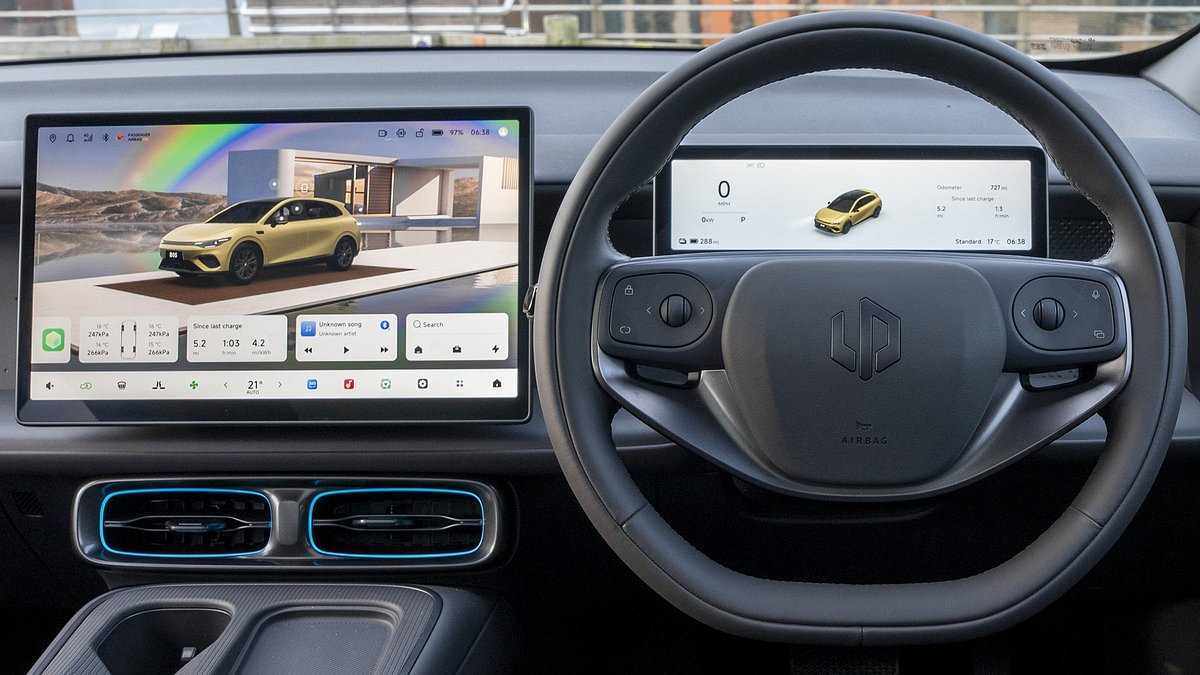
European carmakers have listened to calls from motorists and road safety experts and are reintroducing buttons to the dashboards of their latest models.But Chinese brands haven't. And their cars are more distracting to drive as a result, says Europe's biggest vehicle crash testing body.Advances in technology have seen in-car touchscreen systems grow ever larger, faster and glitzier in recent years. Many manufacturers succumbed to the temptation of these massive displays, removing conventional switches for basic controls from the dashboard to make their car interiors look smarter.But with simple tasks, like changing a radio station or adjusting cabin temperature, buried within multiple sub-menus of these systems, drivers can find themselves repeatedly prodding at screens rather than concentrating on the road ahead. Motorists and road safety groups have long warned that tablet-style touchscreens are overly complicated, distracting and becoming increasingly dangerous to operate.In response to these concerns, experts at Euro NCAP this year introduced new assessment criteria that penalise models lacking physical controls for key functions.And it claims Chinese manufacturers are by far the worst offenders as they attempt to woo British buyers with technology-packed cabins. Euro NCAP says carmakers are starting to listen to customers and bringing buttons back to their dashboards over concerns that touchscreens have become dangerously distractingUnder the Safe Driving section of Euro NCAP's safety rating programme, vital controls, including indicators, windscreen wipers and washers, hazard warning lights, the horn and the eCall emergency button, must be operated using a single button.Failure to meet these requirements results in points being deducted from their scores and ultimately can affect the vehicle's overall five-star safety rating.The move comes in response to growing consumer criticism over everyday driving functions being hidden within touchscreen menus that can be 'needlessly fiddly, and which research has shown has a higher distraction potential for a driver compared to physical buttons', Euro NCAP says.Join the discussionAre touchscreen controls making cars more dangerous and should manufacturers prioritize driver safety over high-tech interiors?What's your view?Some of the biggest names in the automotive industry have already been criticised for taking touchscreen technology too far.Mercedes, for example, offers a massive 55.5-inch Hyperscreen spanning the entire dashboard of some of its flagship electric models.Even Volvo, a brand synonymous with safety, came under fire from experts over its EX30 EV, which requires drivers to navigate a touchscreen submenu simply to adjust the door mirrors and activate the rear-window demister.But Euro NCAP says the latest round of assessments suggest established manufacturers are now 'making a steady return in favour of buttons and switches'.However, Chinese newcomers are ignoring calls from drivers and safety groups. Motorists and safety experts have warned that infotainment screens are becoming distracting to use. Pictured: Mercedes' 55.5-inch 'Hyperscreen' Even Volvo, which is synonymous with safety, has been accused of shifting controls to its touchscreens. Functions for the electric mirrors and rear window de-mister in the EX30 are in the displayThis month, it published evaluations of the cabin controls in three new models: the German Audi Q7, Korean Kia EV2 and Chinese XPeng X9.While both the Q7 and X9 are large, premium family cars, Euro NCAP said the £82,500 Audi SUV features 'simple, intuitive and ultimately safe' controls, while the XPeng people carrier – which starts from £75,000 – 'relies too heavily on touchscreen technology'.Audi, part of the Volkswagen Group, and a company previously criticised for reducing the number of physical controls in its cars, achieved an impressive 90 per cent score for driving-control usability.The crash-testing body said the cockpit's buttons and stalks are clearly visible, ergonomically positioned and easy to operate without increasing driver distraction.The £24,000 Kia EV2, a smaller SUV, also achieved excellent results.In stark contrast, China's XPeng was found to 'rely too heavily on the central touchscreen, which can be distracting'.As a result, it scored just 20 per cent.And Euro NCAP says this reflects a broader trend among Chinese brands. Euro NCAP said the latest Audi Q7 is a good example of European carmakers heeding call from customers to bring more buttons back to the dashboard The crash testing body said the Q7's buttons and stalks are clearly visible, ergonomically positioned and easy to operate without increasing driver distraction In contrast to the Audi's performance, Euro NCAP criticised the complicated touchscreen in XPeng's X9 people carrier The XPeng was found to 'rely too heavily on the central touchscreen, which can be distracting', the crash testing body saidOf the models assessed so far this year, it says there are 'clear differences between European manufacturers and Chinese carmakers', with European brands consistently scoring highly for retaining physical controls for key functions.BMW's iX3, for example, scored a perfect 100 per cent for driving controls, while the Cupra Raval achieved 80 per cent.Chinese rivals fared significantly worse.The Zeekr 7GT and Aion UT both received scores of just 20 per cent. The Leapmotor B05 family hatchback performed worst of all, scoring zero.'Euro NCAP is continually monitoring market trends, and the move toward placing as many driving controls within a car's touchscreen system is one that has concerned us just as much as it has annoyed consumers,' explained Dr Aled Williams, programme director at Euro NCAP.'It is clear in these results that the XPeng adheres to the mantra that everything must be included in the touchscreen, despite overwhelmingly negative feedback by European car buyers.'We applaud Audi and Kia for taking a more common-sense approach.'Our latest protocols reward the intelligent use of physical buttons and controls, as this can reduce driver distraction, and both Audi's new Q7 and Kia's EV2 do an excellent job of keeping safety simple.'Other manufacturers, including XPeng, would do well to follow this strategy.' Euro NCAP this year introduced new rules that downgraded the safety scores of new cars that don't have physical buttons for the most basic controls. Leapmotor's B05 has the lowest rating The Chinese family hatchback, which costs from £30,000, scored a zero for its driving controls - the lowest rating of the year so farWhat Car? recently tested touchscreen systems from 21 car brands to measure how long drivers need to take their eyes off the road to carry out simple tasks.And the results were alarming.In some vehicles, something as straightforward as changing the radio station took up to 81 seconds, leaving drivers distracted for dangerously long periods.The poorest-performing infotainment systems belonged to the Honda HR-V and Suzuki e-Vitara, which both received just one star from the magazine's judges.Its survey of motorists also found that 85 per cent believe infotainment systems should feature more physical buttons than they currently do. CARS & MOTORING: ON TEST
Chinese cars are touchscreen heavy and more distracting to drive than European rivals
Full Article
Original Source
Read the full article at Dailymail →KhanList aggregates and links to publicly available news content. We do not host full articles from third-party sources. Always verify important information with original sources.