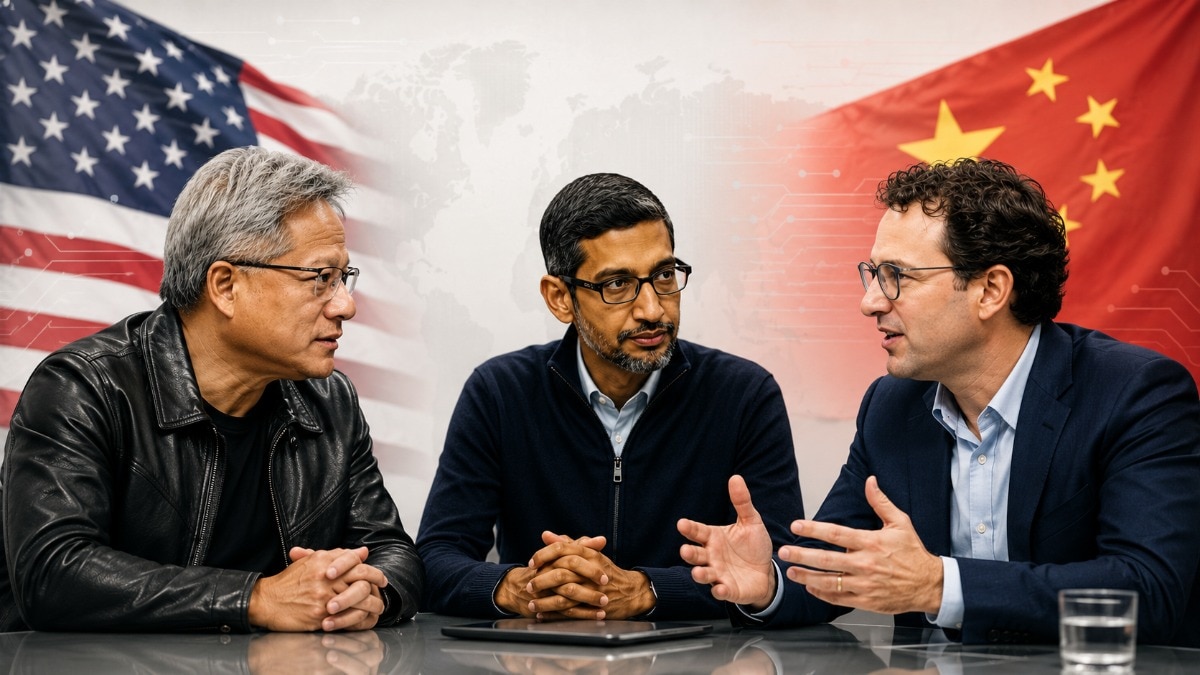
Chinese AI models are becoming more capable and widely available, and Silicon Valley is divided over how the US should respond. While some want Washington to tighten restrictions, others argue America should compete by building better AI, not blocking Chinese models.China's AI rise has split Silicon Valley over how America should respond. (Image created using AI)Chinese AI models are creating some serious tension inside Silicon Valley. For the past few years, American AI companies have been enjoying a comfortable lead in the AI race, believing China would eventually catch up, just not anytime soon. But that confidence is now beginning to crack. China has been on a roll, releasing one powerful AI model after another, from DeepSeek to Zai's GLM 5.2 and, most recently, Moonshot AI's open-weight model Kimi K3. And these back-to-back launches are now concerning the US and leaving the tech industry in splits. On one side companies like Anthropic want Washington to restrict Chinese AI before it threatens America's technological leadership and national security. On the other hand, companies like Nvidia, Google, Microsoft believes the US should not ban but respond by building better AI.But why this fear? You see, Chinese models like Kimi K3 are not just cheaper AI models. They are also matching or even beating capabilities of leading American AI models like Anthropic's Claude or OpenAI’s ChatGPT in benchmarks. More importantly, most of them are open weight models. Meaning, these Chinese models allow developers to download, customise and run them on their own infrastructure, making them affordable and convenient for startups and businesses who may not be able to afford token-based proprietary US models. And it is precisely these freely available Chinese open-weight AI models which are bringing concerns. Anthropic says China is stealing from American models. It argues that the fact Chinese AI firms have managed to catch up with the US is not because of their innovation or research but because of allegedly stealing from closed models. The maker of Claude AI alleges that China has illicitly distilled American frontier AI models, essentially using their outputs to build competing systems. “We have identified industrial-scale campaigns by three AI laboratories—DeepSeek, Moonshot, and MiniMax—to illicitly extract Claude’s capabilities to improve their own models,” says Anthorpic. “These labs generated over 16 million exchanges with Claude through approximately 24,000 fraudulent accounts, in violation of our terms of service and regional access restrictions.” Anthropic wants ban on Chinese models So Anthropic wants the US to treat frontier AI model weights as critical national security assets and impose aggressive federal regulations on API access and legally penalize foreign firms caught siphoning American AI data.According to a New York Times report, Anthropic and OpenAI have also been lobbying the Trump administration behind closed doors to place tighter restrictions on Chinese open-weight AI models, citing concerns around intellectual property theft and national security.And the Trump administration is indeed taking it seriously. Treasury Secretary Scott Bessent recently said the administration is considering sanctions against Chinese companies found to have stolen American AI intellectual property, adding that "open source is not open season on American IP." White House science adviser Michael Kratsios echoed those concerns, condemning what he described as "large-scale, covert industrial distillation" of US AI technology. "The US administration's remarks came after Anthropic alleged that Moonshot AI's Kimi K3 was built from data distilled from Anthropic's Claude AI, though these claims remain independently unverified."Silicon Valley says a ban will harm US innovation But much of Silicon Valley doesn't agree with the ban. In fact, many of the industry's biggest names have come out in support of open-weight AI models. Rather than fearing Chinese AI, they argue that the US should focus on building better AI instead of blocking access to competing models.One of the strongest voices comes from Nvidia. CEO Jensen Huang argues that "the world needs both frontier closed models and frontier open models". Microsoft CEO Satya Nadella has also backed Huang, describing open-weight AI as "essential to a healthy AI ecosystem", while Google CEO Sundar Pichai said Google has long benefited from open source and supports the industry's latest open-weight AI initiative.“The knowledge that makes AI useful is diffused. It lives with scientists, engineers, clinicians, firms. For AI to benefit from distributed knowledge, it must itself be distributed,” said Mira Murti, founder of Thinking machine and former OpenAI CTO. Elon Musk, Meta, IBM and Palantir have also thrown their weight behind the support of open-weight Chinese models arguing that open-weight AI encourages innovation, lowers costs and helps more companies compete.In fact, nearly 200 companies, operating under the newly formed Little Tech Association, wrote to the Trump administration urging it not to restrict Chinese open-weight AI. They argued that many American startups rely on affordable open AI models that cannot easily be replaced by expensive proprietary alternatives from OpenAI or Anthropic. Instead of broad restrictions, they called for targeted safeguards against intellectual property theft while allowing developers continued access to AI models already available worldwide.However, the team on the opposite side is calling the big tech out for hypocrisy. Anthropic chief scientist Julian Schrittwieser even mocked companies backing the open-weight AI letter, suggesting that if Nvidia and Microsoft now champion open source, perhaps they should also open-source CUDA and Windows. He later clarified that he supports open models but questioned why companies that have historically kept their own technologies proprietary were suddenly presenting themselves as champions of openness. “I actually think open models can be very useful! But it’s interesting how some historically extremely anti-open-source companies are suddenly all in favour of openness,” he wrote. Interestingly, OpenAI appears to be walking a fine line. While the company has now joined Nvidia, Microsoft, Google, Meta and dozens of others in supporting an industry letter backing open-weight AI, the New York Times reports that it has also been urging the Trump administration to tighten restrictions specifically on Chinese open-weight AI models.The White House looking for a middle pathSo where does Washington stand? For now, the Trump administration appears to be looking for a middle ground. Rather than imposing a blanket ban on Chinese open-weight AI, officials are reportedly considering targeted action against individual companies accused of threatening national security or stealing American intellectual property. - EndsPublished By: Divya BhatiPublished On: Jul 26, 2026 12:18 IST
Chinese AI models split Silicon Valley, Nvidia and others want open access while Anthropic pushes for ban
Full Article
Original Source
Read the full article at Indiatoday →KhanList aggregates and links to publicly available news content. We do not host full articles from third-party sources. Always verify important information with original sources.