
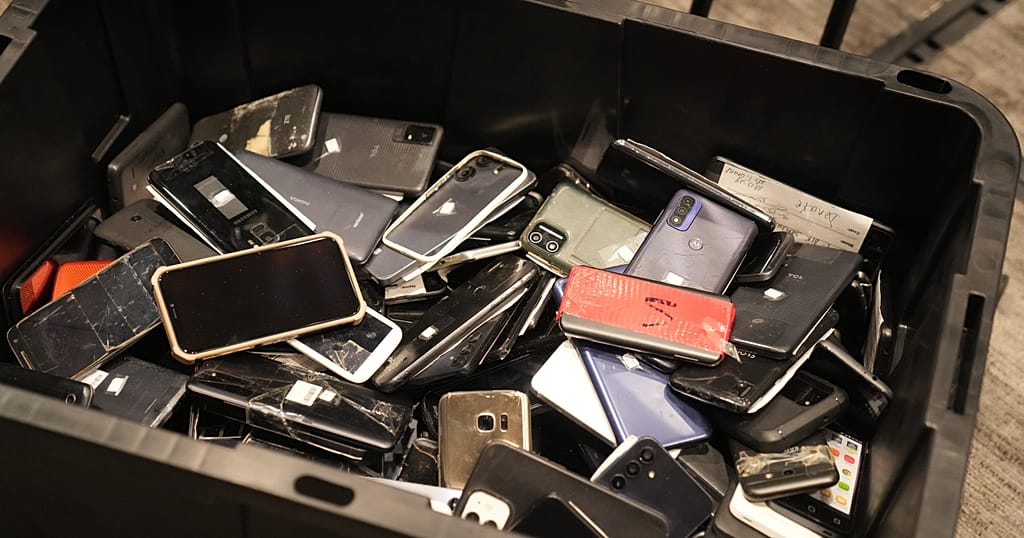
At a neon-lit electronics market in the Chinese city of Shenzhen, buyers from Africa to Bangladesh are snapping up dozens of used smartphones. The number is mind-boggling. As the world's largest smartphone producer, China discards over 400 million devices annually. "From all China, the broken mobile phones come here," said Pakistani businessman Akhtar Muhammad as he browsed the stacks of devices. "We will buy the new LCDs, send the broken phones to our countries, also buy LCDs from here take them to Pakistan where we will fix them," he said. Chip shortages and rising prices are making new devices harder to afford and in emerging markets in Africa and South Asia the demand for used models is soaring. Counterpoint Research says the global secondary smartphone market grew 13 per cent year-on-year in the first half of 2026 to 150 million units. Mama, a young Nigerian buyer, said he had bought around 40 used phones in one day in Shenzhen. "They are more expensive in Africa because we don't have big suppliers or markets like this one," he said. "If I buy and send them to my country, I get profit." But near the market in Shenzhen, a new and more formalised alternative is taking root. PaiJiTang Mall is a self-service second-hand marketplace run by Chinese recycling company ATRenew. Inside, rows of over 20,000 used phones are on display. Buyers scan QR codes for instant inspection reports and pricing, test the units and purchase in bulk. The shop draws up to 1,000 visitors daily, with international traders making up about a third, said store manager Zhang Xiaoming. Algerian shopkeeper, Abdul Rahim, says he flies to China up to three times a month to stock his phone and accessory store, capitalising on a price gap of $110 to $132 per device. "It's very easy for Algerians to get the visa to China. You put in your papers and in two or three days you have the visa in your passport," he said. At ATRenew's massive processing hub in Dongguan, north of Shenzhen, roughly 30,000 second-hand gadgets arrive daily and are inspected and packed by over 300 technicians. Its quality control manager, Li Cankang, says its daily outbound shipments are at a similar level. Apple devices account for 70 to 80 per cent of sales, with the rest split among Chinese brands. Counterpoint says while older models like the iPhone 11, 12, and 13 are losing ground to cheap Androids in China, they retain strong brand power overseas, where they find a second life.
China’s used smartphone trade expands to South Asia and Africa
Full Article
Original Source
Read the full article at Africanews →KhanList aggregates and links to publicly available news content. We do not host full articles from third-party sources. Always verify important information with original sources.