
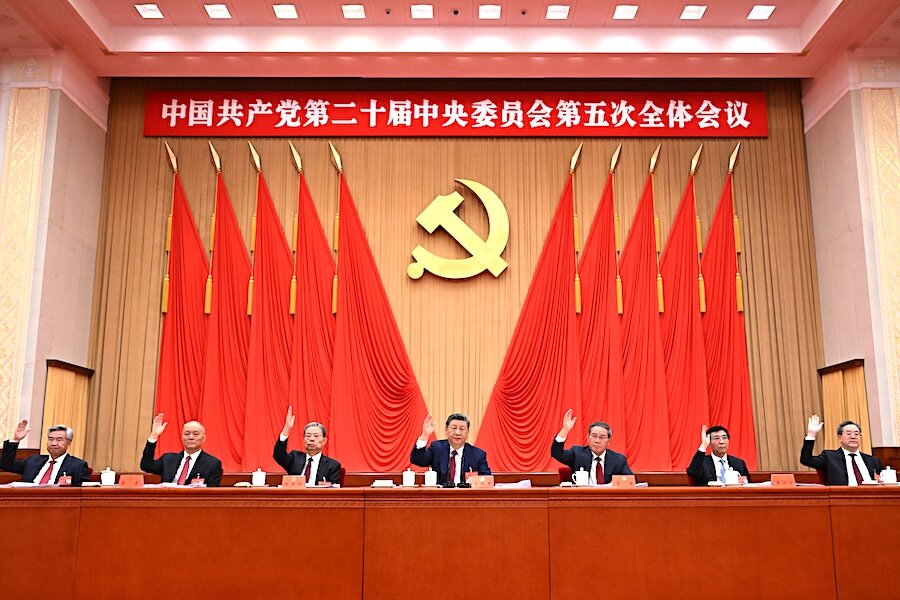
Tuesday’s elections in the United States – the world’s second-largest democracy – will again serve as a way for citizens to decide which party will be the legitimate ruler. Last week in China – the world’s largest one-party state – the ruling Chinese Communist Party (CCP) offered this take on why it has earned political legitimacy: It admitted massive mistakes by party members and then claimed that, by slowly fixing them, it deserves to rule.At a high-level meeting from Oct. 26 to 29, the party revealed that it had purged a record number of senior officials from its 101 million membership. Most of the expulsions were for alleged corruption that were unearthed under a campaign that began in 2012 by party leader Xi Jinping.Yet an increasing number of purges were for “formalism” and “bureaucratism.” Both of those problems can be described as passivity or passing the buck by party members who do not take action to solve problems or who fail to follow party policy. “In practice, some party members and officials fail to act or are slow to act for a range of reasons: some lack motivation and are unwilling to act; others fear getting into trouble and dare not act; still others lack the skills to act effectively,” said Huang Jianfa, deputy head of the party’s Central Organization Department.Yet beyond the numbers, the party’s confession of its internal woes stood out. The meeting’s final communiqué described the problems as grave, “marked by weak, hollow, and watered-down party leadership, lax, superficial and ineffective self-supervision and self-governance, as well as some startling problems within the party.”Not only that, “problems of misconduct and breaches of discipline are persistent, entrenched and recurring,” Zhang Fuhai, deputy director of the Central Committee for Discipline Inspection, told a press briefing. Rather than opening a door to democratic rule, however, officials say the cleansing of the ranks only reinforces the party’s right to rule. “By severely punishing officials who have become corrupt, it encourages and protects those who serve with integrity,” said Mr. Huang.The party defines this process of uprooting “sick trees” as “self-governance” – with the “self” being the party, not Chinese individuals choosing the ideals for governing society.“Xi did not explain,” wrote Bonnie Girard, president of China Channel Ltd., in The Diplomat, “how his party can continue to claim total legitimacy in the face of having exposed millions of party cadres, from top to bottom, who have abused their office and CCP membership for personal gain.” Deepen your worldviewwith Monitor Highlights.Politics with respectGet political stories with respectful analysis.There‘s a world of new ideas in everyBooks newsletter.There‘s more to life, enrich yours withCulture & Learning weekly.Follow humanity‘s discoveries withScience & Nature stories in your inbox.Gain a spiritual perspectivefrom the stories in your inbox.Want to understand the deeper impact of critical events? Learn the Monitor‘s insight.Already a subscriber? Log in to hide ads. In a democracy, abuses by elected offices are corrected at the ballot box. In China, abuses by party members are seen as the gravest internal threat to the party’s survival, with confession and correction as the main ways to stay in power.Yet last week’s party confab left out one data point: A total of 5,343 dissent events occurred in 2025, the highest annual number of protests on record and a 44% increase over the previous year, according to Freedom House. The Chinese people themselves are defining a new style of self-governance. ALREADY A SUBSCRIBER? LoginReal news can be honest, hopeful, credible, constructive.The Christian Science Monitor was founded in 1908 to lift the standard of journalism and uplift humanity. We aim to “speak the truth in love.” Our goal is not to tell you what to think, but to give you the essential knowledge and understanding to come to your own intelligent conclusions. Join us in this mission by subscribing.
China's shifting style of self-governance
Full Article
Original Source
Read the full article at Csmonitor →KhanList aggregates and links to publicly available news content. We do not host full articles from third-party sources. Always verify important information with original sources.