
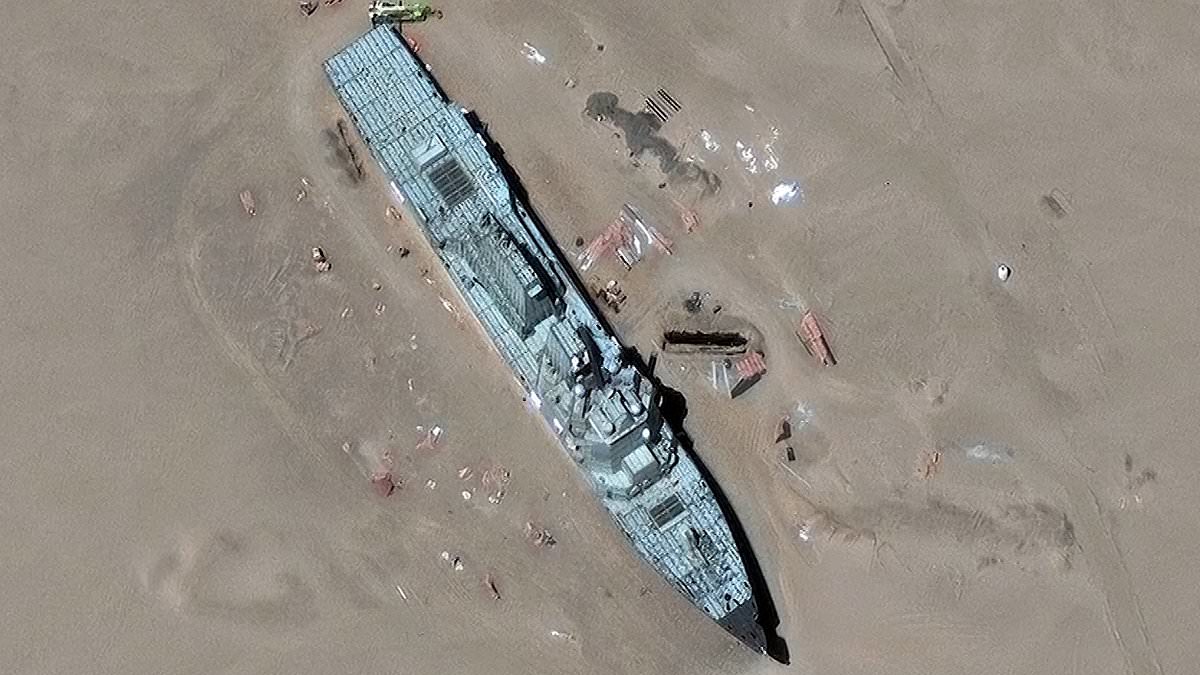
Deep in the remote Taklamakan Desert, China has been secretly developing a blueprint to obliterate US warships.New satellite images show that Xi Jinping’s forces are constructing exact replicas of American destroyers and aircraft carriers, using them as missile practice.Because the models are near-identical to the American warships, Beijing is able to simulate attacks as accurately as possible. The country is preparing for a war against Taiwan - and Washington, if it chooses to come to the island's rescue.Evidence first emerged in February of a 3D model of a US Arleigh Burke-class destroyer under construction in the vast desert, nestled between two high, rugged mountain ranges.Three months later, the vessel appears to be near completion. But its location 1,678 miles away from water means it’s unlikely to be going out to sea.The three-dimensional replica features many of the components of the US original, fitted with a full mast and even some of its radar technology.But the engineers are not just building reproductions of US warships. A model of the USS Gerald Ford, the American Navy's largest aircraft carrier China built a full 3D model of a US Arleigh Burke-class destroyer in the Taklamakan Desert A mock-up of a Arleigh Burke-class destroyer for weapons test in Taklamakan Desert in China on June 19Beijing is also hard at work constructing models of fighter jets, naval bases and Taiwanese presidential buildings.As the president continues to prepare to seize the strategic Pacific island democracy, Beijing has been using the models to test its ever-increasing stockpile of long-range weapons and new AI systems.The accuracy of the replicas 'signals a highly specific focus on potential adversaries rather than generic capability building', Damien Symon, a geo-intelligence researcher at the AI-analysis firm The Intel Lab, told the Telegraph.He was first to identify several of the maritime models. While it's not yet certain whether Washington would come to Taiwan’s defence in the event of an attack, most experts agree that the US would probably step in. Without support from America, the self-governed island would struggle to remain autonomous.The fact that China's People's Liberation Army (PLA) has also constructed to-scale replicas of Taiwan’s presidential office and significant government buildings suggests they are considering storming the capital. According to satellite imagery, China has built two separate mock-ups of the Bo'ai Special Zone, located in downtown Taipei, where the government is located.A newer model, that can be found in the desert in Inner Mongolia, focuses more heavily on the streets around government property, with the angles of the roads and the sizes of the city blocks resembling the island's capital. 'They’re basically creating replicas to provide them with the ability to manoeuvre through there on a training operation as though they were standing in Taipei,' Sean O’Connor, lead satellite image analyst at defence firm Janes, told the newspaper.Experts suggest the intricacy and scale of China's preparation is unprecedented. The PLA has even built a 174 mile-long tunnel connecting the different replicas of Taiwan’s government buildings, in preparation for a scenario in which the country’s senior politicians attempt to escape underground. The model warships move on rails, which imitate the movements of vessels at sea As the president continues to prepare to seize the strategic Pacific island democracy, Beijing has been using the models to test its ever-increasing stockpile of long-range weapons and new AI systems This photograph shows a view of the US Navy's Arleigh Burke-class destroyer USS Farragut (DDG-99) and the Statue of Liberty New satellite images show that Xi Jinping ’s forces are constructing exact replicas of American destroyers and aircraft carriers, using them as missile practiceShielded by towering mountains to the south, China has meticulously built a maritime training area.A 29-mile railway line transports moving targets, mimicking the way vessels move at sea, providing gunners and missile crews an accurate test of their capabilities.One ship measures 75m by 15m, but each model ranges in shape and size - enabling Beijing to test-run its anti-ship ballistic missiles against various targets.The training site also contains to-scale models of US warships, with at least two versions of the USS Gerald Ford, the world's largest aircraft carrier, sitting close to the tracks.Next to them are two outlines of an Arleigh Burke-class US destroyer, according to satellite images.China is also practicing striking US fighter jets. A short distance from the maritime test targets are replicas of US aircraft and mock runways, riddled with craters. Next to one of the runways are two rows of full-sized F-22 aircraft models, four of which have been visibly damaged.To-scale models of F-16s and F-35s - the most advanced stealth aircraft in the world - are also visible. While the US is yet to sell any F-35s to Taipei, they form the bedrock of the US Air Force and would be of paramount importance in the event of a Chinese invasion.Another set of satellite images show a mock-up of the Yokosuka Naval Base, Washington's largest naval base in Japan.The base would almost certainly be utilised in the event of a battle for Taipei.As part of a security treaty between the two countries, America has over 55,000 troops stationed in Japan, the largest number outside the US.These soldiers would prove instrumental in the event of Washington intervening in a Taiwan emergency.There are currently 10 Arleigh Burke-class ships permanently stationed at Yokosuka as part of the Destroyer Squadron 15.'It’s one of the most important US bases. If China attacked Taiwan, the Yokosuka Naval Base would presumably be involved so they include a model of Yokosuka for anti-access and area denial drills,' Lu Li-shih, a former lieutenant commander in Taiwan’s navy, told The Telegraph. Beijing has also constructed a model of Taiwan's Su'ao Naval Base, a significant maritime hub on the island's north-eastern coast, as well as a replica of a US Kidd-class destroyer moored at its port.The base was used in a live-fire test between January and February 2022, according to satellite imagery, where a missile hit part of the pier and obliterated a black arch-shaped model that had most likely been used to calibrate missile seekers.The destruction of the Su'ao replica, as well as Yokosuka and the ship models, suggest multiple test-missile launches.'These aren’t close-range, controlled demonstrations. You’re looking at missile launches from kilometres away… That alone points to credible long-range strike capability,' Symon said. It is believed that the US ship replicas are most likely being used as targets to test China's vast variety of weapons, such as the YJ-21 and the YJ-17 hypersonic anti-ship missiles and the DF27 ballistic missiles, which can reach up to 4,971 miles.All have the ability to reach Taiwan from China, even if they're fired from the country's more remote, inland launch ranges.Beijing has also constructed a mock-up of one of the country's largest airbases, which doubles up as a civilian airport servicing its second-largest city, Taichung.Dating back to 2002, it is one of China's oldest, least-developed mock-ups, consisting only of a few lines in the sand.The model can be found next to Jiuquan Satellite Launch Centre, China's oldest rocket launch facility, meaning it is probably utilised for weapons testing and to practice bombing runs. A view of the American aircraft carrier USS Gerald Ford arrived in Split as part of a planned visit and technical maintenance after a months-long mission and war operations in the Middle East on March 29 Back in 2015, the first replica of Taiwan's presidential office was constructed.The PLA subsequently published a training video showing troops firing and storming towards it.Along with military drills, experts suggest that the models themselves are a very effective method of sending a message to all potential foreign enemies.'It’s messaging to Japan that "if there’s a fight, you’re going to be in it". It’s messaging to the US that "if you try to intervene, we’re going to strike your bases". And messaging to Taiwan that "we are practicing to take your capital,"' said Thomas Shugart, a senior fellow at the Centre for a New American Security and a former US Navy submarine commander.And the message is effective. Nations across the world, especially in the Indo-Pacific, have been bolstering their defence budgets and boosting their weapons production and procurement in anticipation of Chinese aggression.Pete Hegseth, the US defence secretary, said in May there was 'rightful alarm regarding China’s historic military buildup and the expansion of its military activities in the region and beyond'.Taiwan faces an extremely difficult diplomatic situation because China is suppressing the island 'everywhere', Vice President Hsiao Bi-khim said on Friday after Papua New Guinea said it was closing Taipei's representative office in the country. The Pacific has long been an area for diplomatic competition between China and Taiwan, which Beijing views as its own territory with no right to the trappings of a state. The democratically ruled island rejects China's sovereignty claims.Papua New Guinea Foreign Minister Justin Tkatchenko said on Thursday that Taiwan's office would be closed, drawing praise from Beijing and condemnation from Taipei. Papua New Guinea, like most countries, only has formal ties with China, not Taiwan. 'Our diplomatic situation is truly extremely difficult. China is suppressing us everywhere - suppressing our chances to survive and to expand our international space,' Hsiao told reporters in Taipei. 'For us, this is a setback, but we will still continue to strive - to strive for opportunities, whether for our overseas compatriots or to continue expanding our cooperation with the international community.'Only 12 countries now maintain formal diplomatic ties with Taiwan, three of which are in the Pacific - Palau, Tuvalu and the Marshall Islands.
China's secret blueprint to bomb US warships: Satellite images show huge replicas of American destroyer and carrier built for missile practice in remote desert
Full Article
Original Source
Read the full article at Dailymail →KhanList aggregates and links to publicly available news content. We do not host full articles from third-party sources. Always verify important information with original sources.