
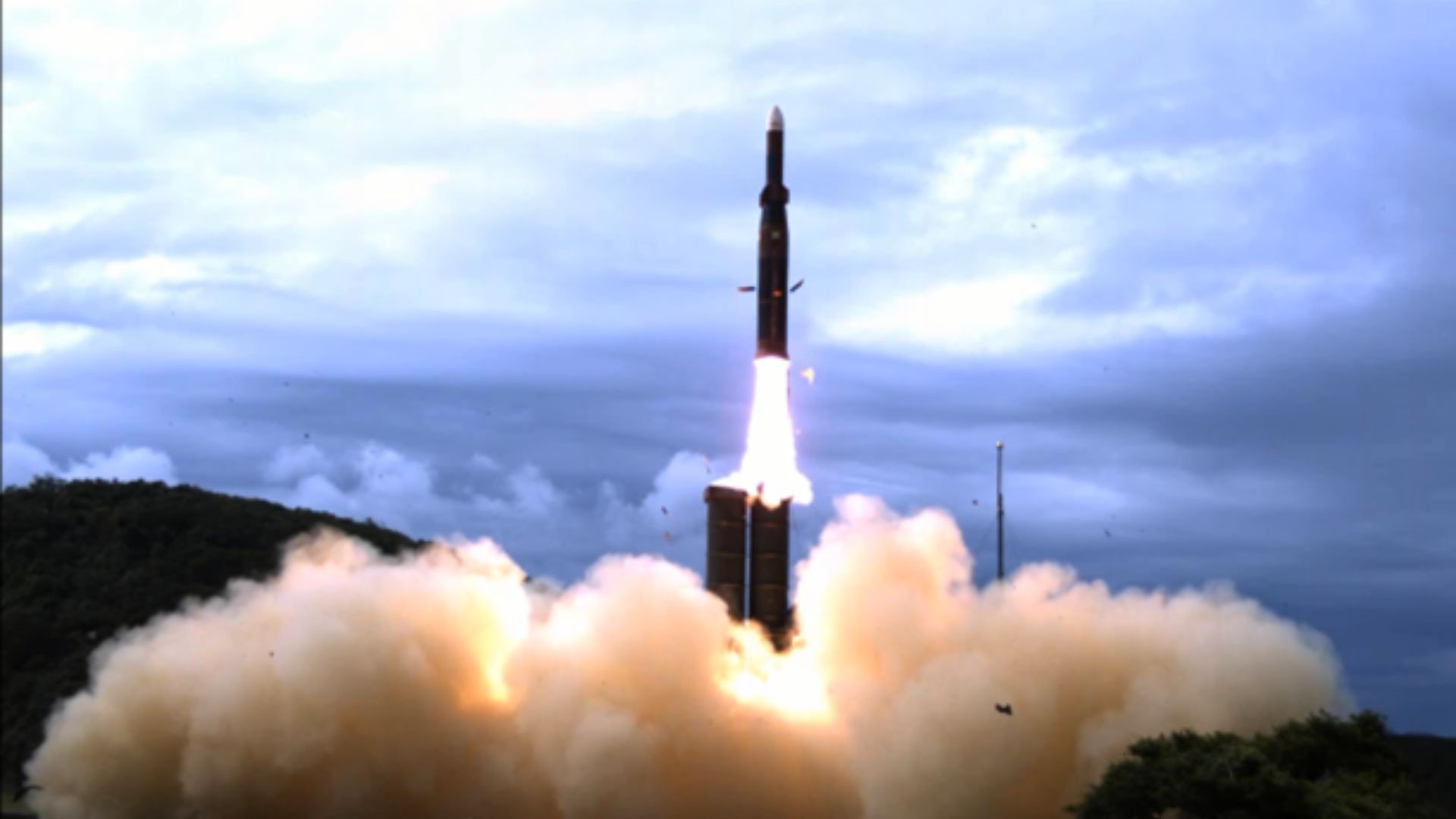
Taiwan has revealed new details about its homegrown Strong Bow anti-ballistic missile system as the government seeks funding to move the weapon into mass production. The disclosure came earlier this month, as Taipei works to strengthen its air defenses amid growing military pressure from Beijing. The National Chung-Shan Institute of Science and Technology (NCSIST), Taiwan’s main weapons developer, released specifications covering the missile’s propulsion, guidance and radar systems. The government is seeking NT$36.1 billion (about US$1.13 billion), to produce two Strong Bow systems and 128 interceptor missiles. A high-altitude missile shield Strong Bow, also known as Tien Kung IV, is designed to intercept tactical ballistic missiles at altitudes of at least 70 kilometers (43 miles). That puts its intended interception zone above Taiwan’s existing Patriot and Tien Kung III systems. The interceptor launches vertically and uses a two-stage solid-fuel rocket motor, allowing it to reach hypersonic speeds. During its flight, it relies on inertial guidance and gets updates through radar uplinks. An active seeker guides the missile in the final phase. Thrust-vector control helps the missile maneuver at high altitudes, where the air is thin. The interceptor is equipped with a high-explosive fragmentation warhead. Mobile launchers and advanced radar The Strong Bow system uses mobile launchers, and each one holds four missile canisters. Tactical command vehicles support the launchers, and an advanced radar system helps with detection and tracking. The radar is designed to identify several threats at once and continue operating against electronic countermeasures. Taiwan’s defense ministry said it can detect threats at greater ranges and altitudes than the radars used with the Patriot PAC-3 and Tien Kung III. Taiwan plans to use Strong Bow as the outer layer of its planned multilayered missile defense network, known as T-Dome. Lu Chien-sheng, deputy director of the institute’s Tien Kung program, said the system was developed specifically for tactical ballistic missiles and could work with other air defense units. Funding remains a major hurdle Strong Bow had initially been included in a proposed NT$1.25 trillion special defense package. The plan called for production to begin this year, with the first integrated locally developed regional air defense system targeted for completion in 2027. However, the opposition-controlled legislature approved only about two-thirds of the requested package in May, leaving Strong Bow outside the final allocation. Attempts to move the program into the regular 2027 defense budget have also faced pressure from other weapons commitments and payments for U.S. arms. The government is now preparing a supplementary budget. The defense ministry has confirmed that additional funding is being considered for missile and drone programs that failed to secure approval. Analysts warn against further delays Su Tzu-yun, a senior analyst at the Institute for National Defense and Security Research, described Strong Bow as essentially a new missile despite its Tien Kung IV designation. “The tactical advantage is that the higher it can fly, the larger the area it can protect,” he said, estimating that a battery could provide 100 to 150 kilometers (62 to 93 miles) of coverage. Su said Strong Bow had been described as “Taiwan’s version of THAAD,” referring to the U.S. Terminal High Altitude Area Defense system, and estimated its radar detection range was almost 1,000 kilometers (621 miles). Chi Tung-yun, president of the Taiwan Security and Development Association, said combining Strong Bow with Patriot PAC-3 Missile Segment Enhancement interceptors could provide defenders with additional opportunities to engage incoming ballistic missiles. He urged lawmakers “to fund production as soon as possible”, warning that postponing it until 2028 would be “bad news for Taiwan’s missile defense capability” as the PLA continued expanding its ballistic missile forces. Beijing claims Taiwan as part of China and has not ruled out using force. Washington opposes a forced takeover and continues to supply Taiwan with weapons. Get the latest in engineering, tech, space & science - delivered daily to your inbox.A versatile writer, Sujita has worked with Mashable Middle East and News Daily 24. When she isn't writing, you can find her glued to the latest web series and movies.
China’s rival reveals ‘Strong Bow’ hypersonic interceptor specs, offers 93-mile range
Full Article
Original Source
Read the full article at Interestingengineering →KhanList aggregates and links to publicly available news content. We do not host full articles from third-party sources. Always verify important information with original sources.