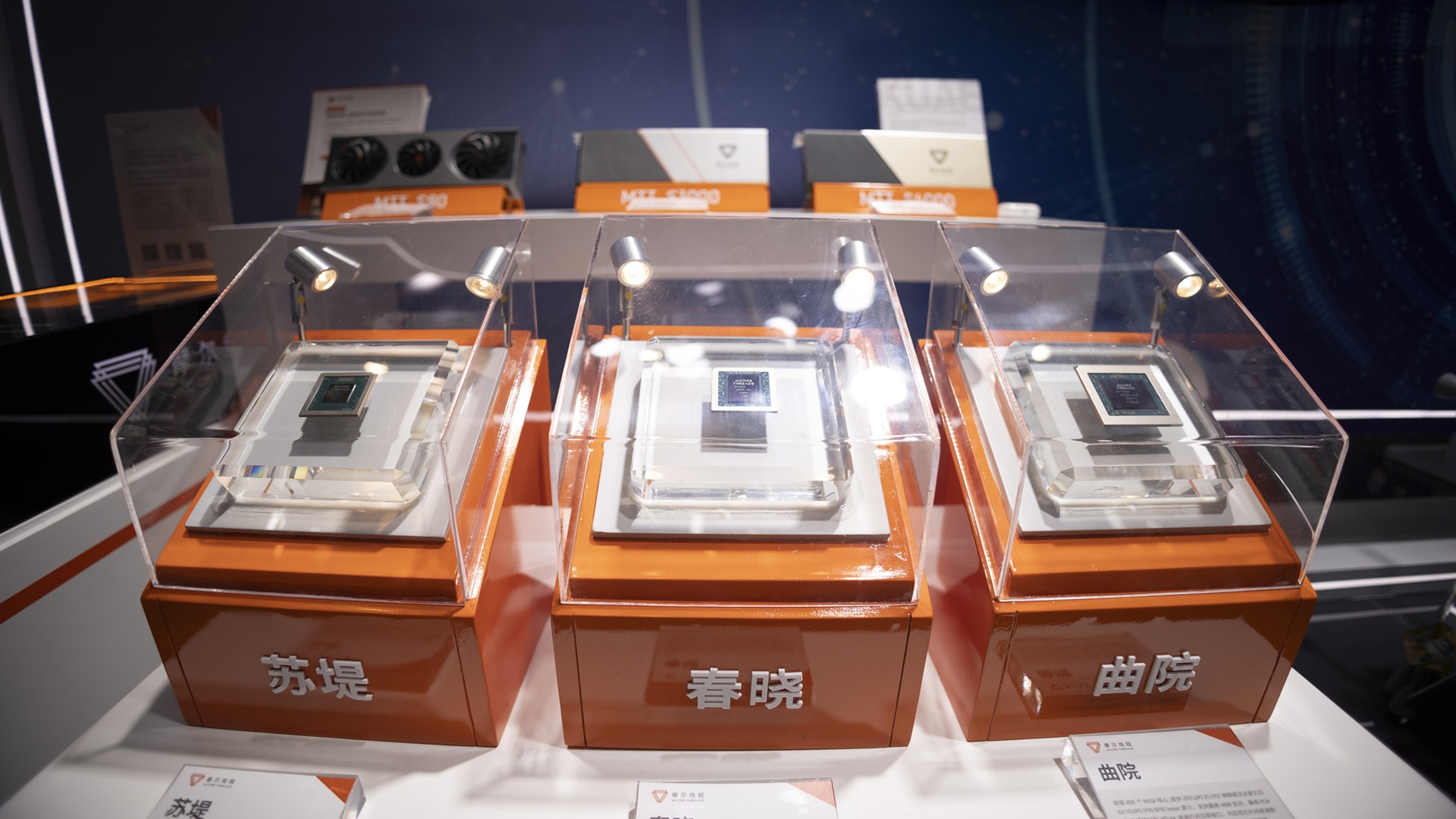
Chinese chip designers Moore Threads Technology and Hygon Information Technology are forecasting strong first-half revenue growth, signaling rising demand for domestic computing hardware as the country expands its home-grown semiconductor ecosystem. The guidance comes as Chinese companies continue investing in local alternatives to overseas chip suppliers amid export restrictions on advanced processors. Both firms expect sharp revenue gains driven by growing deployment of computing infrastructure and demand for chips used in large computing models. Moore Threads said it expects first-half revenue to reach between 1.65 billion yuan ($243.5 million) and 1.75 billion yuan, representing year-over-year growth of 135.1% to 149.4%. The company attributed the increase to stronger sales of its graphics processing units and wider commercial deployment of its Kua’e computing clusters. Hygon projected first-half revenue of 8.5 billion yuan to 9.3 billion yuan, up 55.6% to 70.2% from the same period last year. The company develops central processing units and deep computing units, accelerator cards designed for computing-intensive workloads. Domestic chips gain The projections highlight China’s continued effort to strengthen its domestic semiconductor industry as access to the most advanced overseas chips remains restricted. Moore Threads said demand for its full-function GPUs helped drive the revenue increase, while commercial deployment of its Kua’e computing clusters also gathered pace. The company added that its flagship MTT S5000 GPU has entered mass production and delivers computing efficiency comparable to leading international products. Hygon also linked its outlook to the rapid expansion of advanced computing applications. According to SCMP, the company cited “the accelerated iteration of large AI models, the large-scale application of AI agents and the progress of localization towards commercial application” as key factors supporting growth. The company added that these developments created new opportunities for its high-end processor business. Competition heats up The upbeat forecasts come as Chinese semiconductor firms race to capture a larger share of the domestic computing market. US export controls have limited NVIDIA’s ability to ship its most advanced processors to China, creating opportunities for local companies developing graphics processors, accelerators, and server chips. Along with Moore Threads and Hygon, companies including Biren Technology, MetaX Integrated Circuits, Iluvatar CoreX and Enflame Technology are expanding their presence as cloud providers seek more domestic hardware options. Despite the strong revenue outlook, investors reacted cautiously. Hygon shares fell 4.8% in Shanghai trading, while Moore Threads dropped 5.5% as domestic semiconductor stocks broadly declined. Industry analysts remain optimistic about Hygon’s long-term prospects. According to SCMP, Bernstein described Hygon as “the key China beneficiary for the CPU renaissance,” pointing to growing demand from computing infrastructure and data centers. The latest forecasts suggest China’s domestic chip industry continues to gain commercial traction as companies invest heavily in locally developed processors, accelerators and computing platforms to support rising demand for advanced computing workloads. Recommended ArticlesGet the latest in engineering, tech, space & science - delivered daily to your inbox.With over a decade-long career in journalism, Neetika Walter has worked with The Economic Times, ANI, and Hindustan Times, covering politics, business, technology, and the clean energy sector. Passionate about contemporary culture, books, poetry, and storytelling, she brings depth and insight to her writing. When she isn’t chasing stories, she’s likely lost in a book or enjoying the company of her dogs.
China’s NVIDIA rivals forecast strong revenue growth despite US chip export curbs
Full Article
Original Source
Read the full article at Interestingengineering →KhanList aggregates and links to publicly available news content. We do not host full articles from third-party sources. Always verify important information with original sources.