
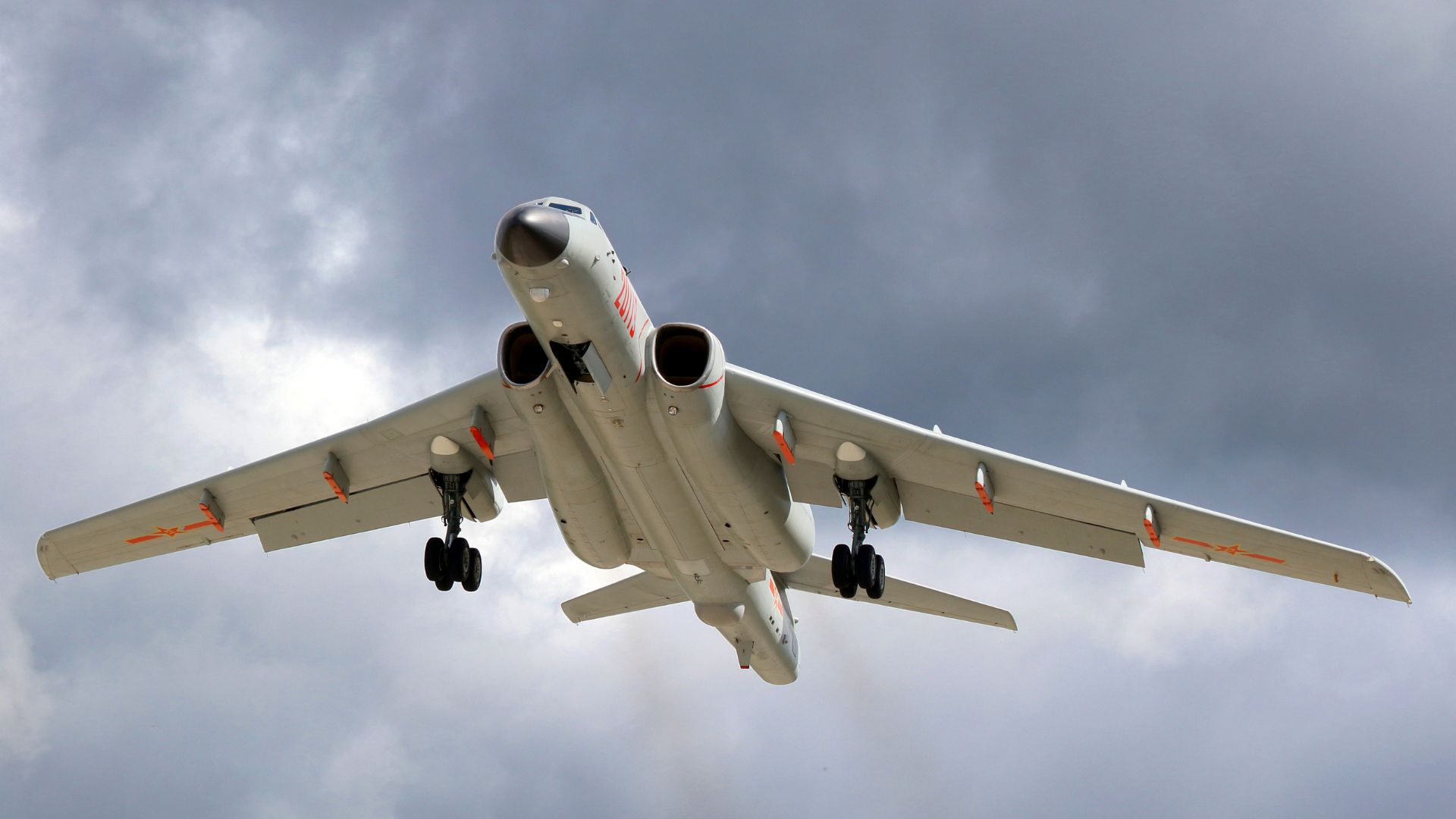
China is giving its H-6N strategic bomber a more prominent role in its nuclear forces, with recent footage showing the aircraft carrying the nuclear-capable Jing Lei-1 (JL-1) air-launched ballistic missile. The combination provides China with an airborne nuclear strike option alongside its land-based intercontinental ballistic missiles and submarine-launched ballistic missiles. The H-6N is a heavily modified version of the H-6, China’s long-serving strategic bomber derived from the Soviet Tu-16. Unlike conventional H-6 variants, it was designed to carry oversized weapons externally, including the JL-1. With aerial refueling and a reported combat radius of more than 2,175 miles, the aircraft gives Beijing additional flexibility in a retaliatory nuclear scenario and potentially extends its reach well beyond the western Pacific. Bringing back the airborne component The aircraft is an evolution of the H-6, which has been China’s principal strategic bomber for more than six decades. The original design was based on the Soviet Tu-16, with China beginning licensed production after reaching an agreement with Moscow in 1957, the South China Morning Post writes. The first Chinese-assembled Tu-16 made its maiden flight in 1959. Following the Sino-Soviet split, however, China had to continue development and production without Soviet assistance. The first fully domestically produced H-6 eventually flew in December 1968. More than 230 H-6 aircraft have reportedly been produced over the decades, with numerous versions developed for different missions. Today’s H-6K and naval H-6J are primarily conventional strike platforms, while the H-6N is designed around a very different requirement, which is carrying large nuclear-capable air-launched ballistic missiles. That capability effectively restores an airborne component to China’s nuclear triad, supplementing its land-based ICBMs and ballistic missile submarines. The H-6N differs from earlier H-6 variants in several important ways, and most notably, its traditional internal bomb bay has been removed or substantially modified, with the fuselage incorporating a recessed area underneath the aircraft to accommodate oversized external weapons. H-6N could give Beijing an intercontinental nuclear strike option The configuration allows the bomber to carry the JL-1, which is considerably larger than the conventional cruise missiles carried by other H-6 variants. The H-6N also features a nose-mounted aerial-refueling probe. This allows it to refuel from China’s YY-20A tanker aircraft, extending its operational range and reducing one of the major limitations of a relatively old airframe. The aircraft reportedly has a combat radius of more than 2,175 miles, although the actual range available in a particular mission would depend on factors including payload, flight profile and tanker support. The JL-1 adds another layer to that capability, with the missile reportedly derived in part from China’s DF-21 medium-range ballistic missile family and designed to be launched from the bomber at altitude rather than from a fixed or mobile ground launcher. Reports have placed the JL-1’s maximum range at up to 5,000 miles, although publicly available information about the missile remains limited. Combined with the bomber’s own range and aerial-refueling capability, the system could potentially give China an intercontinental strike option. While China’s land-based ICBMs and ballistic missile submarines remain the core of its nuclear retaliatory capability, the H-6N adds another option that operates differently from both. The aircraft’s strategic importance has additionally grown alongside China’s broader expansion of its nuclear arsenal. The Stockholm International Peace Research Institute estimates that China had around 20 H-6Ns in service in 2026, with up to 20 nuclear warheads assigned to the force.Get the latest in engineering, tech, space & science - delivered daily to your inbox.Bojan Stojkovski is a freelance journalist based in Skopje, North Macedonia, covering foreign policy and technology for more than a decade. His work has appeared in Foreign Policy, ZDNet, and Nature.
China’s nuclear triad gains flexibility as H-6N bomber gets airborne nuclear strike capability
Full Article
Original Source
Read the full article at Interestingengineering →KhanList aggregates and links to publicly available news content. We do not host full articles from third-party sources. Always verify important information with original sources.