
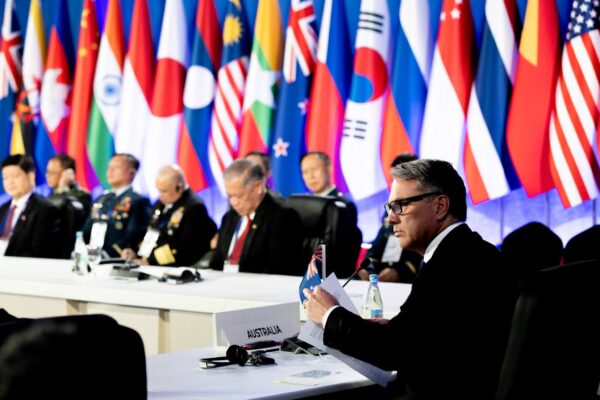
Australian Defense Minister Richard Marles said yesterday that China’s military build-up was creating a “condition of pressure” in Southeast Asia, as China and the Philippines sparred over Beijing’s attendance at an Association of Southeast Asian Nations (ASEAN) defense summit in Cebu. Speaking to the press on the sidelines of the ASEAN Defense Ministers’ Meeting-Plus (ADMM-Plus), Marles described China’s military build-up as “the biggest conventional military build-up” since World War II. “There’s not an explanation from China as to why it’s doing this, and all of that is creating the condition of pressure,” he said, as per the AFP news agency. Beijing’s growing assertiveness had created “challenges” for the Australian government and urged like-minded allies and partners to deepen cooperation. “We need to be ensuring that how we understand the rules of the road continue to apply, because for a middle power like Australia, it is actually the rules which give us agency,” he said. In July, Australia protested China’s test of a nuclear-capable ballistic missile in the South Pacific, calling the launch “provocative and destabilizing.” Over the past few years, China has also increased both the frequency and the intensity of its incursions into areas of the South China Sea claimed by the Philippines, resulting in a string of increasingly dangerous confrontations between the two sides. The South China Sea disputes hovered over the two-day ADMM and related meetings in the Philippines. At the ADMM on Wednesday, U.S. Secretary of War Pete Hegseth pledged support for allies and partners in Southeast Asia. He added that the U.S. would advance practical cooperation, such as “strengthening maritime domain awareness, improving interoperability, and advancing cooperation among our navies.” The maritime tensions also lay behind a controversy yesterday, when China’s Ministry of Defense accused the Philippines of obstructing its attendance at the ADMM meetings in violation of “basic diplomatic protocols.” Ministry spokesperson Zhang Xiaogang claimed that unnamed Philippine politicians had “imposed obstacles to China’s participation” in the ADMM-Plus, the Straits Times reported. As a result, China’s Defense Minister Dong Jun did not attend the meeting, which brings together defense ministers from ASEAN’s 11 member states and the bloc’s eight dialogue partners: Australia, China, India, Japan, New Zealand, Russia, South Korea, and the United States. Instead, Beijing was represented by its defense attaché, the lowest-ranking Chinese representative at the ADMM-Plus since it was first held in 2010. Zhang accused the Philippines of “holding ASEAN hostage and stirring up trouble”, saying China’s decision to send representation underscored its “firm support for Asean centrality and a responsible approach towards regional security cooperation.” In later comments, Philippine Defense Secretary Teodoro Gilberto did not directly address the Chinese allegation, but stated China was “given an opportunity to articulate their position, which is not any different from what they have been articulating before.” The Chinese comments reflect the poor state of relations between Beijing and Manila, which have frayed due to continued confrontations in contested parts of the South China Sea, particularly over Scarborough Shoal and Second Thomas Shoal in the Spratly Islands. In July, a Philippine marine was injured in a melee with Chinese sailors at Second Thomas Shoal. Also yesterday, Marles met with his counterparts from the “Squad,” an informal defense and security group composed of Australia, Japan, the U.S., and the Philippines, where they committed to greater defense policy coordination. It was the sixth meeting of the four countries’ defense leaders in four years. “I think the challenges that are being faced in this part of the world and the pressures that are being experienced are well understood by all four countries,” Marles said, according to AFP. “Now is a time to double down on friends and to double down on neighbors and to be working more closely together to provide for our collective security.” Marles also met for a bilateral meeting with Hegseth, during which they discussed “common-sense strategies to maintain a favorable balance of power in the Pacific region.”
China’s Military Build-up Has Created ‘Pressure’ in Southeast Asia, Australian Defense Chief Says
Full Article
Original Source
Read the full article at Thediplomat →KhanList aggregates and links to publicly available news content. We do not host full articles from third-party sources. Always verify important information with original sources.