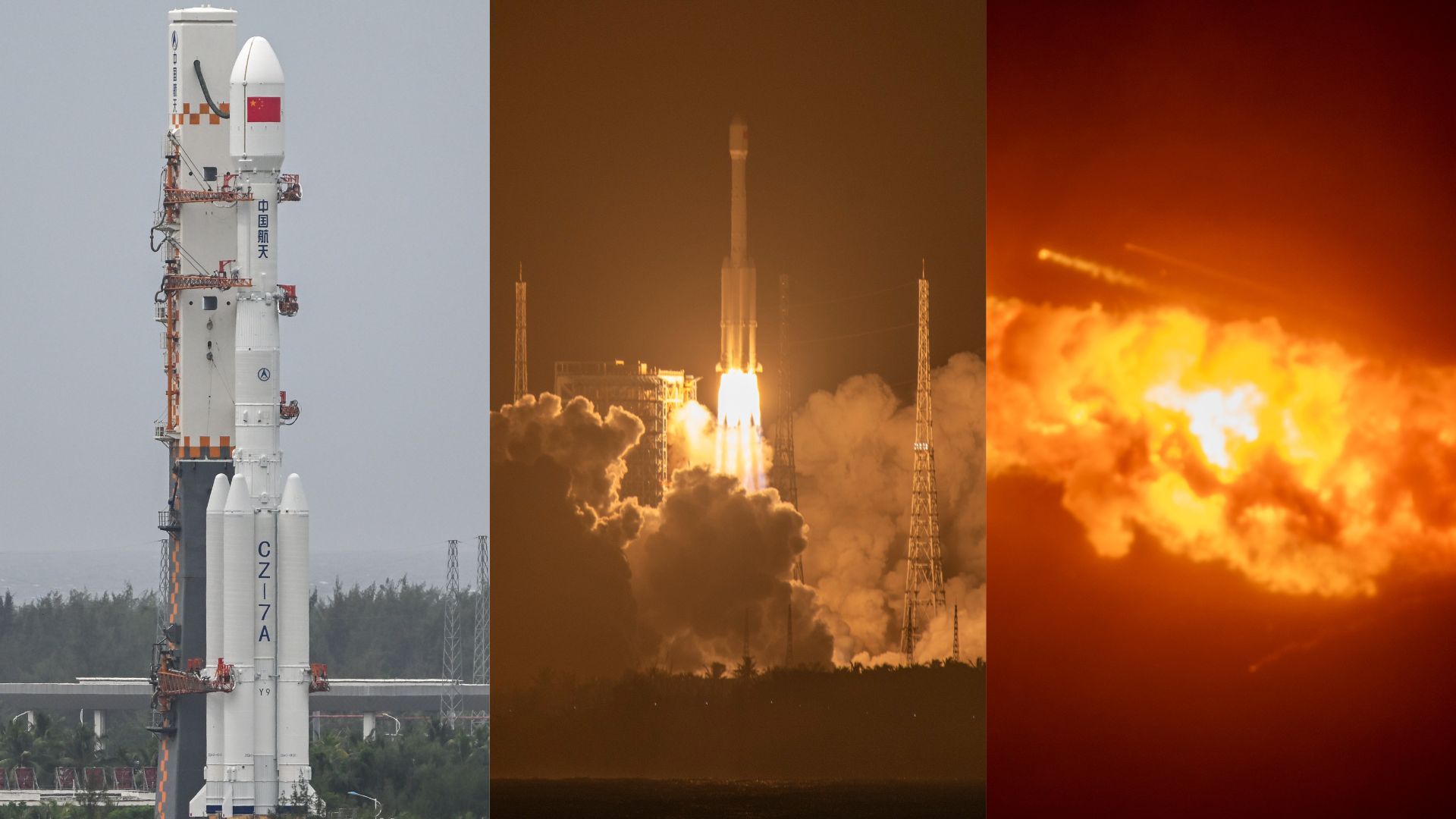
A Long March 7A rocket broke apart shortly after liftoff Monday, destroying a communications satellite and ending China’s latest orbital mission. The rocket launched from the Wenchang Space Launch Site at about 8:02 p.m. Beijing time. It carried the ChinaSat-4B satellite toward geostationary orbit. Roughly 85 seconds later, the vehicle erupted into a fireball during its ascent. Videos from nearby observers captured the rocket disappearing behind thick smoke and debris. The failure occurred before the rocket could complete its initial powered flight. Both the launcher and satellite were lost over the South China Sea. Rocket fails early in flight China’s state news agency Xinhua confirmed the failure several hours after liftoff. The China Academy of Launch Vehicle Technology also shared the announcement. Officials have not publicly identified the technical cause. Footage indicates the vehicle experienced a major anomaly during its early ascent. Some spaceflight observers have suggested the flight termination system may have destroyed the rocket. Such systems can end a mission when a vehicle becomes unsafe or deviates significantly from its planned trajectory. The timing provides an important engineering detail. The Long March 7A normally spends several minutes climbing before its first-stage separation sequence. Monday’s incident came far earlier. The rocket was still in its initial ascent phase when the failure occurred. Rare setback for China The accident marks the 18th Long March 7A mission since the rocket debuted in 2020. Its inaugural flight also ended in failure after an engine malfunction. China returned the launcher to service in 2021. It then completed a series of successful missions. The 60-meter rocket has become a key part of China’s launch fleet. It uses kerosene and liquid oxygen as its primary propellants. Long March 7A missions often target high-energy orbits. Reaching geostationary orbit requires significantly more energy than reaching low Earth orbit. ChinaSat-4B was intended to support communications services around the world. Those services include television and radio transmission. Some lower-numbered ChinaSat spacecraft are also believed to have military communications applications. That gives the lost payload potential significance beyond commercial communications. Pressure on China’s launch tempo Monday’s failure also interrupts an unusually rapid launch schedule. The previous Long March 7A mission launched only about 12 days earlier. Chinese media had highlighted that turnaround as a potential record for the rocket. The failed mission now puts that launch tempo under a different spotlight. China has expanded its space activity rapidly in recent years. Its launch fleet now supports military, government, scientific and commercial missions. For U.S. space observers, the incident offers another reminder of the risks involved in maintaining a high launch cadence. One failure does not erase the Long March 7A’s recent record. Engineers will now need to determine exactly what went wrong during those critical first 85 seconds. That investigation could reveal whether the problem was isolated or linked to a broader design or operational issue. Until then, one of China’s established launch vehicles has an unexpected setback to overcome.Recommended ArticlesGet the latest in engineering, tech, space & science - delivered daily to your inbox.Aamir is a seasoned tech journalist with experience at Exhibit Magazine, Republic World, and PR Newswire. With a deep love for all things tech and science, he has spent years decoding the latest innovations and exploring how they shape industries, lifestyles, and the future of humanity.
China’s Long March 7A rocket explodes 85 seconds after liftoff, losing ChinaSat-4B
Full Article
Original Source
Read the full article at Interestingengineering →KhanList aggregates and links to publicly available news content. We do not host full articles from third-party sources. Always verify important information with original sources.