
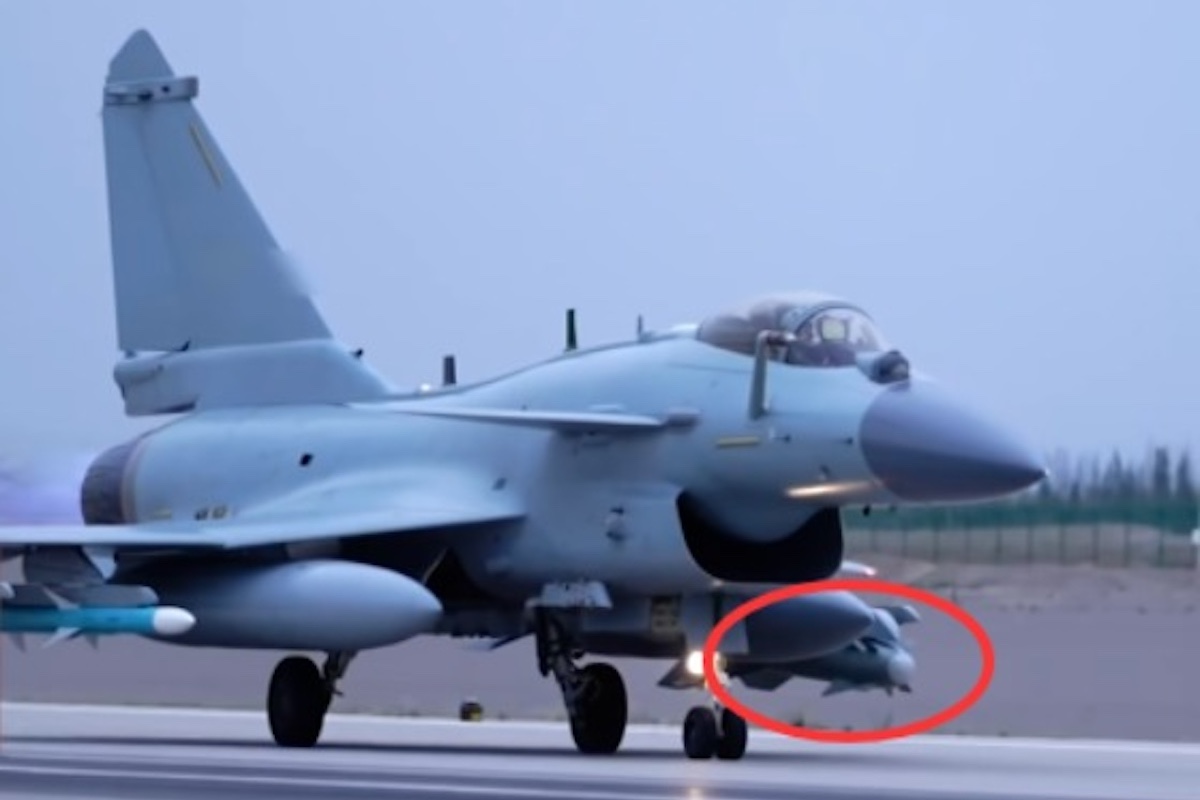
China’s integration of upgraded short-range air-to-surface missiles onto its frontline fighters exposes a critical vulnerability in a Taiwan conflict: if Taiwan’s air defenses survive initial barrages and exhaust China’s long-range stockpiles, jets forced closer with shorter-range weapons risk severe losses, mirroring US experience in Iran. This month, the South China Morning Post (SCMP) reported that China’s state broadcaster CCTV released footage showing a Chinese-modified variant of the Russian-origin Kh-29T air-to-surface missile mounted on a Chengdu J-10C fighter jet for the first time. China originally imported roughly 2,000 Kh-29T missiles alongside Su-30MKK fighters from Russia in the early 2000s, and military bloggers noted the newly spotted munition appears to feature a domestically upgraded imaging infrared seeker. Weighing about 685 kilograms and carrying a 320-kilogram armor-piercing high-explosive warhead, the rocket-powered missile is designed for tactical precision strikes against hardened targets such as bunkers, bridges, runways, and surface ships within a 10- to 30-kilometer range. Previously observed on JH-7A and J-16 aircraft, the Kh-29T — now integrated onto the 4.5-generation J-10C, the People’s Liberation Army’s (PLA) most numerous fighter family used in routine patrols around Taiwan — provides a cost-effective alternative to the jet’s more expensive KD-88 cruise missile, which has a 200-kilometer range. In a cross-strait conflict, the J-10C would ideally employ these cheaper munitions for follow-up strikes only after long-range barrages neutralize Taiwanese air defenses. However, the US-Iran War offers Taiwan a clear blueprint for attriting an adversary that holds an overwhelming long-range precision-strike advantage. During the opening salvos of that conflict, the US expended large numbers of expensive, hard-to-replace standoff weapons, triggering acute concerns over stockpile depletion. An assessment released this month by the Center for Strategic and International Studies (CSIS) shows that for long-range ground-attack munitions, the US spent 70 to 90 rounds from its 90-round prewar stock of Precision Strike Missiles (PrSMs), over 1,100 rounds from a prewar stock of 4,400 Joint Air-to-Surface Standoff Missiles (JASSMs), and over 1,100 rounds from a prewar stock of 3,100 Tomahawk cruise missiles. According to the CSIS assessment, while PrSM inventories can be replenished by late 2026, JASSM stocks will not be restored until mid-to-late 2027, and Tomahawk stockpiles will not recover until early 2031. As the war progressed and long-range missile stocks dwindled, the US military increasingly had to conserve its remaining standoff inventory by relying on deeper reserves of shorter-range munitions, including the Joint Direct Attack Munition (JDAM), Small Diameter Bomb I (SDB I), and Hellfire missile. While the CSIS report documents substantial inventories of JDAMs (roughly 160,000 units), SDB Is (roughly 20,000 units), and Hellfires (roughly 50,000 units), their vastly shorter engagement ranges forced launching aircraft closer to surviving Iranian air defenses. While Iran’s larger, high-altitude air defense systems — such as its S-300 batteries — were destroyed early in the conflict, substantial numbers of smaller, easily dispersed and concealed systems likely survived US strikes. These include man-portable air defense systems (MANPADS) and short-range air defense (SHORAD) units, which cannot engage high-altitude targets but pose a severe threat to low-flying aircraft. An October 2026 US Congressional Research Service (CRS) report documents significant US aircraft losses to Iranian anti-aircraft fire, including the destruction of one F-15E fighter, one A-10 attack aircraft, three MQ-1 drones, and one AH-64 Apache helicopter, alongside battle damage to an F-35 stealth fighter. Although those platforms can strike from well outside Iran’s air defense envelope, changing mission requirements and operational pressures—including rationing long-range standoff weapons in favor of shorter-range munitions—likely forced crews into contested airspace. Recreating that dynamic in the Taiwan Strait, however, depends on whether Taiwan can preserve its air defenses through an opening Chinese offensive. In an April 2023 article in the Journal of Indo-Pacific Affairs, Matthew Revels argues that Taiwan can survive an initial Chinese missile-saturation attack by shifting from static long-range batteries to mobile, concealed, and asymmetric networks. Drawing on Yugoslav and Ukrainian tactics, Revels recommends keeping radars switched off during initial strikes, using restricted and urban terrain to complicate Chinese suppression efforts, and hardening communications. Because stationary Patriot batteries take two hours to relocate, Revels adds that Taiwan should stockpile mobile short-range air defenses and MANPADS, deploy vertical-takeoff drones and swarms, and disguise long-range launchers inside shipping containers to ensure survivability. Should Taiwan’s defenses weather the opening storm, China would face a steep stockpile dilemma. While China possesses a formidable arsenal of long-range strike weapons, its inventory is finite. The US Department of Defense’s (DoD) 2025 China Military Power Report (CMPR) estimates that the People’s Liberation Army Rocket Force (PLARF) fields 300 ground-launched cruise missiles (GLCMs), 900 short-range ballistic missiles (SRBMs), and 1,300 medium-range ballistic missiles (MRBMs) capable of reaching Taiwan. Yet William Alberque stated in a November 2025 CNN report that China initially estimated it would need 5,000 to 10,000 missiles to overwhelm Taiwan—a figure the Russia-Ukraine War may have forced China to revise upward exponentially. Protracted high-intensity combat would rapidly strain those reserves. A January 2026 Heritage Foundation report warns that China faces a severe risk of exhausting its precision-guided munitions during an extended conflict, noting that even without strikes against its replenishment capacity or stockpiles, simulations show China’s air force would deplete its long-range precision stockpiles within 90 days and its naval precision munitions within 120 to 140 days. Under such depletion pressure, China would be forced to fall back on older, shorter-range munitions like the Kh-29T to sustain strike operations, compelling J-10C pilots to fly within the engagement envelope of Taiwan’s surviving air defenses. Unlike the US entering the Iran conflict, however, China has the benefit of observing these replenishment bottlenecks in advance and is actively expanding its industrial capacity. A May 2026 Bloomberg report reveals that China significantly accelerated missile production in 2025, marking its largest annual buildup since President Xi Jinping took office in 2013. Bloomberg notes that while China keeps exact factory output secret, US DoD estimates show its ballistic missile stockpile jumped 147% from 1,275 in 2015 to 3,150 in 2024. The Bloomberg report adds that the surge is fueled by orders from China Aerospace Science and Industry Corporation (CASIC) and China Aerospace Science and Technology Corporation (CASC), with 81 listed component suppliers—up from 32 in 2013—posting combined 2025 revenues of 189 billion yuan (US$28 billion), a 20% increase as nearly four in ten firms hit record sales. Ultimately, whether China’s accelerating missile production can overwhelm Taiwan’s asymmetric air-defense survival strategies will determine whether a cross-strait conflict ends in a swift Chinese victory or degenerates into an attritional war of exhaustion that forces Chinese fighters into Taiwan’s surviving defenses.
China’s J-10C missile upgrade could become a Taiwan war trap
Full Article
Original Source
Read the full article at Asiatimes →KhanList aggregates and links to publicly available news content. We do not host full articles from third-party sources. Always verify important information with original sources.