
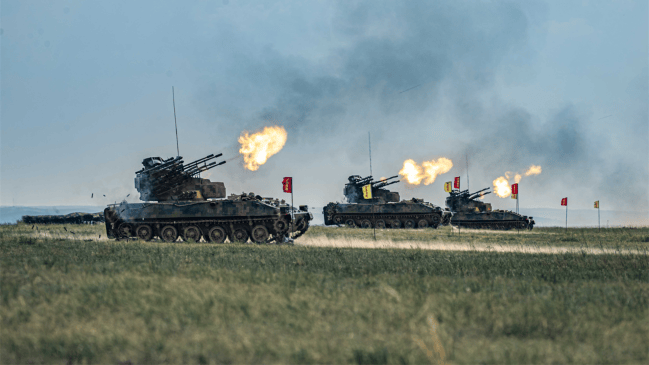
Key TakeawaysChina's wheeled HQ-17A can reportedly launch missiles while travelling at up to 15.5 mph, providing mobile air cover for amphibious formations.Each launcher carries eight missiles with an engagement range of approximately 0.9 to 9.3 miles, limiting its ability to protect forces farther offshore.The PLA would need layered defenses combining missile launchers, guns, lasers, electronic systems and ship-based protection to counter drones and other aerial threats. China’s mobile HQ-17A air-defense system could play an important role in protecting amphibious forces and military equipment assembled along the mainland coast ahead of a potential operation against Taiwan. A recent exercise showed a wheeled launcher engaging a drone simulating an incoming cruise missile while amphibious armored vehicles moved toward open water, highlighting how the People’s Liberation Army (PLA) could provide short-range air cover for troops preparing to cross the Taiwan Strait. The system is designed to move alongside ground formations and engage aircraft, cruise missiles and precision-guided weapons. Its wheeled configuration also allows it to launch missiles while moving, potentially keeping armored columns protected without requiring them to stop and wait for air-defense coverage. HQ-17A provides mobile air cover for amphibious formations The exercise that happened last June involved amphibious armored vehicles moving into open water while a six-wheeled HQ-17A launcher positioned along the coastline fired at a drone simulating an incoming cruise missile. The unit involved was believed to belong to the PLA’s 125th Amphibious Combined Arms Brigade. A US Army analysis identified the formation as one of six amphibious brigades considered central to a potential landing operation against Taiwan, the South China Morning Post reported. Each launcher carries eight vertically launched missiles and an onboard radar, allowing it to detect and engage aerial targets independently. The missiles have an engagement range of approximately 0.9 to 9.3 miles and can intercept targets flying between roughly 33 feet and 32,808 feet above the ground. A typical battery consists of four launchers supported by command and ammunition vehicles. The tracked HQ-17 can search for targets while moving but must stop to fire, whereas the HQ-17A is reported to engage up to four targets simultaneously and launch missiles while travelling at speeds of up to 15.5 mph. Eight missiles and radar dependence create vulnerabilities Despite its mobility, the HQ-17A has limitations that could become significant during a prolonged conflict involving large numbers of drones and precision-guided weapons. Each launcher carries eight ready-to-fire missiles, half the 16 reportedly carried by newer Russian Tor-M2 launchers. Reloading an HQ-17 or HQ-17A takes approximately 18 minutes, potentially creating a vulnerable period during which a launcher has reduced engagement capacity. Its radar-based guidance also creates opportunities for adversaries to detect and target the system. Operating close to the coastline, where Taiwanese drones, rockets and missiles could threaten military staging areas, would require crews to maintain situational awareness and coordinate with other air-defense units. Furthermore, Taiwan is expanding its own uncrewed capabilities. In August, its legislature approved a six-year, approximately $7.3 billion, funding framework covering uncrewed systems, including coastal attack and reconnaissance drones, SCMP adds. The PLA is also exploring ways to protect amphibious troops after they leave the coastline. During the June exercise, soldiers aboard amphibious vehicles fired shoulder-launched missiles at drones. However, even a coordinated network would not guarantee complete protection, and its effectiveness would depend on overlapping radar coverage, communication between units, ammunition availability and the ability to detect threats early enough to engage them. Get the latest in engineering, tech, space & science - delivered daily to your inbox.Bojan Stojkovski is a freelance journalist based in Skopje, North Macedonia, covering foreign policy and technology for more than a decade. His work has appeared in Foreign Policy, ZDNet, and Nature.
China’s HQ-17A air-defense network offers mobile missile protection for troops near Taiwan Strait
Full Article
Original Source
Read the full article at Interestingengineering →KhanList aggregates and links to publicly available news content. We do not host full articles from third-party sources. Always verify important information with original sources.