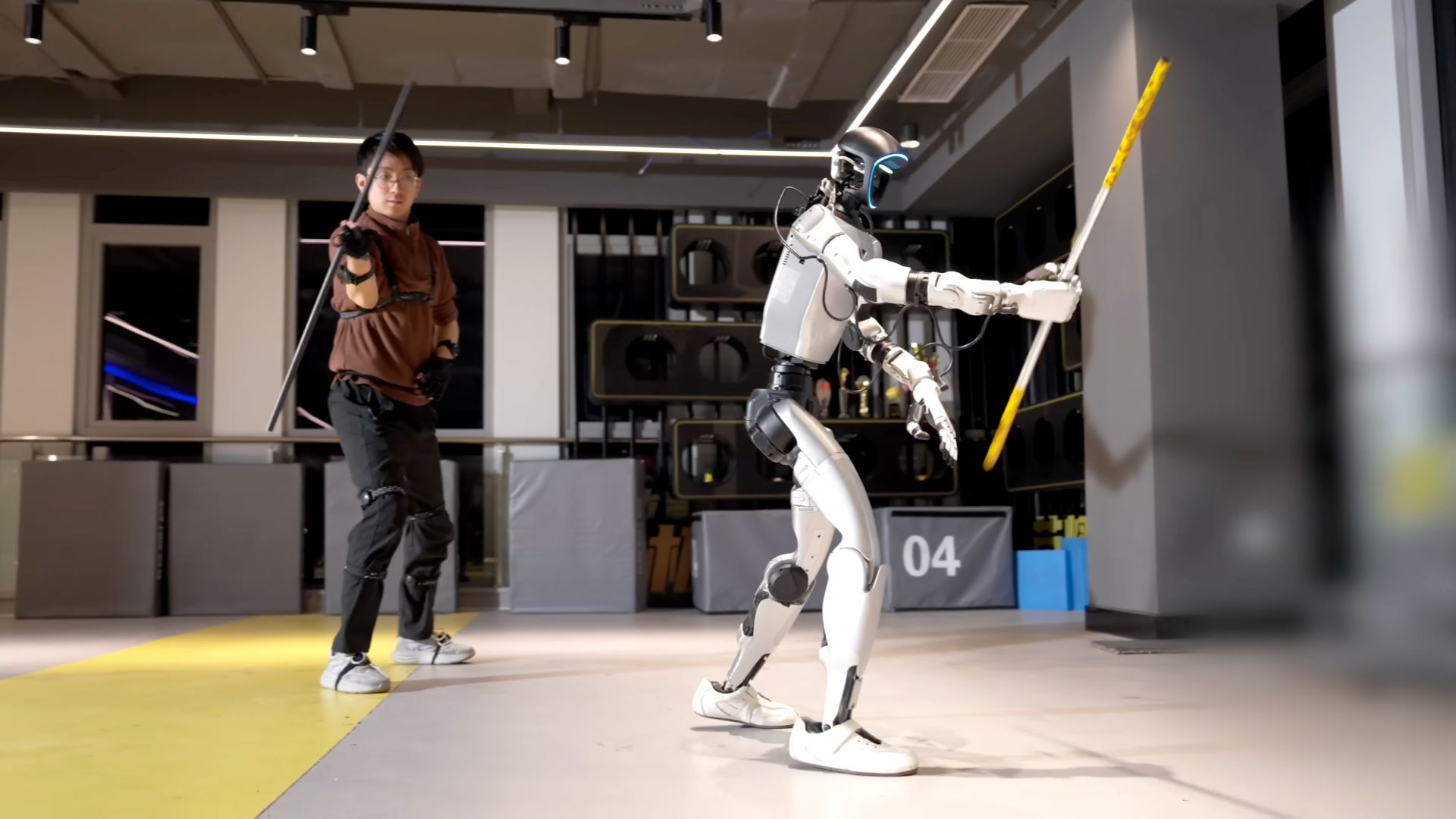
A Chinese firm is set to unveil a special-purpose humanoid robot, designed for reconnaissance, patrols, and operations in hazardous environments. The Fuxi robot, developed by China North Industries Group Corporation (NORINCO Group), can operate in all weather conditions and allows human operators to control its movements in real time remotely. Developed alongside a dedicated teleoperation system, Fuxi is intended to enable closer coordination between humans and robots during on-site missions. Recently, twenty-three humanoid robot teams tackled a real-world firefighting and rescue challenge in Beijing, testing their ability to perform practical tasks under unpredictable conditions. Humanoid robot patrols The full-size humanoid, developed by NORINCO’s innovation institute, uses domestically developed technologies focused on human motion sensing, motion transfer between robotic platforms, and whole-body coordination. Though further details have not been disclosed, the robot can identify personnel and issue alerts when it detects abnormal situations, supporting its use in sentry and surveillance roles, the Global Times (GT) reports. Fuxi is also designed for all-weather reconnaissance, intelligent patrols and operations in dangerous areas where direct human involvement could be difficult. Multiple robots can operate together in formations, while an individual robot can reproduce an operator’s movements in real time during remote-controlled missions. NORINCO has developed a dedicated teleoperation system called “external avatar” to support these capabilities. The company describes it as China’s first independently controllable teleoperation solution for full-size humanoid robots weighing around 198 pounds (90 kilograms). The system incorporates technologies for real-time human-motion remapping and remote control. It is intended for complex and high-risk environments and can support remote reconnaissance, unmanned operations, and specialized response missions. NORINCO said combining human control from a remote location with robots carrying out tasks on site could provide a new approach to unmanned operations in special-purpose scenarios, reports GT. A group of Fuxi robots will also demonstrate nighttime urban inspection operations during the event. The demonstration will highlight coordinated management among multiple robots, intelligent assessment and closed-loop responses, according to the company. Humanoids face reality China’s humanoid robot industry is shifting its focus from flashy demonstrations to practical applications as manufacturers face growing pressure to prove the technology can deliver measurable economic value. More than 300 companies are expected at the World Robot Conference in Beijing this week, showcasing over 2,000 exhibits and more than 150 new products. The event comes as Chinese humanoid makers increasingly emphasize industrial inspection, material handling and other tasks rather than entertainment-focused demonstrations. The industry is also using the World Humanoid Robot Games, which begin in Beijing on August 22, to test robots in more demanding work scenarios. Competitions will include factory, hotel and household tasks such as packing, warehousing, industrial assembly, material feeding, retail services, EV charging and connecting cables. These applications require robots to do more than perform programmed movements. Machines must recognize unfamiliar objects, manipulate them repeatedly, recover from errors, and complete tasks without constant intervention from engineers, reports Reuters. The economic challenge remains significant. Robotics analysts estimate that 50 percent to 70 percent of humanoid robots produced this year could be used primarily to collect training data rather than perform paid work. Guotai Securities estimates an industrial humanoid would need to cost about 160,000 yuan ($22,300), including maintenance, to achieve payback within two years against a worker earning 80,000 yuan ($11,100) annually. However, robots currently typically cost between 300,000 and 500,000 yuan ($41,800-$69,600). According to experts, the challenge extends beyond hardware. Companies must also address shortages of skilled operators and the costs associated with transporting, deploying and maintaining humanoids. Together, these factors could determine whether China’s rapidly expanding humanoid sector moves from impressive prototypes to commercially viable robotic workers, reports Reuters. Get the latest in engineering, tech, space & science - delivered daily to your inbox.Jijo is an automotive and business journalist based in India. Armed with a BA in History (Honors) from St. Stephen's College, Delhi University, and a PG diploma in Journalism from the Indian Institute of Mass Communication, Delhi, he has worked for news agencies, national newspapers, and automotive magazines. In his spare time, he likes to go off-roading, engage in political discourse, travel, and teach languages.
China’s Fuxi humanoid robot lets operators remotely take control in dangerous zones
Full Article
Original Source
Read the full article at Interestingengineering →KhanList aggregates and links to publicly available news content. We do not host full articles from third-party sources. Always verify important information with original sources.