
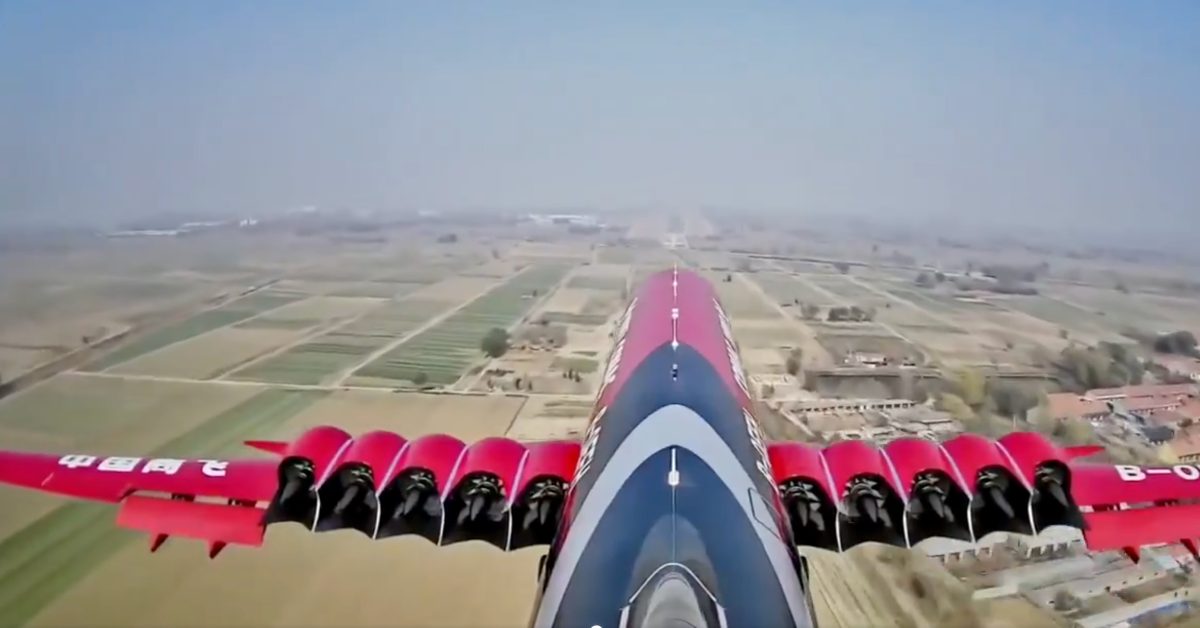
COMAC’s CE-25A, China’s 19-seat battery-electric commuter plane, flew with a crew for the first time on Saturday in Binzhou, Shandong. Two pilots and a flight test engineer were aboard the roughly 10-tonne demonstrator, and COMAC says every system worked normally. It wasn’t the plane’s first flight. The CE-25A had already completed 19 autonomous test flights with nobody on board since February 2, and China’s aviation regulator is now reviewing it for a type certificate. The CE-25A: 19 seats, 10 fans, 400 km The CE-25A is a T-tail commuter plane with 10 electric ducted fans on the wings, five per side, instead of propellers. COMAC lists a 300 km/h cruise speed and a 400 km (250-mile) range. The CAAC accepting COMAC’s type certificate application starts the airworthiness review. It doesn’t mean paying passengers are close, and COMAC hasn’t given a date for commercial service. The program has been quiet for a long time. COMAC showed a CE-25A model at the China International Import Expo in Shanghai in November 2023, with a placard listing 400 to 500 km of range and a 400 km/h top cruise speed. The full-size aircraft, registered B-0EFH, only became public when photos leaked on Chinese social media on October 28. The CATL connection The obvious battery candidate is CATL. In July 2023, COMAC, CATL, and Shanghai Jiao Tong University formed a joint venture with CNY 600 million in registered capital to develop electric aircraft, as we reported when CATL launched its aviation unit. CATL had just unveiled its “condensed” battery at the time, claiming up to 500 Wh/kg at the cell level, and said it was testing the cells to aviation standards. Neither company has confirmed what’s inside the CE-25A, though. ~500 Wh/kg has long been seen as the target for battery energy density to enable electric flight on a commercial scale. How it compares COMAC isn’t alone in flying a large electric demonstrator. In August, Heart Aerospace flew its X1 in Plattsburgh, New York, for 27 minutes. It’s a 25,000-lb aircraft with a 106-foot wingspan, which Heart calls the largest battery-electric aircraft ever flown. Eviation flew its 9-passenger Alice back in September 2022, then laid off most of its staff in early 2025. Heart is the closest Western comparison. It dropped its 19-seat ES-19 for the 30-seat ES-30 back in 2022, and the ES-30 now relies on reserve turbogenerators to stretch its range, with BAE Systems working on the battery. Heart is targeting 2031 for service and claims “more than 40%” lower operating costs. Electrek’s Take For years, the go-to excuse in the West for doing nothing about emissions was China. Why should we bother, the argument went, if China won’t? Now China is pulling ahead, and it’s doing it by cutting its dependence on fossil fuels. Look at trucking. Electric trucks hit 50.3% of China’s heavy truck sales in September, and they’re already eating into the country’s diesel demand. In the US, electric models were about 0.3% of heavy-truck sales last year, according to the ICCT. Now it’s planes, starting where batteries make sense today: short regional routes. The CE-25A’s 400 km shrinks once you keep the reserves regulators require, and a Beechcraft 1900 turboprop in the same class covers well over 1,000 km. So it’s not replacing turboprops anytime soon. But that’s how trucking started too. Short-haul first, then long-haul tractors once the batteries caught up. And this couldn’t happen fast enough. We’re in the middle of a diesel and jet fuel crisis. Jet fuel averaged $3.50 a gallon in early August, up 63% from a year earlier, according to Heart Aerospace. Every truck and plane China moves to batteries is one less exposed to that. China also has the batteries to pull it off, with CATL in the joint venture. Meanwhile, Heart has pushed to 2031 and added a fuel-burning backup, and Eviation is a cautionary tale. If you’re following the electrification of transport, the cheapest place to start is your own roof: home solar can power your EV for close to nothing. With electricity rates up almost 10% last year and expected to keep climbing, going solar is one of the best ways to protect yourself against rising costs. And with lease and PPA options, you can do it with zero upfront cost and start saving immediately. If you want to find the best deal, check out EnergySage. It’s a free service with hundreds of pre-vetted installers competing for your business, so you save 20 to 30% compared to going it alone. No sales calls until you pick an installer. Get your free quotes here. FTC: We use income earning auto affiliate links. More.
China’s electric airliner era starts with a 19-seat plane and 400 km of range
Full Article
Original Source
Read the full article at Electrek →KhanList aggregates and links to publicly available news content. We do not host full articles from third-party sources. Always verify important information with original sources.