
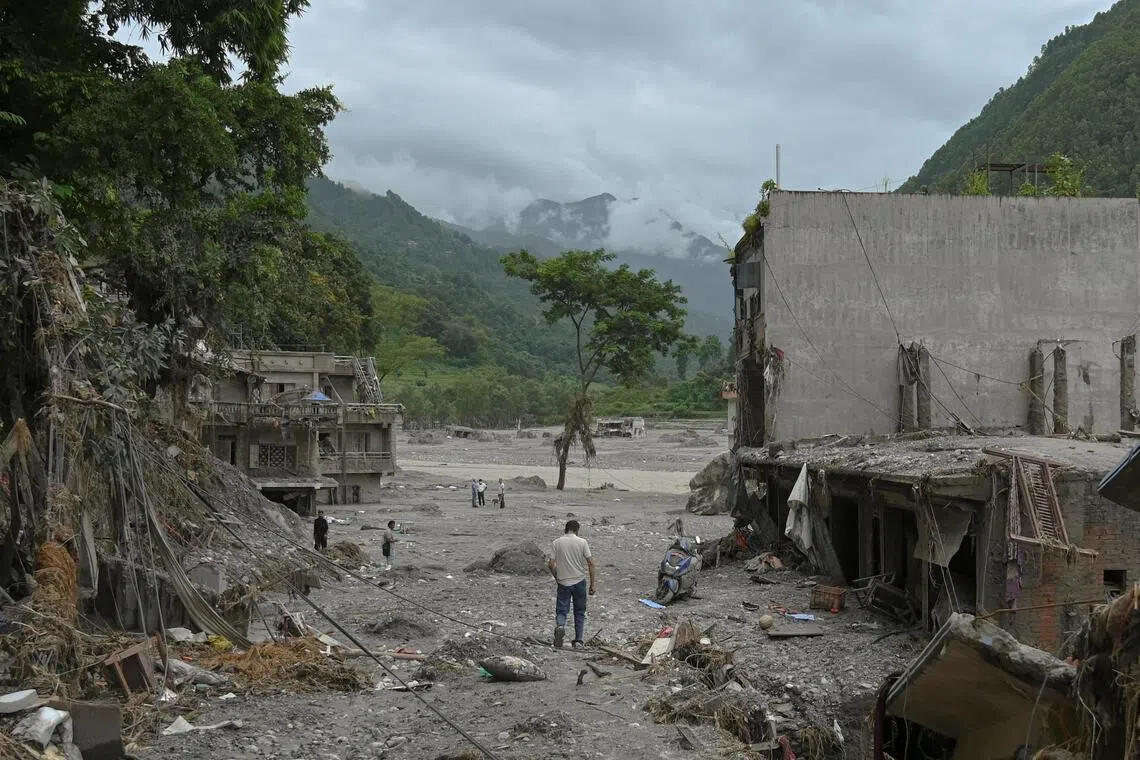
BEIJING – China pushed back against claims by some Indian commentators who debated whether Beijing was to blame for last week’s deadly landslide along the Nepal-Tibet border.Experts have determined that “the disaster has been triggered by the collapse of a high-altitude glacier in Nepal,” Guo Jiakun, a spokesman for China’s Foreign Ministry, said in response to a question at a daily briefing in Beijing on Aug 31.“In the face of major disasters, we firmly oppose such groundless and malicious speculation.”A nationalist Indian television personality, Arnab Goswami, whose combative prime-time shows are a fixture of the right-leaning television landscape, called the Nepal floods a possible “China made” disaster.He later promoted a segment laying out “5 Reasons That Nail China’s Role” in the catastrophe.The India Today TV station ran a similar prime-time segment that asked whether Beijing played “foul.”Much of India’s mainstream media has reported on the disaster cautiously, distinguishing between questions over possible gaps in China’s data sharing and the cause of the floods.The Indian government has not publicly commented on the matter.Brahma Chellaney, an Indian strategic analyst and former national security adviser who has written extensively on China and transboundary water disputes, has also added his voice to the debate.In an opinion piece for Nikkei Asia, Chellaney said that while a natural glacier and rock collapse triggered the flood, Chinese infrastructure and alterations to the Himalayan river system “may have amplified its consequences.”The episode arrives at a delicate moment, as Prime Minister Narendra Modi prepares to welcome Xi Jinping to India in September for the first time in seven years during a broader warming of ties.The two men are likely to meet at the Shanghai Cooperation Organisation Summit this week in Bishkek, Kyrgyzstan, although a bilateral sit down is not planned.The sides have spent the past two years cautiously trying to rebuild ties after relations collapsed following deadly fighting along their disputed Himalayan frontier in 2020, prompting India to restrict Chinese investment, ban scores of apps and sharply reduce political engagement.Scientists examining satellite and seismic data say the catastrophe began when part of a glacier and the mountainside beneath it collapsed at high altitude, sending a gigantic mass of ice, rock and debris into the valley below.The US Geological Survey concluded that a seismic event initially interpreted as a 5.2-magnitude earthquake was generated by the collapse.Preliminary assessments from Chinese and Nepali institutions also point toward the glacier collapse in Nepal.Scientists are still investigating what destabilised the mountainside, with researchers examining the possible role of unusually warm conditions, melting ice and degrading permafrost, and possibly also construction activities.On Aug 31, Guo added that China had sent money, humanitarian aid and rescue teams to Nepal.“We have also shared with the Nepali side important information such as images, satellite and hydrological data of the disaster-affected areas, including early-warning information on an upstream barrier lake,” he said. BLOOMBERG
China slams ‘malicious’ Indian media accusations on deadly flood
Full Article
Original Source
Read the full article at Straitstimes →KhanList aggregates and links to publicly available news content. We do not host full articles from third-party sources. Always verify important information with original sources.