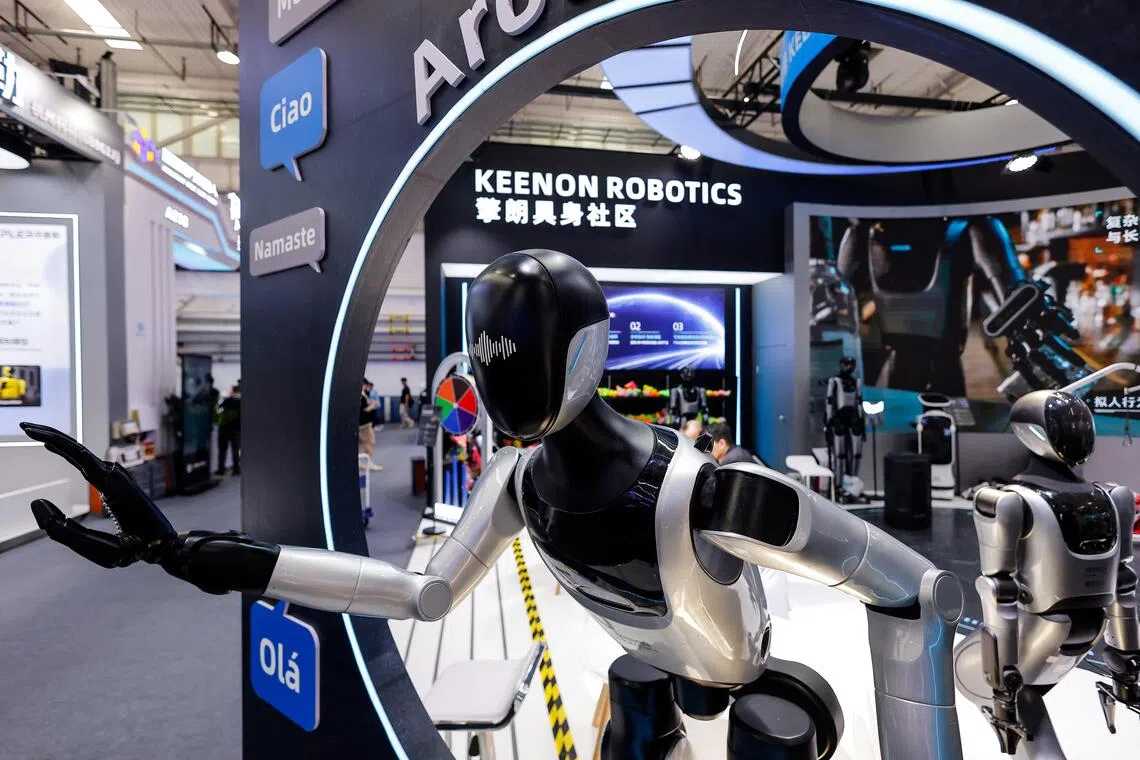
BEIJING – China’s robot makers showcased their latest machines at a Beijing conference on Aug 19, seeking to convince investors and customers that the technology is moving forward for broader commercial adoption.More than 300 companies are attending the World Robot Conference, which runs through Aug 23, displaying over 2,000 exhibits and launching more than 150 products.The conference comes as robotics emerges as a new front in the US-China rivalry, and as investor enthusiasm for the sector hits fresh highs in China.Shares in Unitree, China’s best-known humanoid robot maker, soared nearly sixfold in their Shanghai trading debut on Aug 19.Following its successful initial public offering, which was more than 8,000 times oversubscribed by retail investors, start-up Lumos Robotics and the robotics division of China’s largest auto exporter Chery Automobile said they were also considering stock market listings.At the conference’s opening ceremony, Xin Guobin, vice-minister of the Ministry of Industry and Information Technology, pledged support for the sector’s development, saying robotics has already become “an important force” in China’s economic and social development.While robots in China are increasingly being deployed for tasks such as hotel food deliveries and on some assembly lines, large-scale adoption beyond pilot projects remains limited.A child sits next to Unitree’s G1 humanoid robots, as he interacts with Unitree GO2 robot. PHOTO: REUTERSStart-up Robotera displayed a slick demonstration of a parcel-sorting humanoid robot torso on a wheeled tripod base at the show. The robots have a continuous running time of 900 to 1,000 hours and are 85 per cent as effective as a human worker, a sales representative said.The industry’s rapid expansion mirrors China’s electric vehicle sector a few years ago, when scores of companies emerged rapidly and competed aggressively.“A large number of (robot) companies appeared almost overnight,” Zhang Guibing, head of AiMOGA Robotics, Chery’s robotics division, said on the sidelines of the conference.“But from the perspective of industry development, there is a positive side to this. It allows everyone to compete fully,” he said. “In the end, this will help deepen the industry’s technology and capabilities. From that perspective, I think this is a good thing.”Global humanoid robot shipments nearly quadrupled in the first half of 2026 to 19,100 units, with Chinese manufacturers dominating the market, according to data from Smart Analytics Global.Still, Georg Stieler, a robotics analyst who advises industrial companies in China, estimates that between 50 per cent and 70 per cent of humanoid robots produced in 2026 could end up in “data factories”, where they are used to collect training data rather than perform productive work for paying customers.“Competition in the Chinese market could become extremely intense in the future, especially when it comes to costs,” Zhang said, adding humanoid robots could take about a decade to mature before seeing rapid adoption. REUTERS
China robot makers flock to Beijing show, seek path to mass adoption
Full Article
Original Source
Read the full article at Straitstimes →KhanList aggregates and links to publicly available news content. We do not host full articles from third-party sources. Always verify important information with original sources.