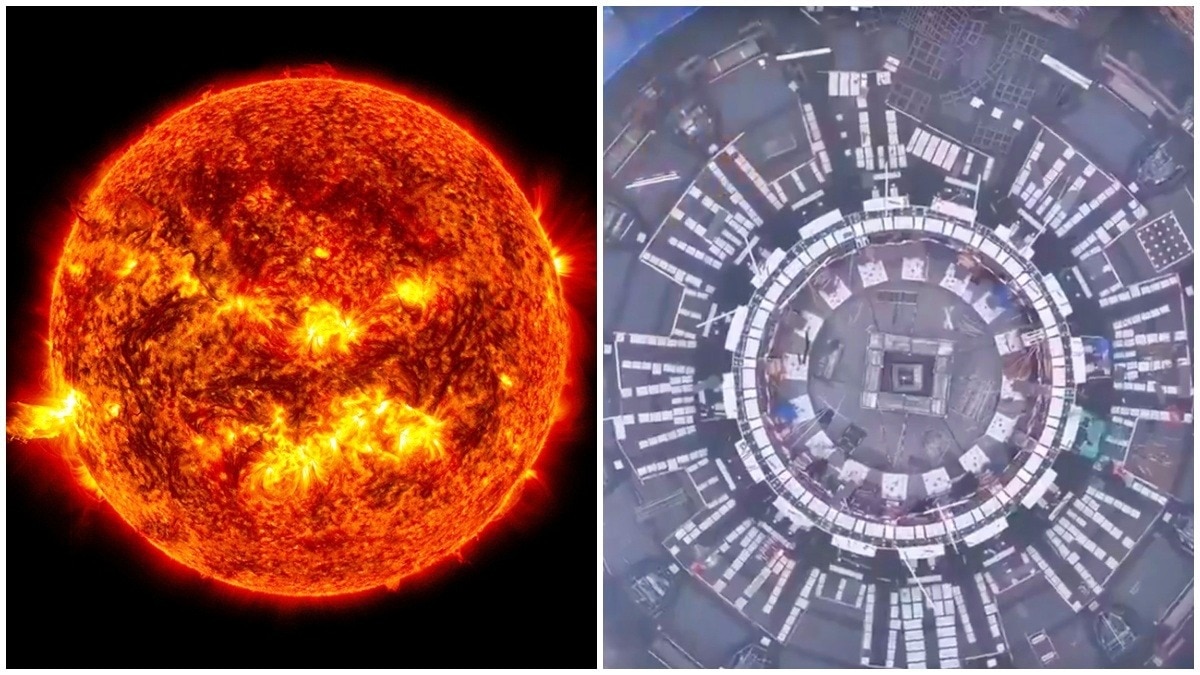
China has completed and tested the world's largest superconducting fusion magnet for its artificial Sun programme. The milestone strengthens its 2030 fusion power roadmap, though major technical hurdles remain.China has laid out a three-stage roadmap for commercial fusion. (Photo: X/@STANLEES4)China has taken a major step towards building an artificial Sun after completing and testing the world's largest superconducting fusion magnet, a key component needed to generate clean, virtually limitless energy through nuclear fusion.The achievement marks a significant milestone in China's ambitious plan to produce electricity from fusion power by around 2030, positioning the country among the global leaders in the race to harness what scientists call the ultimate source of carbon-free energy.Developed by the Institute of Plasma Physics under the Chinese Academy of Sciences, the newly accepted toroidal field superconducting magnet is a giant D-shaped structure measuring 21 metres long, 12 metres wide and weighing 582 tonnes.WHAT IS ARTIFICIAL SUN?An artificial Sun is a nuclear fusion reactor that recreates the same process powering the Sun. It fuses hydrogen atoms at temperatures exceeding 100 million°C, releasing enormous amounts of energy without producing carbon dioxide.Scientists hope it will provide a virtually limitless, clean and safe source of electricity in the future. HOW DID CHINA BUILD WORLD'S LARGEST MAGNET?Researchers say it is the largest fusion reactor superconducting magnet ever built, with 1.3 times the volume and three times the stored energy of similar magnets developed for the International Thermonuclear Experimental Reactor (ITER), the world's largest fusion project.The magnet's role is to create an immensely powerful magnetic field that traps plasma, a superheated gas reaching temperatures of around 100 million degrees Celsius, inside a reactor without allowing it to touch the walls.Alongside the giant magnet, researchers also successfully tested a high-temperature superconducting central solenoid coil, often described as the heart of a fusion reactor. Similar to a spark plug in a car engine, the component helps ignite and sustain the plasma needed for fusion reactions. The country aims to build the China Fusion Engineering Demonstration Reactor. China says both technologies were developed entirely using domestic materials and manufacturing capabilities, ending reliance on foreign suppliers for critical fusion components.According to the research team, the six-year programme has resulted in 47 patents and 25 industry standards.Building the magnet required extraordinary engineering precision. It must operate reliably for 60 years at temperatures close to minus 269°C, while carrying extremely high electrical currents and withstanding intense radiation and mechanical forces.Engineers also reduced electrical resistance in critical joints to nearly zero, allowing currents exceeding 100,000 amperes to flow with almost no energy loss, an essential requirement for commercial fusion reactors.The breakthrough builds on China's growing expertise in fusion research. Earlier this year, its Experimental Advanced Superconducting Tokamak (EAST), often called China's artificial Sun, set a world record by sustaining plasma at 100 million degrees Celsius for 1,066 seconds, demonstrating the ability to maintain fusion conditions for unprecedented durations.China has laid out a three-stage roadmap for commercial fusion. Its Burning Plasma Experimental Superconducting Tokamak is expected to be completed by the end of 2027, followed by the first fusion power generation around 2030.The country ultimately aims to build the China Fusion Engineering Demonstration Reactor, which could become the world's first fusion demonstration power station.Despite the milestone, researchers caution that significant challenges remain. Full reactor assembly, long-term testing and proving the technology can reliably generate more energy than it consumes are still ahead.Even so, scientists say each technological breakthrough brings the dream of virtually unlimited, zero-carbon energy one step closer to reality, potentially transforming the future of global electricity generation.- EndsPublished By: Sibu Kumar TripathiPublished On: Jul 28, 2026 11:03 IST
China ready to build artificial Sun, completes world's largest magnet
Full Article
Original Source
Read the full article at Indiatoday →KhanList aggregates and links to publicly available news content. We do not host full articles from third-party sources. Always verify important information with original sources.