
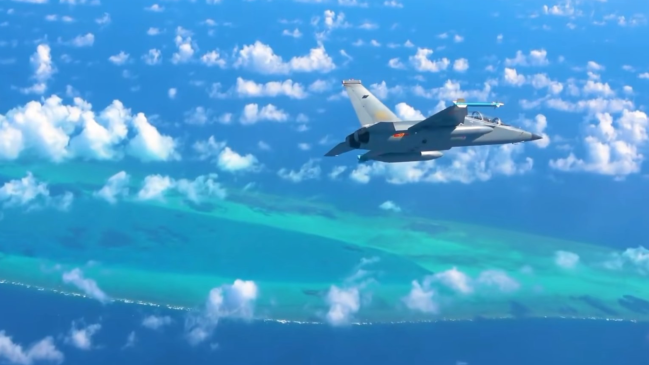
China has deployed armed JL-10 trainer jets to intercept and drive away Philippine aircraft over Scarborough Shoal, a coral atoll in the disputed South China Sea. The latest deployment of the jets highlights China’s potentially cheaper approach to the increasingly frequent air confrontations in the contested region. According to footage released by the PLA’s Southern Theatre Command, at least three Chinese JL-10s carrying PL-5 short-range air-to-air missiles were involved in the operation.The video showed the jets tracking three Philippine aircraft, including a BN-2A Islander, C-208, and PA-31T, while a Chinese pilot was heard warning the aircraft to leave the area or face unspecified action. The deployment is notable because Beijing has previously relied on more expensive combat aircraft for similar missions. JL-10 offers a cheaper option The JL-10, also known as the L-15 in its export configuration, is a twin-engine lead-in fighter trainer designed for advanced pilot training and light combat missions. Its relatively low minimum controllable speed makes it better suited than high-performance fighters to operating around slow-moving aircraft. The Philippine aircraft involved in the incident fly at substantially lower speeds than modern fighter jets. The slowest can reportedly operate at around 162 mph, creating a difficult interception problem for high-speed combat aircraft that must slow down considerably while maintaining control and situational awareness, the South China Morning Post reported. The JL-10 can reportedly operate at speeds as low as roughly 130 to 162 mph while retaining the ability to carry air-to-air missiles and guided weapons. That makes it a practical platform for missions that require persistent monitoring and interception rather than the full capabilities of a heavyweight fighter. Cost is another factor, as the JL-10 is estimated to cost roughly $10 million to $15 million on the international market, while a J-16 fighter can approach an estimated $100 million. Pairing the trainer with older but capable PL-5 infrared-guided missiles therefore gives China a considerably less expensive option for confronting relatively lightly equipped aircraft. Different approach to South China Sea patrols The operation marks the first time China has publicly shown armed JL-10s taking the lead in an encounter around Scarborough Shoal. The PLA has previously used more sophisticated platforms, including J-16 fighters, for similar missions. The shift could reflect an effort to match the response more closely to the threat. Deploying advanced fighters against slow utility and reconnaissance aircraft provides considerable capability, but it can also consume expensive aircraft hours and impose greater operating costs. The JL-10s were also accompanied by more powerful aircraft. Footage released by the PLA showed J-16 fighters and an H-6 strategic bomber in the wider operation, suggesting that the trainer deployment forms part of a broader layered presence around the disputed shoal. Scarborough Shoal remains one of the most sensitive flashpoints between China and the Philippines. Beijing has controlled the area since 2012, while Manila continues to challenge China’s claims through maritime and aerial patrols. Get the latest in engineering, tech, space & science - delivered daily to your inbox.Bojan Stojkovski is a freelance journalist based in Skopje, North Macedonia, covering foreign policy and technology for more than a decade. His work has appeared in Foreign Policy, ZDNet, and Nature.
China puts missile-armed jets to operate over contested area, move could intimidate Philippines
Full Article
Original Source
Read the full article at Interestingengineering →KhanList aggregates and links to publicly available news content. We do not host full articles from third-party sources. Always verify important information with original sources.