
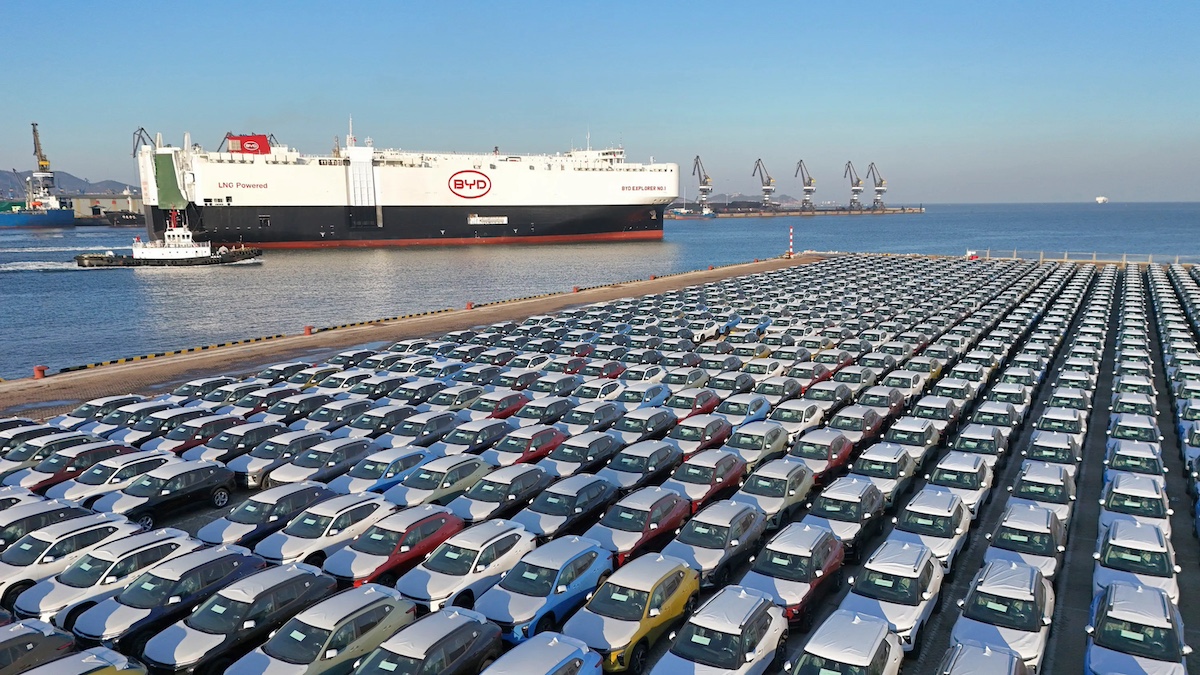
As Chinese exports keep surging, Western tariffs increasingly blur the line between defending fair competition and protecting industries from superior global competitors. The European Union has threatened “harsher measures” as it approaches an October 2026 deadline to conclude a deal to rein in China’s trade surplus with the bloc. Meanwhile, the United States has threatened a 7.5% industrial overcapacity tariff on Chinese goods. This increasingly frequent invocation of “overcapacity” to justify restrictions on imports from China deserves considerably more critical scrutiny than it has generally received. While there may be legitimate concerns about Chinese state support and excess investment in particular sectors, describing Chinese export strength simply as the product of “overcapacity” risks becoming a convenient political justification for protectionism. In particular, the argument becomes substantially less persuasive when you consider the ownership structure of production in China. A significant proportion of goods exported from China are produced not by Chinese state-owned enterprises, but by private Chinese companies and foreign-invested enterprises, including companies headquartered in Europe, the United States, Japan and elsewhere. The scale of foreign participation in China’s trade is substantial. China’s General Administration of Customs reported that total goods trade reached US$6.8 trillion in 2025. Foreign-invested enterprises accounted for $1.97 trillion of the total, which is about 30% of China’s total merchandise trade. The historical trend is even more revealing. According to data reproduced in the World Openness Report 2025, foreign-invested enterprises accounted for 45.9% of Chinese exports in 2014, 38.7% in 2019, 34.8% in 2021, 28.6% in 2023 and 27.4% in 2024. In 2024, foreign-invested enterprises exported approximately $979 billion of China’s total exports of $3.58 trillion. Thus, although the foreign-invested share has fallen considerably as Chinese domestic companies have become more competitive, it remains very large. This distinction matters greatly when considering the political language surrounding “Chinese overcapacity.” The geographical location of a factory does not necessarily correspond to the nationality of the capital, technology, management, intellectual property or ultimate beneficiaries involved. A vehicle manufactured in China by a European or American company is statistically a Chinese export, but economically it may represent the internationalization of a Western company’s production system. The European Commission’s anti-subsidy investigation into Chinese battery-electric vehicles (EVs), in 2023, provides a clear illustration of this. Its investigation explicitly identified imports into the EU associated with Renault, BMW, Mercedes-Benz, and Tesla, alongside Chinese manufacturers and brands. These Western companies plan to keep EV production in China, motivated by access to local innovation and economies of scale. This creates an important contradiction in the overcapacity argument. If production in China is intrinsically evidence of unfair Chinese industrial excess, then Western multinational corporations that deliberately established highly competitive Chinese manufacturing operations become beneficiaries of precisely the supposedly objectionable system. Conversely, if these companies are rationally locating production in China because Chinese engineering capabilities and economies of scale make them competitive, then the resulting exports cannot automatically be interpreted as evidence of predatory Chinese overproduction. They may instead show the international division of production working effectively. The EU’s own evidence also suggests that the situation is more complicated than a simple narrative of Chinese goods flooding Western markets. In its anti-subsidy investigation, the Commission found that Chinese EVs were subsidized and sold at prices substantially below those of EU producers. These are legitimate grounds for investigating subsidies and possible injury under trade law. They do not, however, establish that the broader concept of “overcapacity” itself is an adequate justification for unilateral tariffs. Subsidization, dumping, competitive advantage and excess productive capacity are different economic phenomena and should not be treated as interchangeable concepts. The United States has taken an even more protectionist approach. In 2024, the Biden administration increased the US tariff on Chinese electric vehicles from 25% to 100%, explicitly citing “substantial risks of overcapacity.” Such a tariff prevents American consumers from accessing many competitively priced Chinese EVs, regardless of whether each vehicle has benefited from a subsidy. The measure functions not merely as a correction of a particular trade distortion but as a powerful industrial-policy instrument designed to shield domestic producers. A further problem arises when applying the term “overcapacity” to industries in which global demand is expanding exceptionally rapidly. Electric vehicles and batteries are not conventional mature commodities whose demand is stagnant while China indiscriminately produces unwanted output. They are central technologies in the global transition towards lower-carbon transport and electricity systems. The International Energy Agency estimates that almost 22 million electric cars were produced globally in 2025, more than 25% above 2024 levels. China accounted for approximately three-quarters of global electric-car production and about 40% of global electric-car trade. Chinese electric-car exports exceeded 2.5 million units in 2025, approximately doubling from the previous year. This enormous Chinese production base undoubtedly creates competitive pressure on European and American manufacturers. But competition should not automatically be equated with overcapacity. Indeed, the fact that consumers in numerous countries are purchasing Chinese EVs suggests genuine international demand for the products. The technological dimension is equally important. China has developed exceptionally sophisticated capabilities in batteries, electric drivetrains, power electronics, manufacturing automation and integrated EV supply chains. It is therefore reasonable to argue that at least part of the Western “overcapacity” narrative is actually a narrative about technological competitiveness. European and American manufacturers have struggled to reproduce the combination of battery scale, cost efficiency, supply-chain integration and rapid product development achieved in China. Rather than confronting this competitiveness through greater investment and domestic productivity improvements, tariffs provide governments with a comparatively simple political response. This does not mean that every Chinese industrial policy is benign or that allegations of subsidies should be dismissed. China has undoubtedly used industrial policy aggressively, and concerns over state-directed investment are legitimate subjects for investigation. The stronger argument, however, is that these issues should be addressed through evidence-based anti-subsidy and anti-dumping procedures and negotiated international rules rather than through broad unilateral tariffs justified by an elastic concept of “overcapacity.”
China overcapacity or Western protectionism? What the numbers say
Full Article
Original Source
Read the full article at Asiatimes →KhanList aggregates and links to publicly available news content. We do not host full articles from third-party sources. Always verify important information with original sources.