
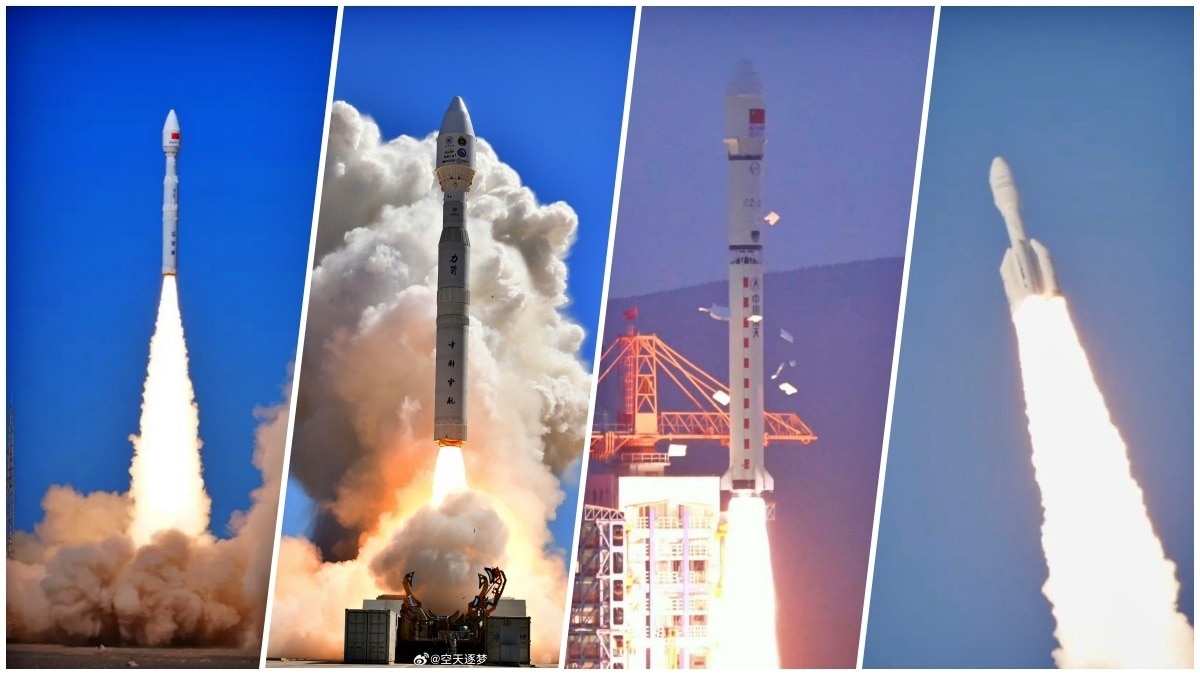
China launched four orbital rockets from three sites in a 45-hour window between 15 and 16 September. The run highlighted expanding launch capacity, private-sector participation and progress towards more frequent space missions.The launch sequence, which took place between September 15 and 16, involved both state-owned and privately developed rockets. (Photo: CNSA)China's rapidly expanding space sector demonstrated its growing launch capacity last week, with four different orbital rockets lifting off within a span of just 45 hours from three separate launch sites.The launch sequence, which took place between September 15 and 16, involved both state-owned and privately developed rockets.All four missions successfully delivered their payloads into orbit, highlighting the diversity of China's launch vehicles and the country's growing ability to support high-frequency satellite deployments.The first launch came early on September 15, when LandSpace's Zhuque-2E lifted off from the Jiuquan Satellite Launch Center in northwest China. The privately developed rocket, powered by liquid methane and liquid oxygen, carried 10 satellites into low Earth orbit for China's Qianfan, or Thousand Sails, broadband megaconstellation.Qianfan is planned to eventually comprise around 15,000 active satellites, making frequent and reliable launches essential for building the network. Later the same day, Orienspace's Gravity-1 launched nine more Qianfan satellites from a sea-based platform off Shanghai. The rocket, known for its unusually short and wide design, is currently described as the world's most powerful solid-fuel rocket.The third launch involved the state-owned Long March 12, which lifted off from the Wenchang Space Launch Site on Hainan Island. It carried nine spacecraft for China's other major low-Earth-orbit broadband network, known as SatNet, which is planned to eventually include around 13,000 satellites.The rapid-fire launch campaign concluded with a Kuaizhou-11 rocket launching from Jiuquan. Operated by a subsidiary of the state-owned China Aerospace Science and Industry Corporation, the rocket carried two Earth-observation radar satellites for Chinese company Spacety.The four missions also underscore the growing role of private companies in China's space programme. Two of the rockets in the sequence were developed and operated by private-sector companies, while the other two were linked to state-owned aerospace organisations.However, none of the four missions attempted to recover and reuse their rocket stages.China is nevertheless making progress in reusable launch technology.In recent months, LandSpace's Zhuque-3 and CASC's Long March 10B have successfully demonstrated first-stage landings during orbital missions, marking an important step towards more frequent and potentially lower-cost spaceflight.- EndsPublished By: Sibu Kumar TripathiPublished On: Sep 21, 2026 11:54 IST
China launched four different rockets in 45 hours from three launch sites
Full Article
Original Source
Read the full article at Indiatoday →KhanList aggregates and links to publicly available news content. We do not host full articles from third-party sources. Always verify important information with original sources.