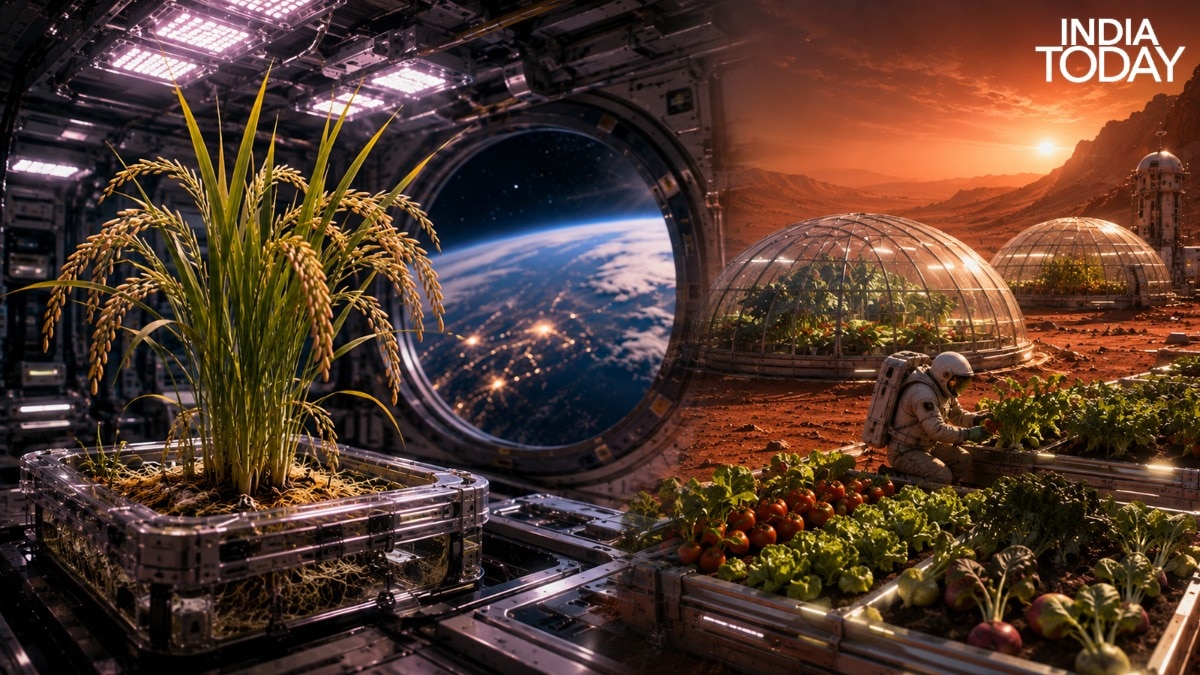
China has harvested the first rice grown in orbit aboard its Tiangong Space Station, a world first in space farming. Here is the simple science of space rice, why we grow food beyond Earth, and whether humanity can one day farm on Mars.China has harvested the first rice grown entirely in orbit aboard its Tiangong space station. It is a world first, and it brings the dream of farming on Mars a little closer. (Photo: India Today)Somewhere above your head, 400 kilometres up, a handful of rice plants has just pulled off a quiet miracle.Aboard China's Tiangong Space Station, the Shenzhou-23 crew has harvested the first rice of an experiment that inches us closer to an astonishing idea: dinner grown on another world.It sounds like science fiction, but it is fast becoming science.And it asks one of the boldest questions humans have ever posed. Can we feed ourselves far from Earth? HOW DO YOU GROW RICE IN SPACE?With enormous difficulty. In 2022, Chinese scientists nursed rice through its whole life, from seed to seed, in orbit for the first time. Six seeds became 59. The current mission is bolder still, chasing two generations one after the other.The problem is that plants were built by gravity, and space steals it. This near weightless state, called microgravity, baffles a plant completely. Roots forget which way is down. The first rice grown entirely in orbit aboard China's Tiangong space station marks a world first in space farming. (Photo: X/@ChinaScience) Water refuses to trickle and instead balls up into floating spheres that can drown the roots or leave them gasping.Even pollen loses its way, drifting through the cabin rather than landing where it should.WHY GROW FOOD IN SPACE AT ALL?Because you cannot pack a lunchbox for the Red Planet. A journey to Mars and back may swallow two to three years, and every kilogram lifted off Earth costs a fortune in fuel. Stored rations fade too, quietly losing their vitamins over the long months.So the answer is to turn the spacecraft into a tiny farm. Plants are far more than food. Through photosynthesis, they inhale the carbon dioxide astronauts breathe out and hand back fresh oxygen.After more than two months aboard China's Tiangong space station, the Shenzhou-23 crew members are all in good condition while making steady progress on a range of space science experiments, including a study on multigenerational rice cultivation in microgravity. pic.twitter.com/lMmRzIIBrc— China Science (@ChinaScience) August 4, 2026They help clean water. They turn a sealed metal shell into something closer to a living world, what scientists call a bio-regenerative life support system.There is a tender reason too. On long, lonely voyages, astronauts say that tending a green shoot soothes the mind like nothing else. A single leaf becomes a piece of home.CAN SPACE RICE ALSO FEED EARTH?Here is where the story touches your plate. Since 1987, China has flown seeds skyward and brought them home, letting cosmic radiation jumble their genes. Most changes are useless. A rare few are treasure: shorter, sturdier stalks, richer protein, tougher resistance to disease.Breeders then hunt for these lucky mutants across many harvests. On the ground, the payoff has been hundreds of new crop varieties and millions of extra tonnes of grain. The Shenzhou-23 crew harvested rice from a landmark experiment chasing two generations in microgravity. (Photo: Gen AI/India Today) This is not genetic modification, which stitches in foreign genes. It merely hurries along nature's own accident of mutation.So can humanity grow food on Mars? Not tomorrow. But the rice ripening over your head is the first, patient step. And whether it ends up in a Martian greenhouse or an Indian field, the lesson is the same. We are learning, at last, to grow life where life was never meant to survive.- EndsPublished By: Radifah KabirPublished On: Aug 5, 2026 14:15 IST
China just harvested rice in space. Can humanity have dinner on Mars?
Full Article
Original Source
Read the full article at Indiatoday →KhanList aggregates and links to publicly available news content. We do not host full articles from third-party sources. Always verify important information with original sources.