
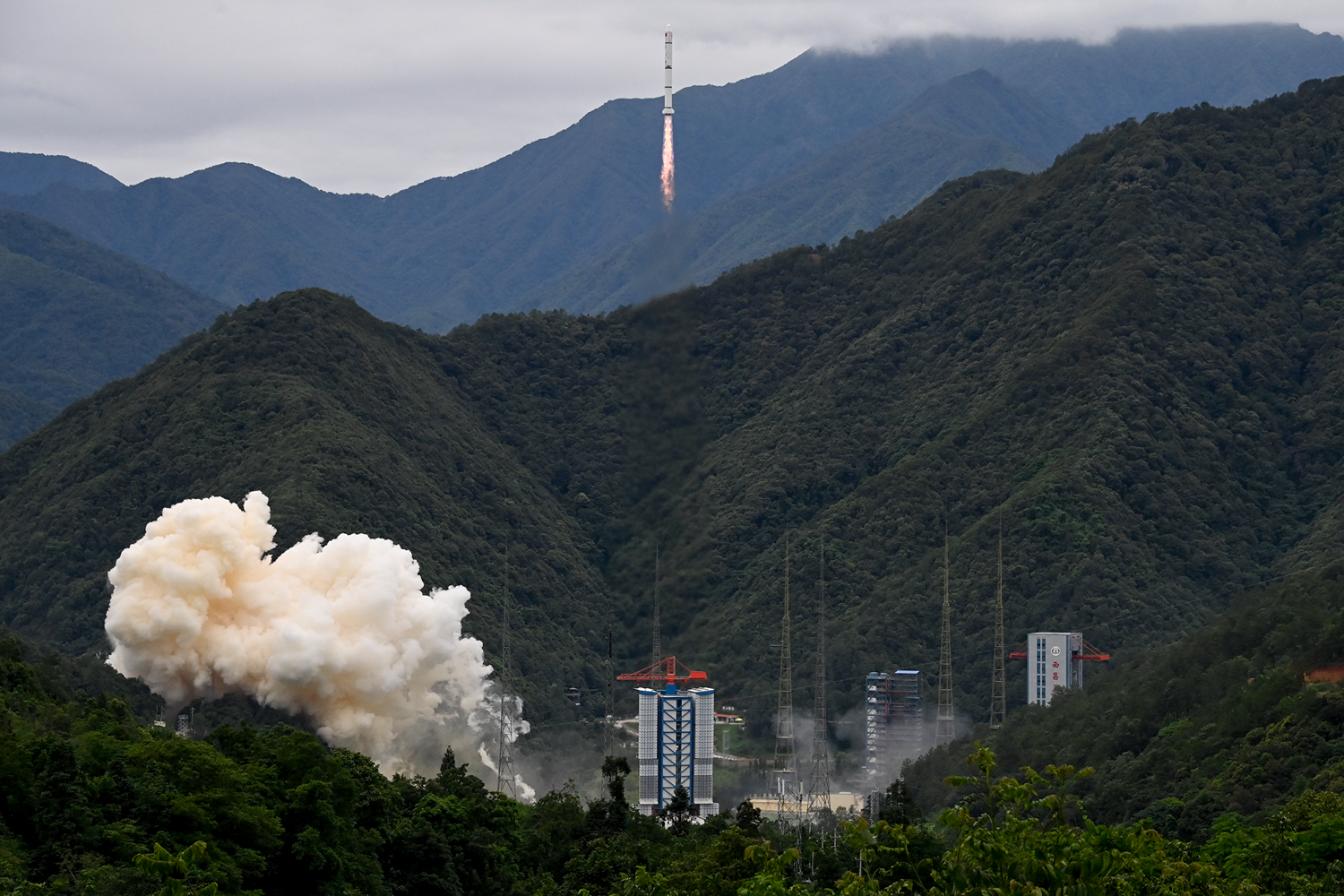
Washington may be focused on the battle over artificial intelligence, but China is also ready to compete among the stars. The rapid progress of China’s space program may not yet be seen as a “Sputnik moment,” but Beijing is a full-spectrum peer competitor with Washington in everything from planned moon bases each powered by nuclear reactors to space weapons. Space, with an already crowded low Earth orbit (LEO) and few rules, is another bifurcated realm of conflict-prone rivalry that brings, like maritime clashes or the future of AI, systemic challenges to the U.S.-China relationship. From potential nuclear warfare in space to competition over real estate on the moon, China’s ambitions are multifaceted and often in direct competition with those of the United States. A key part of Beijing’s ambitious strategy is building an integrated satellite network that rivals U.S. capacities. To capitalize on technological breakthroughs, such as Chinese start-up LandSpace’s reusable rocket, China has built a vertically integrated manufacturing base for its space industry, similar to its approach to electric vehicles. China views space competition holistically, with manufacturing speed and capacity conceived of as a comparative advantage enabled by behemoth aerospace state-owned companies and state support and encouragement for a burgeoning commercial industry where more than 500 players are already competing. Since it is a key national security industry dominated by military-directed state-owned companies, it is a less fiercely cutthroat competitive environment than those for EVs and solar energy—at least for now. The United States remains largely ahead of China in several key areas, including satellites in orbit, LEO broadband capabilities, and space situational awareness (SSA)—the tracking, characterizing, and predicting of the movement of satellites, debris, and natural objects in Earth’s orbit. The United States still has some 10 times more satellites in orbit than China, and while China’s launch cadence is rising, the country’s 92 total space launches in 2025 were still well below the 165 launches of SpaceX alone. SpaceX’s September launch of Starship, intended to propel the United States back to the moon, is another measure of U.S. commercial superiority. Given their existing constellations, launch costs, and technological advancement. U.S. LEO broadband providers still represent a standard that Chinese competitors strive toward. U.S. SSA systems are robust, including the NASA-designed Space Traffic Management (STM) architecture, the Traffic Coordination System for Space, and U.S. Space Force’s satellite catalogue. That coordination system now covers 11,345 satellites, including from 10 foreign governments, compared with some 1,500 Chinese satellites. Although China is beginning to develop its own comprehensive SSA capabilities, these efforts are not yet capable of realizing their goal of independence from U.S. SSA systems. Moreover, China lacks a comparable global network of ground radars and will likely lean more heavily on space-based SSA plays as it builds is own STM system. China’s efforts to develop its own STM system is still in an embryonic stage. In sharp contrast, U.S. Space Force’s Space Surveillance Network, with ground-based-radars, optical telescopes, and space-based sensors, is state of the art, despite needing upgrading. It tracks and monitors all man-made objects in space, including some 47,000 pieces of fast-moving, dangerous space debris that could cripple orbiting satellites, warning in cases where debris threatened satellites Despite these U.S. advantages, China has already achieved peer status or surpassed the United States in other areas, such as positioning, navigation, and timing; remote sensing and satellite imaging; and anti-satellite capabilities. These functions underpin myriad fundamental services and would be critical in wartime. While GPS encompasses 31 satellites, all in medium Earth orbit, China’s BeiDou system has 56 satellites spanning three orbits, making it a more diversified and resilient global positioning, navigation, and messaging services provider than GPS. China has progressed significantly in remote sensing and surpassed the United States in visible, radar, and hyperspectral imaging and anti-satellite capabilities. China’s remote sensing and imaging lead is, again, partially due to ambitious constellation layouts—groups of satellites working together—and a greater emphasis on achieving broad, highly resilient coverage. Beijing is not only placing its own satellites but also thinking about how to attack the satellites of others. The United States is already highly concerned by Chinese ground-based anti-satellite missiles, directed energy weapons, jammers, and on-orbit capabilities such as complex multi-satellite rendezvous and proximity operations and moving satellites with robotic arms. China’s progress may be one reason why the United States recently revealed that it has weapons in space. Perhaps the most consequential gap China is narrowing is in reusable rockets and launch technology. On July 10, China recovered a Long March-10B carrier rocket with a net-based capture on a sea platform, a global first for this recovery method and China’s first controlled recovery. On Aug. 19, LandSpace achieved China’s first controlled land recovery with its Zhuque-3 rocket using landing legs. These two successful recoveries catapult China past a critical bottleneck and threaten a key U.S. technological superiority. LandSpace’s August recovery closely resembled SpaceX’s Falcon-9 method, making it just the third company to achieve this feat. A widely read WeChat article points out that the July net capture represents China’s capacity to not just replicate but also innovate. Other commercial firms may follow suit, including Orienspace, a Shandong-based firm planning to launch its Gravity-2 reusable rocket late this year. Beijing will now eye utilizing its manufacturing base, AI application potential, and industrial infrastructure to scale quickly and improve launch costs and frequency. China and the United States’ respective space stations are also moving in opposite directions. The United States plans to retire and deorbit the International Space Station (ISS) by 2030, hoping that private space firms will replace it. Meanwhile, China is expanding its manned Tiangong space station. Tiangong, fully operational since 2022, conducts science experiments with 17 countries, and Beijing is adding three new modules, doubling its size. This will boost China’s global space status among prospective partners and accelerate its space industry’s growth. All these developments pose enormous challenges to U.S. plans for, as a 2025 Trump executive order put it, “Ensuring American Space Superiority.” The order’s goals include establishing “initial elements” of a permanent lunar outpost with nuclear reactors by 2030; detecting and countering the full range of security threats to U.S. space interests; spurring the private sector to create a “commercial pathway to replace the International Space Station by 2030”; and fostering a vibrant private space sector. Only the latter goal seems assured, with an already dynamic private space industry of more than 1,000 firms commanding 65 percent of the global launch market and 69 percent of satellite production, though Beijing is beginning to challenge both. The increasingly frantic race to establish a permanent presence on the moon, a pivotal goal of both nations’ space programs, is among the most ostentatious and intense competitions of the zero-sum space race to stake claims, for prestige, and for broader space operations. One reason for the fierce rivalry is that real estate on the moon is only 25 percent of that on earth, much of which is pockmarked with craters. The prime areas are the north and south poles, which have water. After a previous NASA head predicted last September that China would beat the United States back to the moon, then-acting NASA Administrator Sean Duffy said he’d “be damned” if China got there first. But don’t underestimate China. Beijing has initiated the International Lunar Research Station (ILRS), a project to establish a crewed base presence at the moon’s south pole by 2035, along with its main partner, Russia, and 17 cooperating nations and international organizations. ILRS’s intense competition with NASA’s Artemis program, which plans to send humans back to the moon and then to Mars, represents the decline of space as a global commons since post-Cold War U.S.-Russia ISS cooperation. The one foundational treaty governing space activities is the 1967 Outer Space Treaty, which 118 nations e, including the United States, China, and Russia, have ratified. The treaty defines space as one of the global commons and says exploration and use of outer space “shall be carried out for the benefit and in the interests of all countries” and “shall be the province of all mankind.” However, the policies and actions of the United States, China, and Russia highlight how modern technology and geopolitics have overtaken the Outer Space Treaty. The treaty doesn’t address current realities, including a crowded LEO with more than 16,000 satellites, space debris, and anti-space weapons. Great-power competition and withering international rules are not conducive to updating global norms. A 2020 Trump executive order directly declared that space was not a global commons. The legal basis of building bases on the moon or granting private firms mineral mining rights remains fuzzy—like staking gold claims in the Wild West. The 2011 Wolf Amendment, which bans NASA from cooperation with China, constrains effort to coordinate solutions. The ILRS has only published terms of cooperation for its partners and no detailed space activities or STM principles. The U.S. Artemis Accords, introduced in 2020, offer an elaborate set of principles to govern civil exploration and activities in space. The accords, which claim to be consistent with the Outer Space Treaty, have been signed by 76 nations, including most major space actors except China and Russia. They detail areas and terms of cooperation, from information and data sharing to deconflicting activities to declaring “safety zones” where nations are building bases or doing scientific activity. Had the Artemis Accords not been drafted unilaterally and presented as a fait accompli, they would be a solid starting point for negotiating a global treaty. But given that the United States rejects the premise of space as a global commons and that the Outer Space Treaty says celestial bodies are not subject to “national appropriation by claim of sovereignty,” on what basis do nations build bases, nuclear plants, or extract resources on the moon, asteroids, or Mars? This uncertainty creates risks, such as the 2021 incidents when China’s space station had to maneuver to avoid a collision with Starlink satellites. SpaceX CEO Elon Musk reportedly warned China, but they failed to respond, according to industry sources. Afterward, Beijing filed a complaint, to the UN, but expressed an openness to establishing lines of communication, and the U.S. Space Surveillance Network has asionally warned China of debris threats on an ad hoc basis. This is obviously one area requiring U.S.-China coordination and deconfliction of STM. The system does not work if only your friends stop at red lights. Coordination and deconfliction are vital, even between suspicious opponents. Risk-reduction steps such as pre-notification when satellites are moved, collaboration on space debris monitoring and early warning, and coordination and deconfliction on STM are needed. A starting point for these issues would be to repeal or revise the Wolf Amendment so U.S.-China dialogue can include space. It may take a catastrophic event in space before the reality of mutual vulnerability overcomes deep distrust and suspicion enough to define the terms of coexistence.
China Is a Peer Competitor in a Dangerous Space Race
Full Article
Original Source
Read the full article at Foreignpolicy →KhanList aggregates and links to publicly available news content. We do not host full articles from third-party sources. Always verify important information with original sources.