
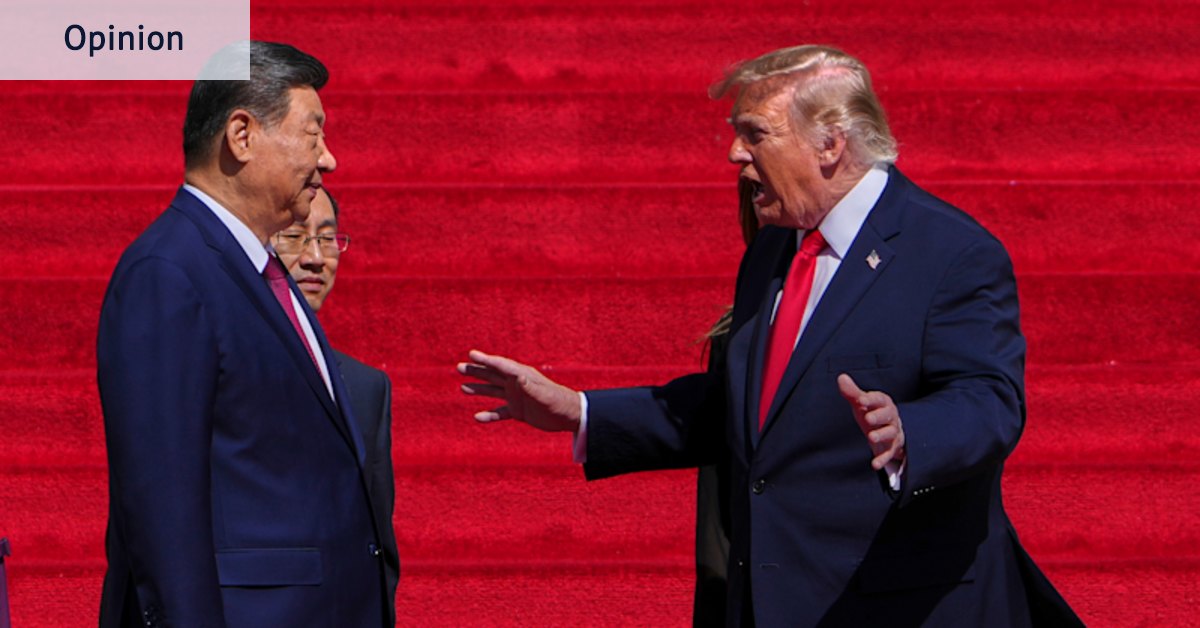
OpinionPolitical and international editorNovember 3, 2026 — 5:00amNovember 3, 2026 — 5:00amThe Chinese Communist Party’s internal discipline agency last week posed this question: “Why is there order in ‘China’ and disorder in the ‘West’?”The contrast between China’s big political event last week and America’s big political event this week could not be more stark. The fifth plenum of the party’s 20th Central Committee was choreographed down to the last bottle of black hair dye. The hundreds of committee members in their identikit suits stood in unison, clapped in unison, raised their hands to vote in unison.Donald Trump with Xi Jinping in Washington recently.AP Photo/Julia Demaree NikhinsonThe main item on the agenda? The need for rigorous discipline within the party – “to forge iron one must be strong oneself”. The vote in favour? Unanimous. And the cadres voted to “strictly implement democratic centralism”. Got that? Democratic centralism. You can have all the democracy you want so long as it’s centralised. In the form of Xi Jinping. All those against?The media coverage was every bit as varied, vibrant and enthralling. The 12 main Chinese daily newspapers all carried the identical two photographs across the top of their front pages, one a close-up of Xi Jinping looking statesmanlike, the other a wide shot of the members meeting in the Jingxi Hotel.Across the top of every paper was the identical headline: “The Communist Party of China has held the Fifth Plenary Session of the 20th Central Committee in Beijing”. And below was straight-faced reporting of the 4000-word plenum communique, including breakthroughs such as this: “It was unanimously agreed that the Central Committee with Comrade Xi Jinping at its core demonstrated tremendous political courage and a strong sense of responsibility …”As for America’s big political event, due on Wednesday, Australian time, I can do no better than to quote the opening sentences of my colleague Michael Koziol’s report of last week: “On Sunday, US President Donald Trump took a break from complimenting the buttocks of Republican senator Jon Husted to admire someone else’s.“‘I looked at one hell of a beautiful ass before – Nicki Minaj,’ [Trump] said of the well-endowed rapper, who attended the president’s rally in Michigan. ‘That’s hard to miss.’” Koziol noted, alongside the comic routine, the “more sinister matter” of “spiralling racism”.Coverage of the fifth plenum was remarkably consistent across China’s 12 main daily newspapers.It’s not just Trump. Americans are so inured to the open slather of their election system that no one seems terribly fussed about the fact that Elon Musk has so far pumped half a billion US dollars into the election in support of Republicans. Legally.The Electoral Integrity Project run jointly by Sydney and Harvard Universities found that “experts rated American elections as the worst among all Western democracies”, as Harvard’s Pippa Norris wrote. And that was in the age of innocence, 2012, pre-Trump.Since then, the deterioration has been wide and deep. Like the ramshackle system that allows gerrymanders every bit as rotten as the rotten boroughs of England, undemocratic affronts that England outlawed in the 19th century while its modern American analogue flourishes more blatantly than ever. Not to mention the endless campaign outrages, the multiplicity of efforts to disenfranchise inconveniently black voters, the wildly varied voting systems state-by-state.And the Chinese Communist Party didn’t need to look too far to find evidence of chaos in the streets of some European nations. Notably, the weekly violence in France and Italy which has now spread to Germany. No wonder the Beijing regime is feeling emboldened to offer itself as the model: “Looking around the world, full and rigorous Party self-governance in the new era has provided new experience for the world’s political parties in resolving governance problems and achieving flourishing parties and well-governed states,” boasted the Central Commission for Discipline Inspection.By contrast, some Western countries were “mired in internal attrition from partisan struggle”. As evidence of its rigorous self-governance, the party last week disclosed that it had purged 33 of its senior members and military officers. For foreign media, this was the big story to emerge from the fifth plenum. It was widely reported as the biggest purge of the party’s top rank in half a century.Xi’s purges are relentless and increasing. At the topmost rank, there were 376 full and alternate members of the party’s central committee three years ago. From the plenum’s roll call last week, we learned that 279 remain, meaning 97 have been purged. The higher the rank, the greater the penalties, including prison and suspended death sentences. Some simply disappear without trace.Xi’s permanent purge is notionally anti-corruption but essentially political. It’s especially sweeping in the military. Of the 47 military leaders who were generals in 2022 or promoted to that rank after 2022, Xi has purged or potentially purged 41, according to the China Power Project of the Centre for Strategic and International Studies. That’s 87 per cent.Absurdly, the seven-member Central Military Commission that rules the People’s Liberation Army is down to just two members – Xi himself plus a general who is not a military commander but a political enforcer. In other words, the military is overseen by two men who know nothing of warfare but everything about politics.“Xi, the poor bastard,” says the Australian sinologist Geremie Barmé. “He’s been in power 14 years, he’s purged all these people and he’s about to launch his ninth nationwide campaign of collective study and patriotism to strengthen the loyalty of the people.”Repression has reached ridiculous extremes. For instance, the party now prohibits criticism of its economic policies, a sure sign of widespread economic discontent. What’s next? Complaining about the weather?Barmé says the neverending rounds of purge and repression are a sure sign that the same political unrest afflicting the West is seething under the surface in China, too, especially among the young.“It’s all going on in China but it’s constantly being crushed by the biggest repression machine in the world, now AI-assisted.” All the accumulating problems of China’s system will have to be confronted eventually, he predicts.In truth, the clashing imagery of a roiling US and a prim China illustrate the fundamental strength of democracy. The advantage of democracy is not that it guarantees the best government possible but that it allows the bloodless removal of a bad one, as the Austrian philosopher Karl Popper observed.China under the dictatorship does not have such an option, which is why Xi must be permanently vigilant against the least crack in the facade lest he be removed bloodily.The US, for all the ugliness of its brawling political contestation, does have the option of bloodless removal of a bad government. On the proviso, of course, that Trump allows the system to work as designed.Peter Hartcher is political editor and international editor of The Sydney Morning Herald and The Age.Get a note directly from our foreign correspondents on what’s making headlines around the world. Sign up for our weekly What in the World newsletter.From our partners
China is a dictatorship. The midterms will prove if the US has also become one
Full Article
Original Source
Read the full article at Smh →KhanList aggregates and links to publicly available news content. We do not host full articles from third-party sources. Always verify important information with original sources.