
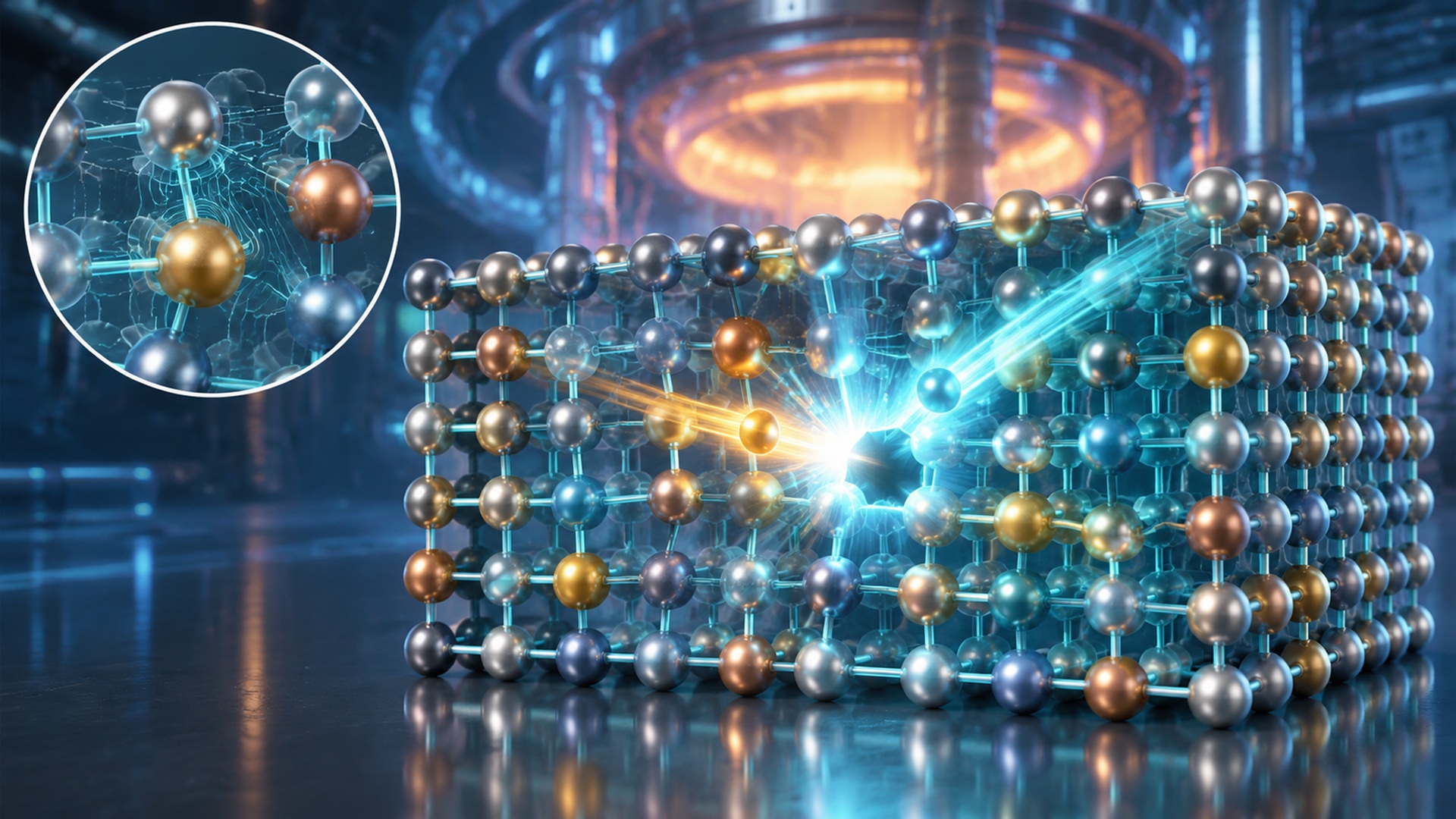
Researchers in China have reportedly identified a new way to develop self-healing metal alloys that could withstand radiation damage in nuclear and fusion reactors. The research was carried out by scientists from the Chinese Academy of Sciences (CAS) and Xi’an Jiaotong University in China’s Shaanxi Province. For the study, the team examined multi-principal element alloys (MPEAs), which have several metals as their main components. They found that tiny irregularities in the arrangement of atoms can influence how metals respond to radiation damage. This finding could make it easier to develop alloys capable of repairing damage at the atomic level. Guan Pengfei, PhD, a researcher at CAS’ Ningbo Institute of Materials Technology and Engineering (NIMTE), and lead author of the study, stressed that the findings could lead to stronger, longer-lasting materials for nuclear energy and aerospace. “This work offers a new path for designing radiation-resistant alloys for extreme environments,” Guan added. Multi-principal element alloys (MPEAs) are materials made by combining several metals, typically three or more, in nearly equal or moderate proportions, instead of relying on one base metal. They include medium-entropy alloys (MEAs), high-entropy alloys (HEAs), and compositionally complex alloys (CCAs). These alloys usually stand out for their strong mechanical properties, resistance to radiation damage, and flexibility in composition. They moreover show promise for applications where traditional metals may not perform well. However, developing them remains challenging, as scientists must examine how different combinations of elements behave when exposed to radiation. This, as a result, can involve a lot of calculations. Lattice distortion narrows the difference in vacancy and interstitial mobility, and promotes the recombination of irradiation-induced defects.Credit: NIMTE As per the team, radiation can displace atoms out of their normal positions inside a metal. This can lead to two types of defects, such as vacancies, where the atoms are missing from their usual positions, and interstitials, where the displaced atoms occupy spaces between other atoms. When these defects move through the material and meet, they could recombine, and potentially even repair some of the damage. The team found that a property known as local lattice distortion (LLD) plays an important role in this process. LLD refers to small shifts in atoms from their ideal positions within a crystal structure. Faster alloy discovery To further investigate the matter, the researchers created a high-fidelity machine-learning model that predicts interactions among atoms in zirconium (Zr), titanium (Ti), and niobium (Nb) alloys. It reproduced results from density functional theory (DFT) and outperformed conventional interatomic potentials. Simulations showed that greater local lattice distortion speeds up the movement of vacancies while slowing down interstitials. This reduces the difference in how quickly the two defects move, and makes it easier for them to recombine. The researchers also confirmed similar behavior in vanadium-cobalt-nickel and nickel-palladium alloys. This suggested that the effect applies to different metal combinations. At the same time, the scientists developed composition–structure that show how alloy composition affects atomic structure. These could identify materials where defects can more easily recombine and repair radiation damage. “We can now screen candidates without expensive calculations for every composition,” Guan concluded in a press release. The study has been published in the journal PNAS on November 20. Get the latest in engineering, tech, space & science - delivered daily to your inbox.Based in Skopje, North Macedonia. Her work has appeared in Daily Mail, Mirror, Daily Star, Yahoo, NationalWorld, Newsweek, Press Gazette and others. She covers stories on batteries, wind energy, sustainable shipping and new discoveries. When she's not chasing the next big science story, she's traveling, exploring new cultures, or enjoying good food with even better wine.
China eyes self-healing, radiation-resistant alloys for nuclear and fusion reactors
Full Article
Original Source
Read the full article at Interestingengineering →KhanList aggregates and links to publicly available news content. We do not host full articles from third-party sources. Always verify important information with original sources.