
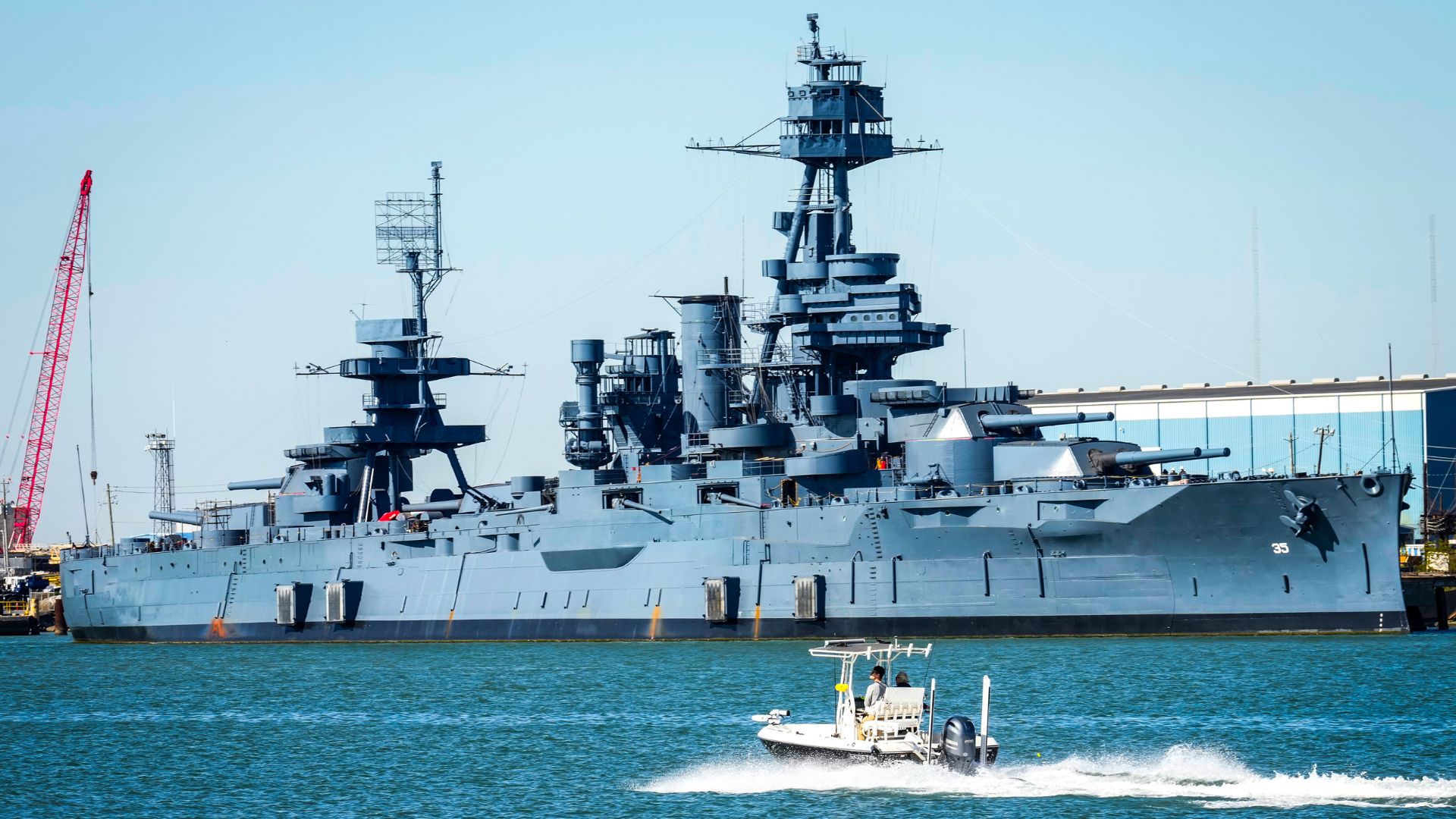
Donald Trump’s proposed battleship fleet has drawn plenty of ridicule. Now, an unexpected voice from China is giving one part of the concept serious consideration. Chinese military scientists argue that large naval guns could help ships defend against drone swarms. Their study focuses on using explosive shells to scatter fragments across a wide area. The idea echoes a debate unfolding in the US Navy. Modern warships rely heavily on missiles, lasers and other advanced systems. Yet cheap drones could force navies to reconsider how they spend ammunition against mass attacks. China tests anti-drone artillery Wang Lei and his team examined how large-caliber guns could attack groups of small unmanned weapons. Their model treats the shell as an area weapon instead of a single-target projectile. The researchers used 30 Russian-made Lancet-3 loitering munitions in their scenario. Each drone weighs roughly 26 pounds and can carry a payload of up to 6.6 pounds. One shell in the model produced 2,000 fragments. The researchers estimated that 1,589 fragments could inflict damage. Their calculations produced a 3.95 percent chance of damaging any individual drone. Across the 30-drone swarm, one shell could therefore damage about 1.19 drones. The model assumed a fragment cloud extending 49 feet around the explosion. That assumption gives the gun a way to engage several drones without scoring a direct hit. Guns could complement lasers The researchers did not present artillery as a standalone solution. They pointed to detection and tracking as crucial parts of the system. Fire-control technology would also need to guide each shot accurately. Programmable fuses could help shells burst at the right point near an incoming swarm. The team also proposed combining naval guns with electronic warfare and laser defenses. Such an approach could create multiple defensive layers around a warship. That concept matters because drones can impose an awkward cost exchange. A relatively cheap unmanned weapon can force defenders to consider expensive interceptors. Trump battleship faces questions Trump’s proposed Golden Fleet includes the new Trump-class battleship. The design calls for nine large naval guns alongside extensive missile capacity. The ships would also carry electromagnetic weapons under the proposed design. Critics question whether such a massive platform makes sense against modern missiles and unmanned threats. Military analysts have long warned about battleship vulnerability. Aircraft, submarines and missiles have repeatedly challenged large surface combatants. China’s defense community also remains skeptical about the gun concept. One weapons specialist dismissed the study as a promotion-driven paper. The specialist said the research failed to prove that large-caliber guns could reliably defeat drone swarms. The US Navy reportedly plans 15 Trump-class battleships between 2028 and 2056. Funding and shipbuilding capacity could still derail those plans. Congress removed program funding from a pending Senate appropriations bill. US shipyards also face labor shortages that could complicate construction. That leaves the bigger question unresolved. Can enormous guns become economical drone defenses, or would they create another expensive answer to a cheap threat? The study was published in the Chinese peer-reviewed journal Command Control & Simulation. Get the latest in engineering, tech, space & science - delivered daily to your inbox.Aamir is a seasoned tech journalist with experience at Exhibit Magazine, Republic World, and PR Newswire. With a deep love for all things tech and science, he has spent years decoding the latest innovations and exploring how they shape industries, lifestyles, and the future of humanity.
China backs Trump’s battleship plan, claims large-caliber guns can counter drone swarms
Full Article
Original Source
Read the full article at Interestingengineering →KhanList aggregates and links to publicly available news content. We do not host full articles from third-party sources. Always verify important information with original sources.