
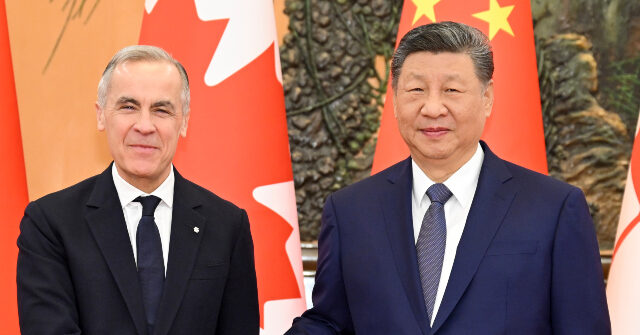
China and Canada agreed to lower tariffs on each other’s goods, including Chinese relief for Canadian pork and seafood and Canadian reductions on steel and aluminum. Carney discussed energy cooperation and a higher quota for Chinese EVs, repeating his threat that Canada could seek auto partnerships beyond the United States. Canadian critics warned China cannot replace the U.S. market and said Carney should prioritize security, human rights, and relations with Washington. Chinese dictator Xi Jinping and Canadian Prime Minister Mark Carney met in Shenzhen, China, on Tuesday and agreed to more bilateral tariff relief and trade concessions, trading lower Canadian tariffs on Chinese steel and aluminum for lower Chinese tariffs on Canadian products. Xi and Carney were in Shenzhen for the Asia-Pacific Economic Cooperation (APEC) summit, which will be held on Wednesday and Thursday this week. President Donald Trump is attending the summit, where he is scheduled to hold his first trilateral meeting with Xi and Russian President Vladimir Putin. Canadian officials said on Tuesday they did not expect Carney to meet with Trump at APEC – or with Putin, given Canada’s support for Ukraine against the Russian invasion that began in 2022. Xi previously met with Carney in Beijing in January. After that meeting Carney said China was becoming a “more predictable” trading partner than America, and Canada went on to break from U.S. trade policy by lowering its tariffs on Chinese electric vehicles (EVs). China rewarded Carney by lowering its heavy tariffs on Canadian food imports, paving the way for the further trade deals announced by Xi and Carney on Tuesday. China’s new concessions to Canada include lower tariffs on $280 million in pork and seafood imports. Canada agreed to reduce its tariffs on steel and aluminum products, and other items where Canada’s supplies are “insufficient or unsustainable.” According to Carney’s office, the Canadian prime minister also discussed “opportunities to deepen cooperation in clean and conventional energy” with Xi, including a higher Canadian import quota for the tidal wave of cheap Chinese electric vehicles (EVs) looming over the Canadian auto industry. Carney said on Monday that Canada was prepared to turn away from its long partnership with the United States on automobiles if trade negotiations with President Donald Trump did not produce a satisfactory outcome. He named China, Japan, and Europe as possible new partners for Canadian auto manufacturing. “Canada and China have recalibrated our relationship to the benefit of citizens in both countries,” Carney said in a statement released on Tuesday. “We have unlocked billions in new export orders for Canadian farmers, ranchers, and fish harvesters – for workers and businesses across the country. We’re making it easier to travel, study, and do business between our nations to create more opportunity and prosperity for all,” he said. “Canada is building our strength at home and diversifying our relationships abroad so that we have the freedom to live our lives as we choose,” he asserted. “The development of Chinese-Canadian relations over the years has provided us with an important lesson. We must respect each other, pursue equality and mutual benefit and seek common ground while setting aside differences,” Xi said at the beginning of his meeting with Carney. Tasha Kheiriddin of Canada’s National Post on Tuesday chided Carney for pretending China could replace the United States as a trade partner. “The country may be the world’s second-largest economy, but its consumers have relatively little spending power, its government has a dismal human rights record, and its economic ambitions don’t stop at selling Canadians cheap electric vehicles,” she said of China. Kheiriddin pointed out that China’s “notoriously frugal” consumers spend about one-sixth as much as the average American household, so they simply cannot afford to buy everything Canada has been selling to Americans, and China’s cheap goods come with huge moral strings attached, including ethnic repression and slave labor. Another Canadian skeptical of the budding bromance between Xi and Carney was Michael Kovrig, the former diplomat held hostage by China to secure the release of Chinese Communist Party aristocrat Meng Wanzhou from Canadian custody in 2021. Kovrig told CBC News on Tuesday that relations between Canada and China are “not back to normal, and they shouldn’t be.” “There are definitely some potential benefits. The challenge is to make sure that the benefits don’t come with bigger and more problematic downsides,” he said, noting China’s tendency to use tariffs and other trade leverage to compel smaller countries like Canada to cooperate with Beijing’s policy agenda. “The readout doesn’t say anything about national security or transnational repression or human rights issues or about Canadian detainees in China. They should also be a priority along with market access,” he said. Kovrig and Kheiriddin both said Carney should be careful not to alienate the United States by throwing himself at Xi Jinping. President Trump’s trade adviser Peter Navarro warned on Monday it was “offensive in the extreme” for Carney to “play China off the United States” to get a better trade deal. “You have to put Washington first. I know that’s not a popular idea in Canada right now,” Kovrig said.
China and Canada Agree to Lift More Tariffs
Full Article
Original Source
Read the full article at Breitbart →KhanList aggregates and links to publicly available news content. We do not host full articles from third-party sources. Always verify important information with original sources.