
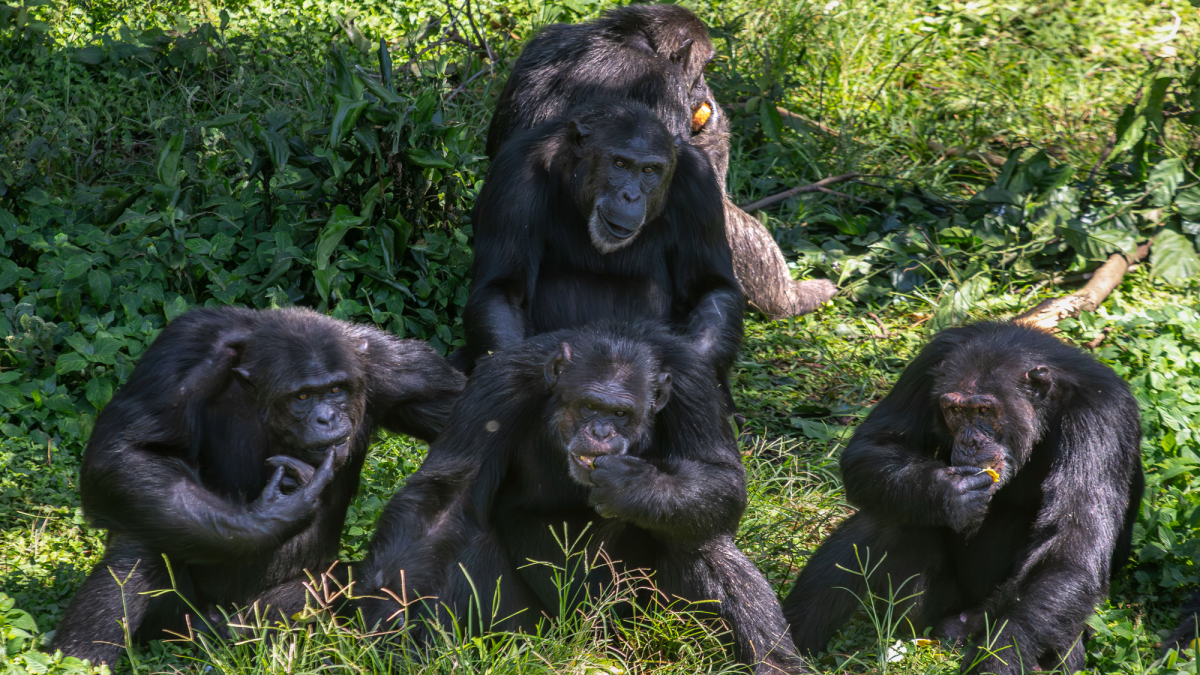
A group of chimpanzees feeding together in a natural forest environment on Ngamba Island, Uganda. Image: Thomas Roell via Getty Images How likely is a chimpanzee (Pan troglodytes) to steal food from another chimp? It depends on whether they’re a friend or a foe. A team of biologists discovered that chimps pilfer less from their friends, and that the relationship between the victim and the thief influenced the emotional display of both parties. The findings are described in a study recently published in the journal Evolution and Human Behavior. The team conducted experiments with chimpanzees from Uganda’s Ngamba Island Chimpanzee Sanctuary. But first, they had to figure out who was “friends” with whom. Scientists sometimes avoid describing a seemingly close relationship between chimps as similar to human friendship. According to study co-author and University of California, Berkeley Oded Ritov, we can’t truly understand their cognitive and emotional complexity, and we run this risk of putting our human ideas and emotions onto other species. But we are starting to see that animals also form friendships. To identify apparently close relationships, the team observed 26 chimpanzees at the sanctuary for over 800 hours. They noticed grooming patterns, daily interactions, and how routinely the animals were physically close to each other. Next, the team set up two rooms: one room had three trays of pineapple pieces connected to a rope that could be pulled from the other room. The “victim” chimp was in the room with the pineapple, while the “thief” chimp was in the other room, where he or she could choose to steal the pineapple by pulling on the rope. Chimps stole from non-friends 70 percent of the time, and from friends 61 percent of the time. Nine percent might not seem like a huge difference, but the fact that each chimp was put in both friend and non-friend conditions gave the authors greater confidence that the difference is significant and not due to chance. The study is the first to demonstrate that chimpanzees can resist antisocial behavior with friends, Ritov said. Ritov and his colleagues also gauged the victims’ response to thievery by judging their stomping, fist-pounding, and screeching. They found that while victims were initially more upset when friends stole from them, they calmed down rapidly in comparison to when non-friends were the thieves. They also noticed that the thieves’ behavior shifted as well. Those stealing from non-friends displayed negative emotions for a significantly longer period of time, which indicates that they considered the interaction more hostile. “This suggests that there may be mutual expectations in chimps from both sides of the friendship, which makes it seem more like the complex friendships we see in humans,” Ritov explained. Researchers have previously demonstrated relation-specific intentions in nonhuman primates, explained Berkeley psychologist Jan Engelmann, a senior author of the study. But human friendships are about stronger expectations, not just special intentions. “We expect more of our friends,” he explained. “These findings really deepen our understanding of the evolutionary roots of friendships,” Englemann added. “These kinds of social expectations might form the basis of human moral principles.” What’s more, “we think that these expectations might be the basic building blocks of the larger-scale cooperation we see in humans,” Ritov said. “The expectations that chimpanzees have from their friends or close collaborative partners might have scaled up to more generalized expectations for how we should treat each other.” 2026 Popular Science Home of the Future Awards 39 products that will improve your everyday life.
Chimpanzees steal less pineapple from their friends
Full Article
Original Source
Read the full article at Popsci →KhanList aggregates and links to publicly available news content. We do not host full articles from third-party sources. Always verify important information with original sources.