
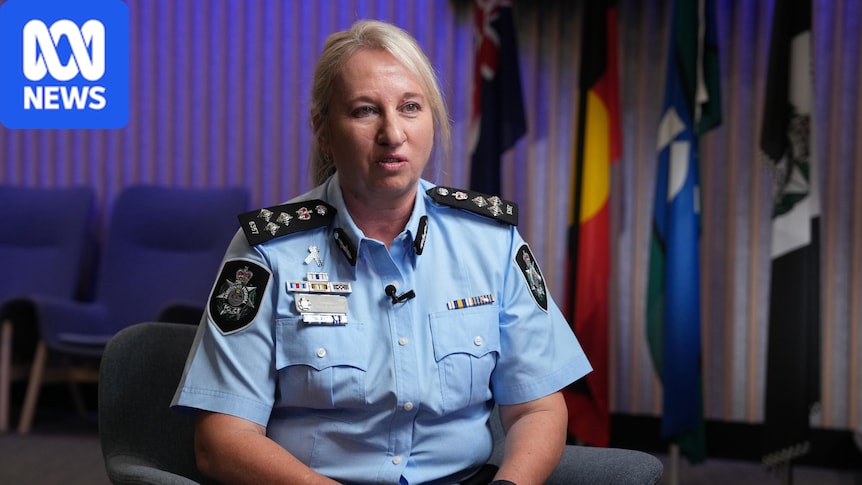
Australian Federal Police are warning of an explosion in the number of children being radicalised online, with new figures revealing minors account for 40 per cent of all active joint counterterrorism cases this year.AFP Counterterrorism Commander Paula Hudson told the ABC the vast majority of children charged with counterterrorism offences since 2020 had been prosecuted in the past two years."Recently we're seeing a spike in our youth caseload which is really concerning for us," she told the ABC. "To paint that picture, since 2020 we've had to prosecute 37 youth for counterterrorism offences — now that's really the most serious offences that you can get. Thirty-two of that 37 have been prosecuted and arrested in the last two years."The warning comes after two children — a boy and a girl — were charged with terrorism-related offences in Darwin last week for plotting to carry out a mass casualty event.Police say the incident serves as a critical wake-up call for parents and educators regarding early intervention.Rapid online exposureAddressing how children are being drawn into extremism, Commander Hudson called on parents and local communities to help turn the tide, warning that children were being radicalised at breakneck speeds across mainstream platforms including TikTok, Instagram, Discord and Roblox."There are multiple rabbit holes that the internet has where our youth are being dragged and siphoned into and being exposed to violent extremist material," she said. "Research tells us that it only takes 23 minutes before a youth would be provided violent extremist material once they go online."Asked whether the government's ban for under-16s, which came into effect in December 2025, had aided law enforcement efforts, Commander Hudson noted that caseloads had continued to rise regardless."Well, the spike has occurred in the last two and a half years for our counterterrorism caseload," she said."Our own research shows that of our 55 caseloads involving 12- to 17-year-olds, every single youth was radicalised in whole or part online."So the online environment has a role to play in some form or another in our youth radicalisation."While social media was accelerating the problem, Commander Hudson noted that legislative tools passed in 2024 had been "very, very helpful" in allowing police to step in earlier and prosecute radicalised individuals.The powers enable police to investigate and prosecute people who access or share violent extremist material online, without needing to prove they have been actively planning a physical terrorist attack."The violent extremist material legislation from 2024 has enabled us to intervene and disrupt much earlier in the radicalisation pathway," she said.What is particularly troubling police is how rapidly that digital exposure is converting into real-world danger."Unfortunately by the time it involves the joint counterterrorism teams and we actually do intervene and go through the door, we are finding they've gone much further down the pathway than just online offences of terrorism," Commander Hudson said."The majority of cases involve other more serious terrorism offences, such as collecting documents, writing manifestos, selecting targets, procuring survival kits and mobilising towards planning violent acts."The pathway from the online world to making plans to act out in the real world is happening a lot faster than what we think."When it comes to the types of extremist content that minors are consuming, Commander Hudson said there was often no one clear ideology and content could blend Islamic extremism with neo-Nazism and nihilism.The risk profileCommander Hudson warned that young people falling into extremist rabbit holes often shared common vulnerabilities, including unstable home lives, difficulties at school, lack of social connection or may be navigating neurodiversity."Most, not all, of our caseload are lacking the protective elements [such as] home, parenting, school, sports and community groups," she said."That's what provides our youth with resilience and those factors are lacking. They are also spending extreme amounts of time online, unsupervised, so that is what draws our youth into the vulnerability of the online world."As for the warning signs, Commander Hudson is urging parents, teachers and community leaders to act as the first line of defence and watch out for children spending large chunks of time online, using hateful speech toward a specific group or becoming withdrawn."That's excessive time spent online, it's a change in rhetoric where their language might change and be more fixated and emotional about social issues… Those are the signs you need to be looking out for," she said. "Reducing time with friends in the real world or withdrawing from family."Commander Hudson is encouraging young people to share their concerns with people and not chatbots amid reports that more and more children are turning to artificial intelligence and not their parents to disclose instances of harm."If you are experiencing online harms or you want to research contentious issues or polarising issues in society, the message is, please reach out to a person and seek alternative views," she said."Nothing is too difficult that we can't work our way through safely to get you out of a situation."Authorities are encouraging parents to establish online safety plans and seek early support through pathways like StepTogether, or report immediate concerns to Crime Stoppers and the National Security Hotline.Meanwhile, law enforcement is pushing for systemic fixes.AFP Commissioner Krissy Barrett has met directly with Big Tech executives this year to share police insights, advocate for "safety by design" algorithm controls, and collaborate on shared solutions to slow the rate of online radicalisation.
Children make up 40 per cent of active counterterrorism cases, AFP warns
Full Article
Original Source
Read the full article at Abc →KhanList aggregates and links to publicly available news content. We do not host full articles from third-party sources. Always verify important information with original sources.