
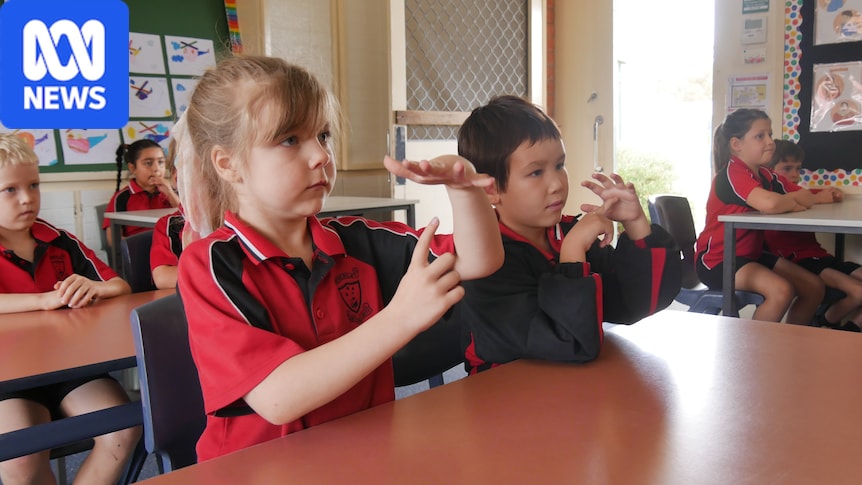
Inside a classroom in regional Western Australia, students are so quiet they could hear a pin drop.The lack of audible chatter is not a reflection of the communication taking place.The silence is the sound of focus and concentration while learning a language.Angela Linfitt provides resources for Beverley District High's classes. (ABC Midwest and Wheatbelt: Eliza Bidstrup)Students are taking part in Auslan classes, a program that has fast become the favourite subject of students at Beverley District High School, 120 kilometres east of Perth.Students from pre-primary to year 8 take part in up to two Auslan classes a week under the guidance of hearing teacher Isabel Freeman.And they are not alone, with statistics from the Department of Education showing nearly 130 public schools in the state now teach Auslan.Four years of learningMs Freeman began sharing her Auslan knowledge by chance while working at the school as a secondary English and HASS teacher."We had a non-verbal student at the school, and I was teaching her Auslan," she said."And when the Italian teacher retired, because Italian was our Language Other Than English, the school asked me if I would like to teach Auslan."Isabel Freeman has been teaching Auslan at Beverley District High School for four years. (ABC Midwest and Wheatbelt: Eliza Bidstrup)Ms Freeman said that as a hearing Auslan teacher, the consultation of her Auslan mentor and qualified Deaf teacher Angela Linfitt meant teaching was culturally appropriate and considered."It makes it more authentic," she said.Ms Linfitt has mentored Ms Freeman throughout her Auslan teaching, and said the expansion of Auslan in schools created more career opportunities for deaf professionals.Angela Linfitt has helped shape the Beverley District High School Auslan program. (ABC Midwest and Wheatbelt: Eliza Bidstrup)"It's critical [to have deaf mentoring] because deaf people are professionals, they are specialists of their own language," Ms Linfitt said."It's really important to have [deaf people] involved in the program to make sure it's being taught correctly."In WA, school-based Auslan teachers are required to hold a teacher's registration and be trained in Auslan, requirements Ms Linfitt said could rule out members of the deaf community."Unfortunately there isn't enough funding at the moment for deaf people to be involved in those roles," she said."It can be very difficult to go to university for a deaf person, they face many barriers."We need additional support to access services and get through that system."Creating an inclusive environmentBethel Fraser says she enjoys sharing the language with others. (ABC Midwest and Wheatbelt: Eliza Bidstrup)Student Bethel Fraser sits front and centre during her Auslan class, eagerly repeating back words and phrases.She said she enjoyed sharing her skills with others."In Auslan we can teach other people around us so that soon everybody knows Auslan so we can communicate with the deaf," she said.There is one child enrolled at the school with a diagnosed hearing impairment.Wendy Norris has seen Auslan skills applied outside the classroom. (ABC Midwest and Wheatbelt: Eliza Bidstrup)Beverley District High School principal Wendy Norris, who joined the school earlier this year, said she was amazed at how engaged students were with the program."It allows our students to be inclusive in the community as well," she said."It's not just something they do in the classroom."They can take these skill sets as life skills to be able to communicate with all people from all cultures and all diverse populations."Students at Beverley District High School have been learning Auslan over the past four years. (ABC Midwest and Wheatbelt: Eliza Bidstrup)Students from the school have previously attended the Beverley Frail Aged Lodge where they taught residents everyday signs."The children loved it because they were the real experts teaching the older generation," Ms Freeman said.She said learning Auslan was accessible to all students, with lessons differing from traditional classes."'I feel I have the best job in the world because the students are so enthusiastic, they want to learn," Ms Freeman said."It's a level playing field so they're not having problems reading or writing or doing maths."Everybody can enjoy it and everybody can learn and everybody can have success."
Children enjoy learning how to communicate with deaf people
Full Article
Original Source
Read the full article at Abc →KhanList aggregates and links to publicly available news content. We do not host full articles from third-party sources. Always verify important information with original sources.