
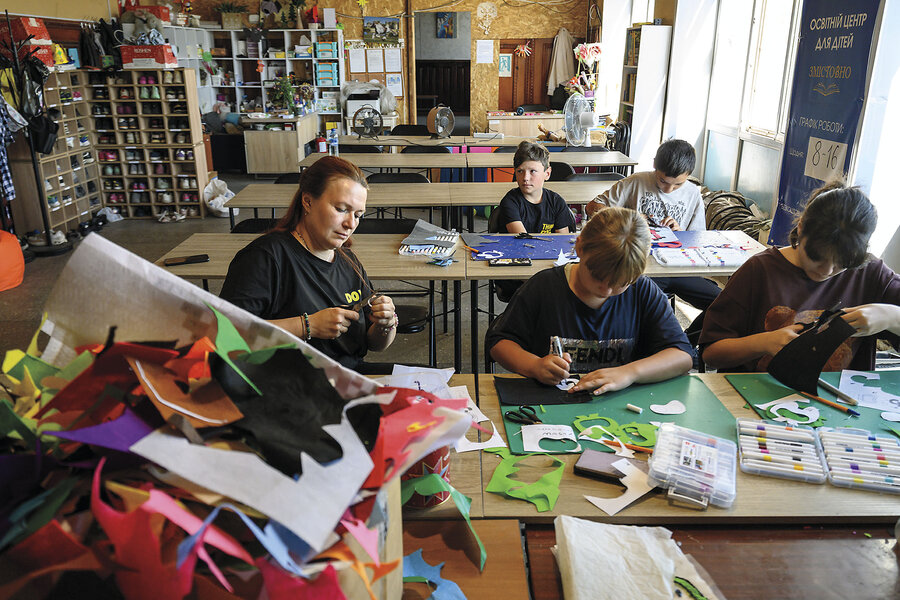
On a walk with a friend along Lake Ontario in Toronto, I shared that our war correspondent, Scott Peterson, had pitched another trip to Ukraine. Scott had visited the country 12 times since Russia’s full-scale invasion began on Feb. 24, 2022. And, as I told my friend, I was trying to figure out how, after 4 1/2 years of war, we could write about Ukraine in a way that made readers continue to care.My friend stopped in her tracks. “Over four years of war? That’s someone’s entire high school experience,” she said. One of her sons had recently finished his senior year. “I can’t even imagine.”Her comment stayed with me as Scott and I discussed how he would approach his assignment. Scott had proposed going back to find some of the people he had met over the course of the war, to see what had become of them. My friend’s comment made me wonder: Could we write a story about Ukraine looking at the passage of a young person’s life?We asked Ryan Brown, an editor on our desk who loves narrative journalism, to work with Scott on this idea. Ryan is our Africa editor, but she frequently ventures into magazine stories from around the world and has a gift for bringing people to life on the page and knitting disparate stories around a common thread.“When Sara told me this story was about coping and what it means to live in a state of seemingly permanent war,” Ryan wrote to Scott before he headed to Ukraine, “the first thing I thought of was children. There are so many young people in Ukraine who either remember nothing before this war or for whom it has been the backdrop to a huge and formative part of their childhoods.” The statistics are staggering: 2.6 million children are displaced. Some 40% of Ukrainian children ages 3 to 6 do not attend preschool. And perhaps the hardest number of all: 1 in 5 children in Ukraine has lost a relative or friend.Numbers that large can become difficult to comprehend until you reduce them to individuals.That’s why Scott went back to visit Olesia Biliaha, an instructor at a community center’s charity arts, dance, and computer program in Izium. Her joy in teaching offers children an escape from a war that has trained them to reflexively head for safety when air-raid sirens sound. He returned to see Yulianna Palahniuk, from Vinnytsia, who learned on her 6th birthday, in May 2022, that her father had been killed in combat. And there was also Serhii Yeroshenko, who was a toddler when his family had to flee their hometown and start anew elsewhere. Deepen your worldviewwith Monitor Highlights.Politics with respectGet political stories with respectful analysis.There‘s a world of new ideas in everyBooks newsletter.There‘s more to life, enrich yours withCulture & Learning weekly.Follow humanity‘s discoveries withScience & Nature stories in your inbox.Gain a spiritual perspectivefrom the stories in your inbox.Want to understand the deeper impact of critical events? Learn the Monitor‘s insight.Already a subscriber? Log in to hide ads. The result isn’t light reading.But I hope you’ll read it. For children, 4 1/2 years can pass relatively quickly. For a child, that length of time can be an entire stage of life. ALREADY A SUBSCRIBER? LoginReal news can be honest, hopeful, credible, constructive.The Christian Science Monitor was founded in 1908 to lift the standard of journalism and uplift humanity. We aim to “speak the truth in love.” Our goal is not to tell you what to think, but to give you the essential knowledge and understanding to come to your own intelligent conclusions. Join us in this mission by subscribing.
Childhood in wartime
Full Article
Original Source
Read the full article at Csmonitor →KhanList aggregates and links to publicly available news content. We do not host full articles from third-party sources. Always verify important information with original sources.