
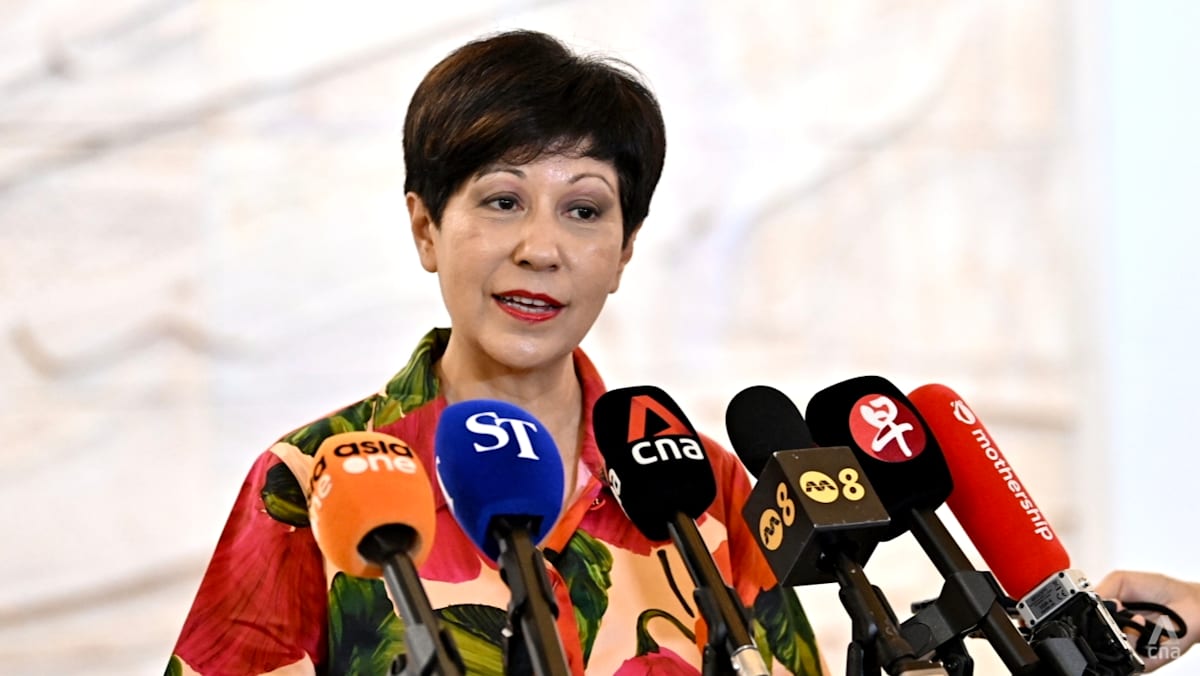
Singapore The government is still ironing out the implementation details with employers and the unions, said Ms Indranee. Minister in the Prime Minister's Office Indranee Rajah, speaking to media on the update of the Marriage and Parenthood Reset Workgroup at D'Marquee, Downtown East on Aug 15, 2026. (Photo: CNA/Raydza Rahman) New: You can now listen to articles. This audio is generated by an AI tool. 02 Sep 2026 05:22PM (Updated: 02 Sep 2026 05:29PM) SINGAPORE: Changes to Singapore's childcare leave scheme will take "at least several months" to kick in, as the government prepares legislative amendments and works through the operational details with employers and unions, Minister in the Prime Minister's Office Indranee Rajah said.Speaking in a CNA938 radio interview that aired on Wednesday (Sep 2), Ms Indranee, who chairs the inter-agency Marriage and Parenthood Reset Workgroup, said that there are “a few things” that need to happen before more childcare leave can be implemented, including amendments to the Child Development Co-Savings Act that will take time to legislate.“Operational issues” need to be worked out with employers, the unions and parents “just to make sure that we get all the details tied down”, she said.Prime Minister Lawrence Wong announced during his National Day Rally speech on Aug 23 that each parent will get eight, 10 or 12 days of leave a year if he or she has one, two or three or more children respectively. This is up from the current six days of leave a year for each parent with children aged six and below, or two days a year if the children are between seven and 12 years old.When asked about concerns that the enhanced leave could cause workload issues for employers and non-parents, Ms Indranee said that the leave situation at workplaces is generally a “very tight” one.“If one person is out of play, somebody else has to step in, bear the load, or you have to scramble to find somebody to cover,” she said.Ms Indranee said the government has done “step one”, which is to cover the costs of the childcare leave.This means that the employer now has the additional cash in hand which they can use to pay those colleagues who are covering for the parent who is taking childcare leave, or to be able to hire somebody else to cover, she said. EASIER SAID THAN DONEHowever, she added that implementing more childcare leave is “easier said than done”.Even if the details are ironed out, the implementation cannot be immediate as childcare leave is provided for in legislation. That means that amendments to the Child Development Co-Savings Act have to be proposed, debated and passed in parliament first, before the amended law comes into force, she said.Ms Indranee added that there will also be IT systems that need to be updated to properly track parents who go on childcare leave, so as to ensure that employers are reimbursed the correct amount.“It's going to take at least several months … these are the things that have to take place first, and we will announce the start date as soon as we can,” she said.In the meantime, she exhorted workers to play their part to give sufficient notice to their employers before taking leave, whether to care for children or for their own aged parents.For employers, she said having contingency arrangements should be part and parcel of normal HR policy.“For example, the job sharing or flexi work arrangements would be helpful,” she said. “In fact, the flexi work arrangements part can benefit anybody - not just parents, but anybody who needs to take time off for unexpected contingencies.” HOW THE GOVERNMENT ARRIVED AT S$70,000Prime Minister Wong also announced during the National Day Rally that every Singaporean child will receive almost S$70,000 (US$55,140) in direct financial support by the time they turn 17.This sum includes a S$10,000 baby gift, top-ups to the Child Development Account, Child Credits of S$2,000 a year until the child turns 16 and a Post-Secondary Education Account top-up of S$10,000. Ms Indranee said that when the government was deciding on the size of the package, it looked at the “essential costs that families typically face as a child grows”.The costs include food, utilities, healthcare, preschool and education.She added that the intention was not to cover “every single expense” but to give additional support to parents and families, noting that “the expenditure varies depending on their circumstances and their choices”.“But what we wanted to do was to make sure that there was enough support to defray essential expenses while at the same time remaining fiscally sustainable,” she said.“Parents can use the support across the child's different stages, whether it's for childcare, preschool, healthcare, education, or everyday expenses.”Ms Indranee also gave further details of how the package will be disbursed. Children born in 2026 will receive the full package and all its components, while those born from Feb 14, 2023 to Dec 31, 2025 who are still receiving the Baby Bonus Cash Gift payments under the existing scheme will receive a top-up, bringing their total Baby Bonus Cash Gift to S$10,000. The Child Credits are to be paid annually on the child’s birthday, said Ms Indranee. However, because the Ministry of Social and Family Development (MSF) needs time to update its systems and transition from the Baby Bonus and Large Families schemes, payments will only begin in April 2027.Eligible children will receive their 2026 Child Credits retrospectively by Apr 30, 2027.Children with birthdays from January to April will receive their 2027 credits by Apr 30, 2027, and those with birthdays from May to December will receive them on their birthdays, said Ms Indranee."MSF will notify the families in due course, so you don't have to do anything for now," she said. Reiterating Mr Wong's remarks at the National Day Rally, she said the almost S$70,000 sum was positioned as a support measure, and not an incentive.“When we did our focus group discussions and we spoke to parents, it is quite clear that there are an entire range of factors that affect the decision on whether to marry and to have children,” she said.Cost, personal aspirations, time spent with children and work-life balance were among the factors raised.“So there's a whole range of things, and our approach this time is not about incentives; it's about understanding that different people have taken into account different considerations,” she said.“What we really want to do is to ensure that all Singaporeans who want to marry and have children feel assured and confident and able to do so, knowing that the government has their back, knowing that the government is willing to give support.”Ms Indranee added that there are still areas that are being worked on, such as enhancing matchmaking opportunities, improving fertility and maternal health, and changing workplace norms and culture.Asked what success would look like for these parenthood measures, Ms Indranee said that it would be “a Singapore where marriage and parenthood are seen as sources of joy and strength, and where the Singaporeans who aspire to them feel confident and assured in doing so”.She added that success would also be a society where marriage and parenthood are valued and supported, and practical barriers to them are reduced, so that the parents' lived experiences are improved.“And over time, of course, we definitely hope to see an improvement in Singapore's total fertility rate,” she added. Singapore has rolled out successive measures aimed at making parenthood easier. They were announced by Prime Minister Lawrence Wong at the National Day Rally on Aug 23. But even as support grows, the Total Fertility Rate continues to fall. CNA speaks to Minister in the Prime Minister's Office Indranee Rajah. She heads the National Population and Talent Division that oversees the Marriage and Parenthood portfolio.
Childcare leave changes to take 'at least several months' to implement: Indranee Rajah
Full Article
Original Source
Read the full article at Channelnewsasia →KhanList aggregates and links to publicly available news content. We do not host full articles from third-party sources. Always verify important information with original sources.