
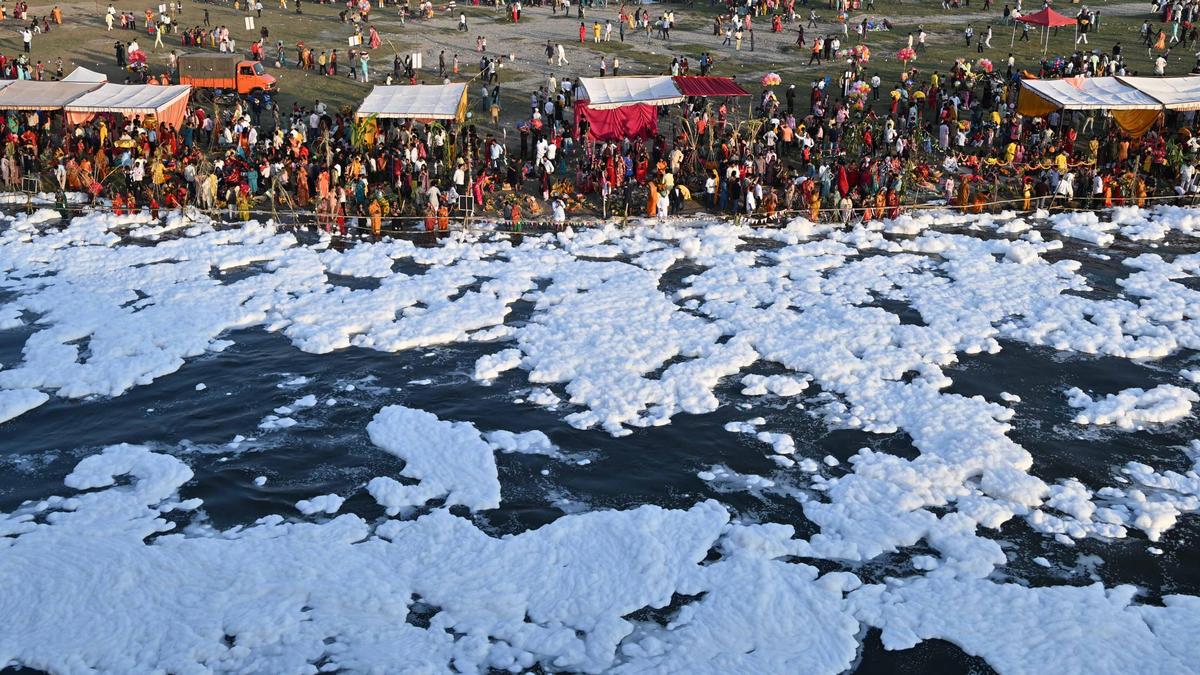
Despite the political slugfest over the Yamuna during yet another Chhath Puja, official data show that the river’s Delhi stretch remains heavily polluted for most of the year, with water quality improving during the monsoon, when floodwaters flush out pollutants.According to official data, the faecal coliform level (microbes from human and animal excreta) in the Yamuna at Asgarpur, where the river leaves the Capital, was 660 times the Central Pollution Control Board (CPCB) desirable limit for bathing water quality in May, before the monsoon. The water quality improved in September, as it does every year after the monsoon. The Delhi government has yet to make the October data public.Religious significanceThe Yamuna holds religious significance for people from Purvanchal (residents of eastern Uttar Pradesh and Bihar), who constitute a significant voter base in Delhi. Many observe Chhath Puja by taking a dip in the river.Scores of devotees offered prayers at Kalindi Kunj in south Delhi on Sunday evening, standing knee-deep in the river as toxic froth floated on the water — a familiar sight during Chhath Puja.Since the Bharatiya Janata Party (BJP) came to power in February 2025, an ambitious plan to divert water from the Ganga to flush out pollutants from the Delhi stretch of the Yamuna has been under discussion. However, it has yet to yield any concrete results.The proposal formed part of a broader plan to clean the river, which was presented to Prime Minister Narendra Modi in April last year. Following his approval, Union Home Minister Amit Shah has held several review meetings on the plan, according to sources.“Even if the plan is finalised, it will take about two to three years for Ganga water to reach Delhi. A detailed project report (DPR) has been submitted to the government, but it will be hard to give a deadline to the project at this time,” an official told The Hindu, requesting anonymity.Under the current plan, the government proposes to divert about 500 cusecs of Ganga water from the Upper Ganga Canal (UGC), the largest canal carrying Ganga water through western Uttar Pradesh, into the Delhi stretch of the Yamuna at Wazirabad.This is the second Ganga water diversion plan being considered by the Delhi government, after the initial proposal was dropped following objections from its counterpart in Uttar Pradesh, according to officials.Addressing the issueExperts have long maintained that cleaning the river requires both increasing its flow and curbing the sources of pollution entering it. To address the latter, Mr. Shah, after chairing a review meeting on the Yamuna clean-up plan in July last year, directed the Delhi government to nearly double its sewage treatment capacity to 1,500 MGD by 2028.To augment sewage treatment capacity, the government this year awarded contracts for the construction of 29 decentralised sewage treatment plants (DSTPs). The plants are targeted for completion by January 2028. However, a Delhi Jal Board (DJB) official said, “All 29 of them are estimated to be completed by January 2028, and some of them will be finished even before this. The construction of the sewer network for these DSTPs is expected to be completed by June 2028.”Crucial roleDSTPs are considered crucial to cleaning the Yamuna, as they are expected to treat sewage generated in several unauthorised colonies that currently flow into the river because of the lack of sewer networks.The DSTP work has been pending for years, with the non-availability of land emerging as a major hurdle. The issue was compounded by a tussle between the previous Aam Aadmi Party government in Delhi and the BJP-led Centre, as much of the required land is under the Centre’s control.“Other projects are under way to increase the treatment capacity of sewage and all of them are expected to be completed before December 2028. It will definitely improve the water quality,” the above-cited official said.Cleaning the Yamuna was one of Mr. Modi’s key promises in the lead-up to the 2025 Delhi Assembly election, which the BJP won after 27 years.This year, too, in the run-up to Chhath Puja, the Aam Aadmi Party (AAP) and the Bharatiya Janata Party (BJP) traded charges over the Yamuna’s pollution. The BJP government inaugurated a cruise service on the river’s upper stretch in Delhi, where the water has traditionally been cleaner, and accused the AAP of doing little to clean the river.AAP hit back, saying the discovery of dead fish in the river showed that it remained polluted and accusing the BJP of misleading people by claiming that it had cleaned the Yamuna.History of missed warningsThe Yamuna originates in the Yamunotri glacier in the Himalayas and flows through Uttarakhand, Himachal Pradesh, Haryana, Delhi and Uttar Pradesh before joining the Ganga.In 1994, the Supreme Court took cognisance of a newspaper article titled “Quiet Flows Maily (dirty) Yamuna” and summoned the CPCB to explain the river’s condition. Later, various stakeholders, including the Delhi government, the DJB, civic bodies, and the governments of Uttar Pradesh and Haryana, became parties to the case.In a landmark judgment on January 13, 2015, in a case filed by Manoj Misra, a former Indian Forest Service officer, the National Green Tribunal (NGT) formulated the ‘Maily se Nirmal Yamuna Revitalisation Plan, 2017’, which was to be completed by March 31, 2017. But that did not happen.In July 2018, the NGT formed a monitoring panel headed by two retired bureaucrats, primarily to implement its 2015 judgment. The NGT dissolved the committee in January 2021 and directed the Chief Secretaries of various States to monitor progress.In 2023, the BJP-led Central government appointed a committee headed by the then Lieutenant Governor of Delhi, V.K. Saxena, to clean the river, but it made little progress.
Chhath Puja: Despite politics over Yamuna, Delhi stretch of river continues to be polluted
Full Article
Original Source
Read the full article at Thehindu →KhanList aggregates and links to publicly available news content. We do not host full articles from third-party sources. Always verify important information with original sources.