
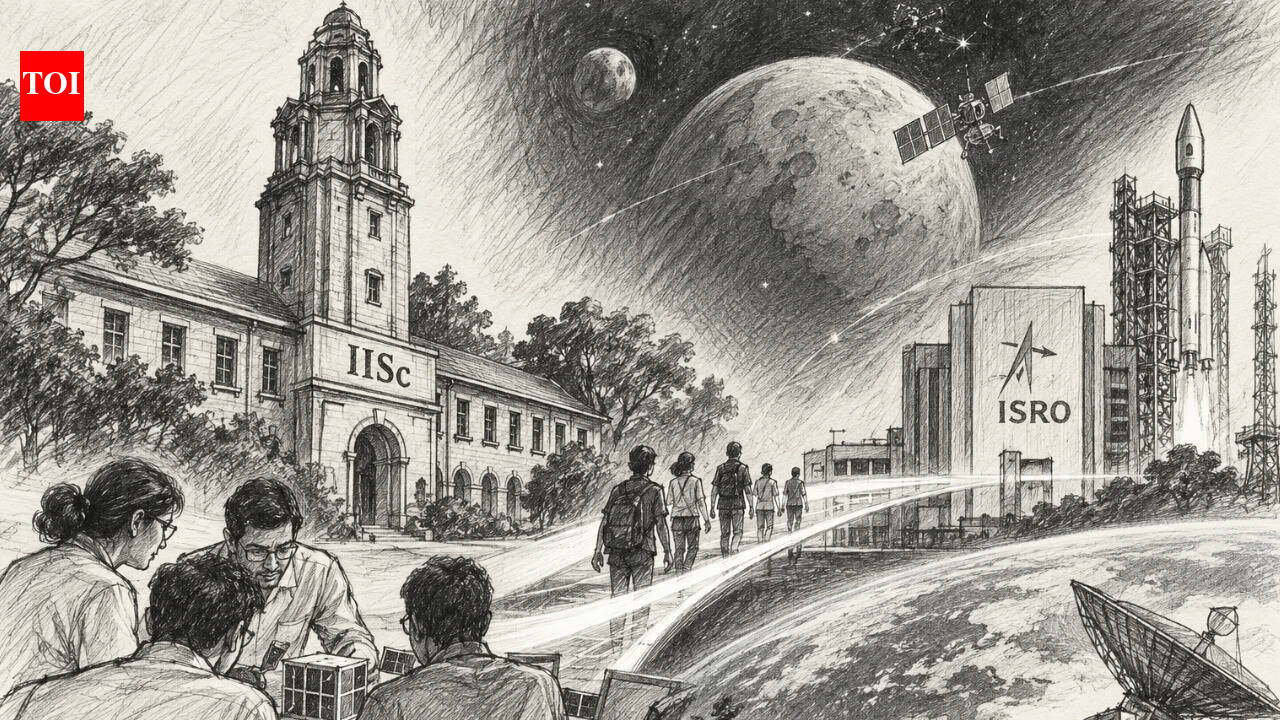
Where you stand changes what you see.There’s something telling about the relationship between IISc and Isro. The two institutions have worked together on everything from navigation signals and spacecraft thermal systems to Martian construction materials and experiments involving microbes in space. Yet, the question remains: could IISc become to Isro what the California Institute of Technology is to Nasa’s Jet Propulsion Laboratory (JPL)?The comparison is not new. At an IISc alumni meet in Washington in 2017, Murthy Gudipati, a scientist at JPL and an IISc alumnus, drew attention to the role the institute could play in India’s space ambitions. It was a vision, not an announced govt plan. But it’s worth revisiting, particularly as India looks beyond launching satellites towards more demanding planetary missions, human spaceflight and longer stays beyond Earth.ParallaxJPL offers a useful model because it occupies an unusual space between academia and a national space agency. Managed by Caltech for Nasa, it combines scientific inquiry with the engineering and mission capabilities needed to explore planets, study the universe and observe Earth. It’s not simply a university department supplying research papers, nor is it merely a workshop building spacecraft. It brings science and engineering together around missions.India has some of the ingredients for such a relationship already. IISc has the breadth of expertise that space exploration demands, from materials science, aerospace engineering and electronics to biology, chemistry and computing. Its historical connection with the space programme runs deep. Vikram Sarabhai, regarded as the architect of India’s space programme, worked at IISc. Satish Dhawan led both IISc and Isro, helping establish the institutional foundations of Indian aerospace research.The collaboration today is far more than a matter of institutional legacy. IISc and Isro have worked on indigenous spreading codes for NavIC’s L1 civilian signal, which are intended to improve receiver performance. Researchers have developed a low-power, self-contained device designed to cultivate and monitor microbes in space experiments. Another IISc team worked with Isro on making bricks from lunar and Martian soil simulants using bacteria, urea and guar gum. These are not interchangeable projects, but they illustrate the range of questions that can emerge when fundamental science meets the demands of space exploration.There are other examples. Isro has funded IISc research on spacecraft thermal management, including a design tool for a heat pipe coupled with phase-change material, which has been shared with Isro scientists. The institute’s work on advanced materials could also have applications in space systems. In 2025, Isro’s National Remote Sensing Centre and IISc announced joint research on carbon-dioxide sources and sinks, as well as the prediction of extreme rainfall events. The relationship extends from the mechanics of a spacecraft to the study of a changing planet.The challenge, then, is not to establish whether IISc and Isro can collaborate. They already do. It is to ask whether these collaborations can become part of a sustained institutional mission rather than remain a collection of projects, however valuable each may be.A JPL-like model would require a clear mandate, predictable long-term funding, dedicated research staff and facilities, and formal routes for IISc researchers to contribute instruments, subsystems and scientific payloads to Isro missions.It would also require a system that allows promising ideas to mature over years, even when they are not immediately tied to a scheduled launch. Space technology often demands precisely this patience: a discovery in a laboratory may need years of testing before it can survive the conditions of space.None of this means IISc should take over Isro’s responsibilities or abandon its academic character. The value of the institute lies partly in its freedom to pursue questions that may not have an immediate application. The point is to create a stronger bridge between that freedom and the country’s strategic ambitions.Nor should JPL be treated as a template to be copied wholesale. India has its own institutional structure, priorities and resource constraints. But the underlying principle is worth considering: a space agency needs an ecosystem of research institutions capable of developing technologies and scientific capabilities well before a mission is approved.India’s space programme has demonstrated that it can design, build and launch sophisticated systems. Its next phase will depend as much on the depth of its scientific ecosystem as on the rockets it sends skywards. IISc could be a major anchor for that ecosystem, drawing together researchers, engineers, industry and mission planners.Opening up the space sector to private players is welcome and necessary, but it cannot, by itself, build the scientific depth India will need for increasingly complex missions. A stronger partnership between Isro and research institutions such as IISc can be part of that transition, turning advances in the laboratory into capabilities for the launch pad and beyond.The question is no longer whether IISc has something to offer Isro. The evidence suggests it does, across a remarkable range of fields. The more consequential question is whether India is prepared to build the institutional framework that allows those contributions to accumulate, mature and shape missions over decades.An Indian JPL need not begin with a grand new building or a new name. It could begin with a decision to treat research as an enduring part of the space programme, rather than something that happens alongside it.The measure of a spacefaring nation is not just how far its spacecraft travel, but how far its ideas travel from the laboratory to the launch pad. A university’s pursuit of knowledge and a space agency’s pursuit of a mission are two halves of the same ambition. That is the Parallax: the distance between an idea and its application may be less a gap to bridge than a partnership waiting to be built.
Chethan Kumar writes in Parallax: Why IISc should be Isro’s JPL
Full Article
Original Source
Read the full article at Timesofindia →KhanList aggregates and links to publicly available news content. We do not host full articles from third-party sources. Always verify important information with original sources.