
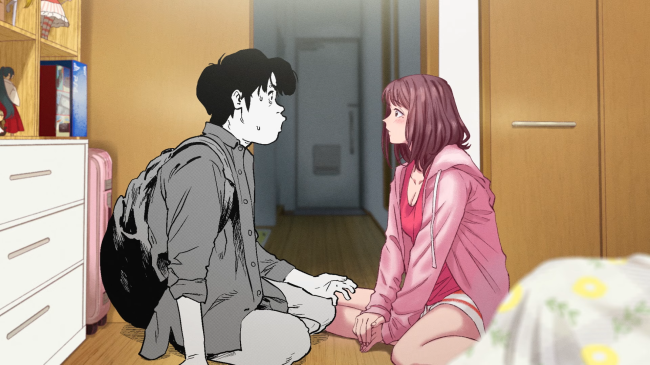
“I draw erotic manga but have never even held a woman’s hand,” admits Ryo (Takashi Okado) at the start of “Cherry & Virgin,” a charming and cuttingly funny diagnosis of two lonely hearts and their mutual struggles with intimacy. He and the part-time fujoshi artist Ami (Yaeko Kiyose) have met on the apps, their feelings of isolation shown in the fact that they’re from different worlds — or so it appears on screen The most immediately striking element of director Masanao Kawajiri’s crowd-funded film — made with support from Toei, who are thanked in a winking moment that just about stays on the far side of the fourth wall) — is how the characters depicted in the style of art they are most closely associated with. Ryo is in sketchy but more naturalistic black and white and textured with screen-tone, resembling something like the more “realist” manga artists he name-checks, such as Inio Asano. Ami is shown in fully stylized color, illustrated in in closer proximity to the sort of BL (“boys love”) characters which she might draw and upload to Pixiv. On their date, the two also exists in background matching the style in which they’re drawn, and the room they share is divided by these different viewpoints. Where the film really impresses is how this unique approach never just feels like a gimmick, instead it feels like a tool by which to offer incredibly direct access to the feelings and personalities of these characters; during the aforementioned first date in the bar, the art styles in which they’re depicted begin to merge as the two come to closer understanding of the other. In flashbacks and in other moments, the design of Ryo and Ami often shifts — their styles swap when they first kiss, and in flashbacks they are drawn in a cruder and more childlike style. In Ami’s case this goes back even further. A simplified drawing style that feels lifted from Microsoft Paint also reflects her own imposter syndrome about her art; it comes with a memory of being bullied by a more accomplished artist, like who is drawn with more technical detail in the same scene, and then her own mother berating her about it the same day. It’s a very pure kind of animated expression which never limits itself to any one formal constraint (a couple of sequences even use puppet theatre). This approach goes far beyond just the two main characters, as the film’s supporting cast includes cartoon animals, mecha and even 3D VTuber avatar (the latter particularly jarring as they walk into an otherwise 2D setting). A lot of the animation itself in “Cherry and Virgin” embraces rotoscoping, though limiting the number of drawings to an extent that it skirts around the sense of sense of uncanniness which can sometimes emerge from the method. Because of how the film so brazenly mixes so many art styles and even mediums, the rotoscoping feels like a natural fit rather than some kind of awkward superimposition. In the spirit of the patchwork art direction of the film, which often also incorporates the language of manga panelling itself into the frame, Kawajiri also occasionally further peels back the layer of illustration – or illusion, perhaps – to show the actors in live-action, though only in brief moments. Similarly, there are segments in “Cherry and Virgin” where a color tool is visible on screen when the background changes. Kaga Misato’s screenplay finds the charm in such antics with both characters even as they confront the worst aspects of themselves, particularly in Ryo’s case, who spends much of the film deprogramming himself from the incel rhetoric creeping in to his reflections on dating. Part of his journey is his self-examination of no small amount of misogyny simmering under the surface, and what works about “Cherry & Virgin”is just how frank the film is about how ugly Ryo’s worst tendencies are – ones he does identify in himself and immediately work to rectify – particularly when it comes to dismissing women as characters passing through his life. Being honest about this side of him it makes the later intimacy feel less phony, more vulnerable, and ultimately more romantic. If there was any knock against the film as a whole it’s that sometimes Ami’s perspective does, ironically, take up a little less space than his. But not that Ami is an afterthought, she also has plenty of anxieties of her own which manifest in the film’s constantly shifting imagery and her awareness of her friends’ lives moving forward while she remains static. Kawajiri crashes the two together both with a rather sweet, tentative courtship and plenty of comedy around the anxiety which would accompany any new romance, let alone one between two shut-ins with no game. One great running gag revolves around what Ryo and his friends refer to as the “Safe Sex Incident” (a double entendre) which returns in live-action insert shots, and once more with phenomenal timing in one prolonged moment of embarrassment for Ryo. Another delightful touch throughout the film’s runtime is how, just in the same way that Kawajiri represents characters through the art-style associated with them, he also creates visual understanding of them through dozens upon dozens of homages to decades of cultural ephemera associated with otaku. No matter how esoteric the reference, it’s always in service of the tone of the scene itself or adds another layer to one of the characters. For a more familiar example, Ryo’s view of his father is represented by the latter being drawn as the famously bad dad from “Neon Genesis Evangelion,”Gendo Ikari. (Anno’s work and the heyday of Gainax in general is all over this film, both in terms of its chosen topic of angry otaku, and the deployment of mixed media in its romantic comedy). Friends comfort each other through quoting Mamoru Oshii. It’s all part of a shared language between the characters which is also open to an unfamiliar audience, to Kawajiri’s credit – even though there are so many it never becomes a secret code to alienate those who know from those who don’t (at one point the Ghanaian pallbearers appear, so it’s not all nods to old manga and anime), but it does make for some great extra laughs on top of the more traditional pratfalls and and gags. “All drawings are lies,” Ryo says in a debate with Ami about what they prefer in how they capture a person or a character, later saying that his style keeps changing in his pursuit of something “novel.” “Cherry & Virgin” is hardly a cop-out by showing all of these different avenues in close proximity as part of its love story, one about seeing all the sides of a person and not just their idealized self. Through those “lies, as Ryo calls them, and by virtue of putting all of these radically different approaches into close proximity, the filmfeels more truthful as a result, a quality highlighted by its moving and often deeply funny script. Grade: A “Cherry & Virgin” premiered at the 2026 Tokyo International Film Festival. It is currently seeking U.S. distribution.
‘Cherry & Virgin’ Review: A Fantastic Indie Anime Blends Different Art Styles and a Slew of Pop Culture References into an Innovative Modern Rom-Com
Full Article
Original Source
Read the full article at Indiewire →KhanList aggregates and links to publicly available news content. We do not host full articles from third-party sources. Always verify important information with original sources.