
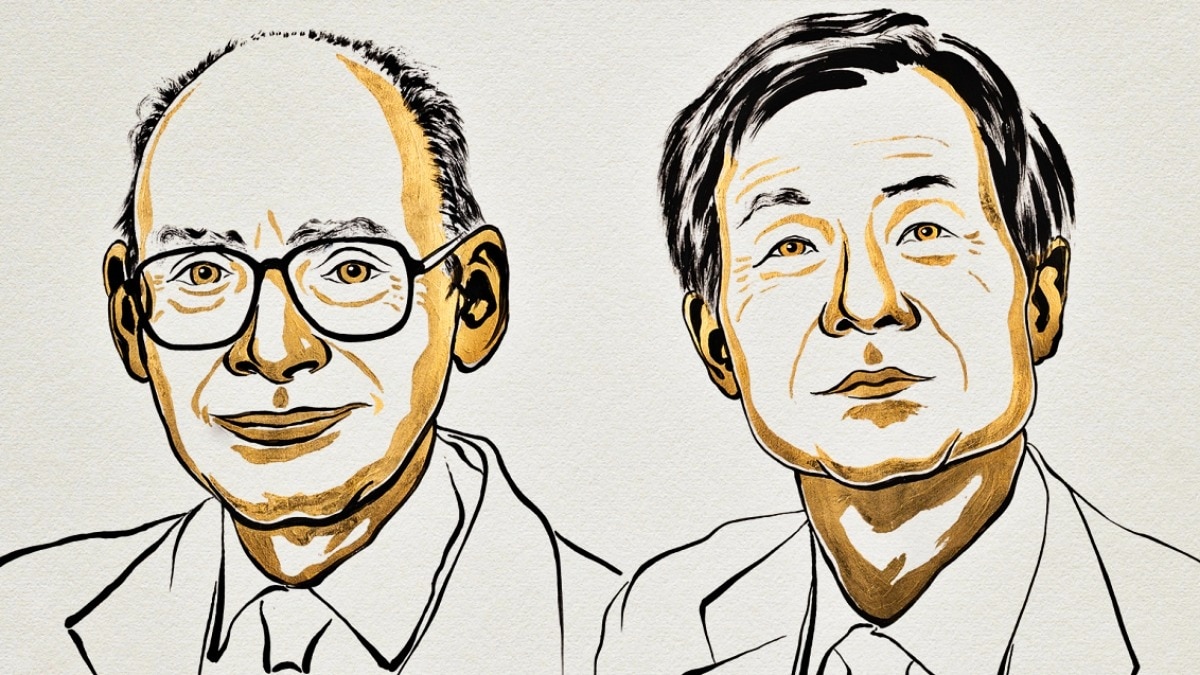
Their work has shown that chemistry itself can amplify a tiny molecular preference, turning a small imbalance into a dominant chemical choice.The 2026 Nobel Prize in Chemistry has been awarded to Henri B. Kagan and Kenso Soai. (Photo: X/obelPrize)New Delhi,Oct 7, 2026 15:57 ISTFrench chemist Henri B Kagan and Japanese chemist Kenso Soai have been awarded the 2026 Nobel Prize in Chemistry for discovering how chemical reactions can favour one mirror-image form of a molecule over the other, a breakthrough that helps explain one of the deepest mysteries of the chemistry of life.The Royal Swedish Academy of Sciences awarded the prize “for the discovery of non-linear effects and autocatalysis in asymmetric organic synthesis.” The citation read: "Other than life itself, no one had previously achieved this feat."At the heart of their work is a strange property called chirality, or chemical “handedness”.BREAKING NEWS The Royal Swedish Academy of Sciences has decided to award the 2026 #NobelPrize in Chemistry to Henri B. Kagan and Kenso Soai “for the discovery of non-linear effects and autocatalysis in asymmetric organic synthesis.” https://t.co/nH090ql1Xc— The Nobel Prize (@NobelPrize) October 7, 2026Some molecules exist in two forms that are mirror images of each other, much like our left and right hands. Although they contain the same atoms connected in the same way, their shapes are different. This difference can be extremely important in biology.Amino acids, the building blocks of proteins, are one example. They can exist as two mirror-image forms, but living organisms overwhelmingly use just one of them to build proteins. This raises a fundamental question: How did life end up choosing one molecular version over the other?WATCH NOBEL PRIZE IN CHEMISTRY ANNOUNCEMET LIVE HERE For decades, chemists struggled to answer it. When they tried to create molecules that could exist in two mirror-image forms, chemical reactions generally produced roughly equal amounts of both.Kagan made a crucial breakthrough in 1986. He discovered a way to manipulate chemical reactions so that one mirror-image product could be produced in a much greater amount than the other.His work showed that chemical reactions did not always have to behave in a perfectly balanced way.Soai then pushed the idea much further.In 1995, he reported a chemical reaction with the potential to amplify one molecular handedness. The reaction involved autocatalysis, in which a chemical product helps drive the same reaction that produced it.This creates a powerful feedback loop: a small initial imbalance can become increasingly amplified.In 2003, Soai demonstrated a reaction in which essentially only one of the two possible mirror-image forms was produced. It was a landmark achievement because, apart from biological systems, scientists had not previously been able to achieve such a high degree of chemical handedness spontaneously.Thanks to the discoveries that are being recognised by the #NobelPrize in Chemistry 2026, chemists have gained fundamental new tools for use in their daily work but, above all, these discoveries have contributed to solving one of chemistry’s greatest mysteries: how homochirality – like that found in all living beings – can be created. The Soai reaction – developed by 2026 laureate Kenso Soai – has awakened new enthusiasm in chemists who want to understand the life’s origins. Around the world, researchers are now trying to repeat Soai’s achievement, but with the aim of producing homochiral amino acids and sugars. The non-linear effects that fellow laureate Henri B. Kagan discovered have become an important tool for chemists when they design new reactions. The fact that a reaction is non-linear provides chemists with information about how it occurs. This information can be used to optimise the reaction, so they can obtain the purest possible enantiomers of the product. This is vital for every company that manufactures substances that are intended to interact with living beings, such as pharmaceuticals, flavours, scents and agricultural chemicals. In some cases, it is also important in the production of new materials.— The Nobel Prize (@NobelPrize) October 7, 2026The phenomenon is known as homochirality — when a system overwhelmingly favours molecules of one handedness.The discovery is important far beyond a fundamental chemistry puzzle. The handedness of molecules can determine how they interact with biological systems. Two mirror-image versions of the same molecule can behave very differently inside the human body.Speaking over the phone, Professor Kenso Soai said he was extremely excited to receive the news of the Nobel Prize, calling it “one of the most exciting days” of his life. He also said he was delighted to share the honour with Professor Henri B. Kagan.That makes controlling molecular handedness particularly important in drug development and pharmaceutical manufacturing, where scientists often need to produce one specific molecular form.“Heinrich Kagan and Kenso Soai have provided a solution to a chemical mystery that is over a century old: how homochirality can emerge spontaneously,” said Heiner Linke, chair of the Nobel Committee for Chemistry.Their work has shown that chemistry itself can amplify a tiny molecular preference, turning a small imbalance into a dominant chemical choice, and offering a possible route to understanding how the molecular handedness of life emerged.Here are other Nobel Prize anoucements: Physics, Medicine.- Ends
Chemistry Nobel to Henri B Kagan, Kenso Soai for solving a chemical mystery
Full Article
Original Source
Read the full article at Indiatoday →KhanList aggregates and links to publicly available news content. We do not host full articles from third-party sources. Always verify important information with original sources.