
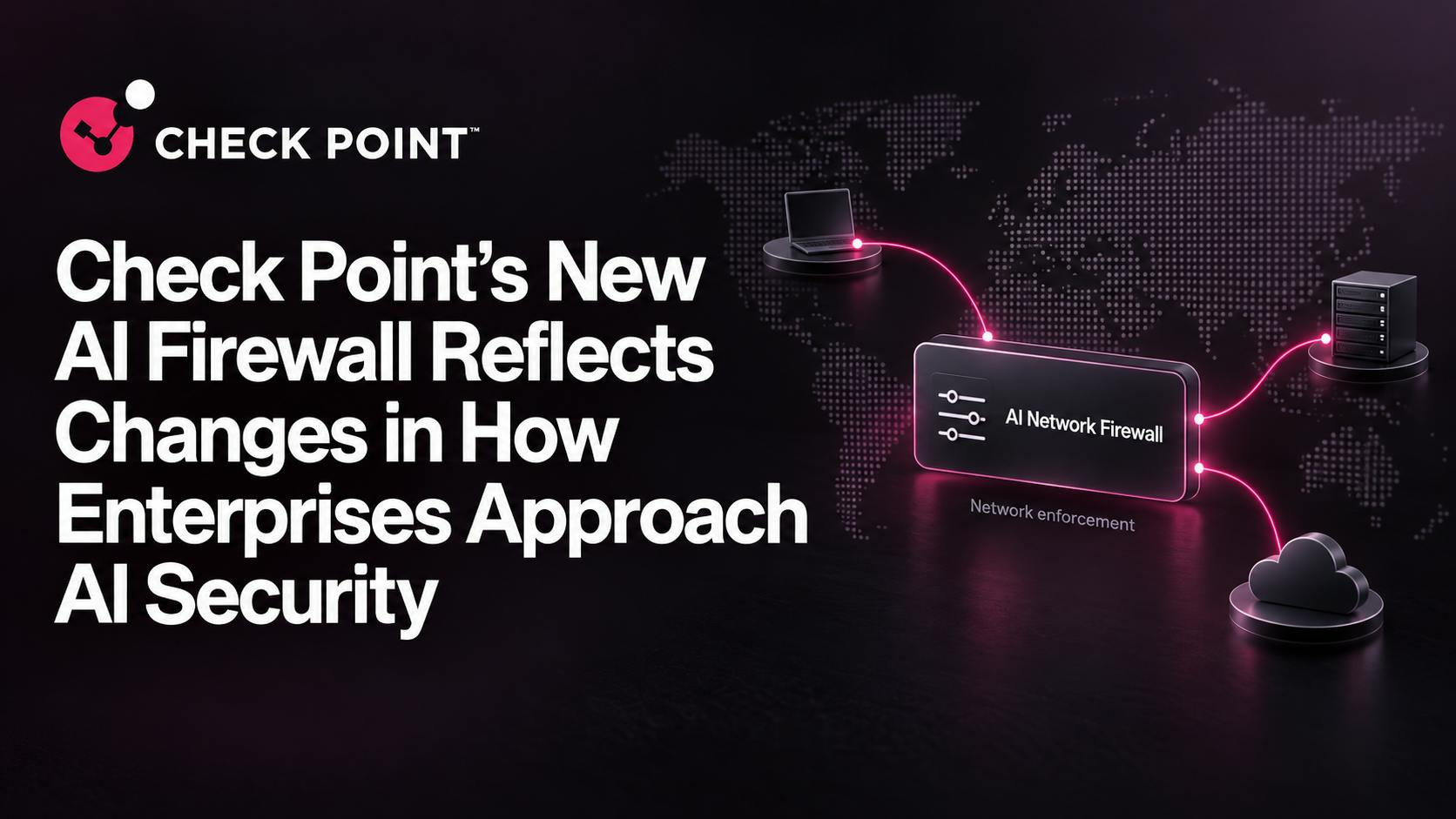
Check Point's new solution is the latest sign that AI security is being absorbed into infrastructure enterprises already trust, rather than treated as a separate system to adopt. Enterprises are deploying artificial intelligence faster than security teams can secure it with an AI-specialized cyber tech stack. Evaluating, purchasing, and deploying a new security system takes time, and few organizations are willing to slow their AI rollout to wait for that process to finish.Security vendors are responding by extending the platforms already running in production, rather than trying to sell enterprises something new. Released in late July, Check Point’s AI Network Firewall is the latest, clearest example of this shift.These days, there’s quite a bit of confusion about what an AI firewall is. That confusion is itself a sign of how early we still are in the lifecycle of this category. Traditional network firewall providers are bolting on AI features to help those systems better protect corporate networks from evolving cyber threats. But they’re still legacy security systems. On the other hand, there is an entirely new breed of AI firewall that’s specifically designed to protect AI models and applications. That’s the category Check Point’s AI Network Firewall belongs to.How Check Point’s AI Network Firewall protects AI applications at the network layer Check Point is among the vendors leading a deeply integrated approach to protecting AI environments. With its new AI Network Firewall, it’s able to address the three core attack surfaces enterprises are most concerned about. The first is their employees. It has become common to use both sanctioned and unsanctioned AI tools on a daily basis to get work done faster. This is great for productivity, but from a security perspective it’s alarming, because existing data protection tools were never designed to work with AI models.Check Point’s firewall protects against employee AI use by first discovering which AI apps and tools employees are actually using, sanctioned and shadow alike, then applying intent-based classification to their prompts. This allows it to understand the context of what people are asking AI to do, so the firewall can prevent them from feeding sensitive information to third-party models. This kind of visibility gap is exactly what’s driving CISOs to build formal audit frameworks for shadow AI risk in the first place.Autonomous AI agents and MCP traffic are the second major attack surface. Employees aren’t just asking AI to answer questions anymore. These days, they’re having AI do the actual work too. But these agents need to be carefully governed to prevent them from doing something disastrous, such as deleting a critical database. Check Point counters this risk by discovering all of the AI agents and MCP servers operating in an enterprise’s environment, then enforcing policy on that traffic in real time, blocking an agent from accessing a resource or taking an action the moment it falls outside what’s allowed.Finally, there are the AI applications and models themselves. Check Point protects these with a defensive inline prompt injection system, built based on tech developed by Lakera, the AI security startup that Check Point acquired to bring purpose-built prompt-injection defense into its platform. The firewall blocks adversarial inputs and data exfiltration attempts before they reach the underlying model, and it screens the model’s own outputs for harmful or manipulated responses before they reach the end user.These capabilities are deployed directly into the firewalls Check Point’s customers are already running. There’s no need to purchase any new hardware or software, and no new console to contend with. Customers just update their existing infrastructure, and they’re good to go.Why extending existing infrastructure is becoming the industry’s default answer Many of Check Point’s peers have taken the same approach, extending their existing firewalls rather than building something new. A prime example is Zscaler, which debuted AI Broker, Endpoint AI Security and AI Access Graph features within its flagship Zero Trust Exchange platform in June, as opposed to launching a new product. Not every vendor is taking that route, though. Cloudflare has gone in the opposite direction with its dedicated AI Gateway product, a standalone service that adds guardrails, rate limiting, and traffic controls in front of AI application calls rather than folding that protection into infrastructure customers already run.There are arguments for both approaches. Some teams may benefit from the distinction between traditional and AI cyber defenses. For others, it makes sense to avoid dealing with yet another dashboard, especially if they’re already contending with security tool fragmentation.“Organizations are challenged to deploy dedicated AI security solutions, which are additive to their existing security architecture, contributing to the sprawl of dis-jointed, siloed security tools and agents,” says Pete Finalle, Research Manager of Trusted Access and Network Security at International Data Corp. “While rare, the native integration of AI security across existing enforcement points provides improvements to visibility, telemetry effectiveness, security posture and management simplicity.”In the case of Check Point, the AI Network Firewall lives under the umbrella of its AI Defense Plane, as part of a unified security and governance system that spans AI applications, APIs, browser plugins, cloud environments and endpoints. The AI Network Firewall is one of several enforcement points, alongside endpoint agents and browser plugins, through which the AI Defense Plane’s policy gets applied at the network layer.The cost of waiting, according to breach data Securing AI has become a matter of urgency. In a recent study, IBM found that shadow AI incidents hit 43% of breached organizations, up from 20% the year before. This illustrates why enterprises are so nervous about their employees’ use of AI tools. In many cases, staff simply ignore corporate policy and start feeding data to their favored AI chatbots, but doing so can be extremely costly, as the IBM report puts the average cost of a shadow AI security breach at a staggering $5.39 million. IBM’s study also revealed that breaches involving an organization’s own models or apps rose from 13% to 21% in the last year, which explains why security teams have every reason to be concerned about the AI application and model layer, too.The numbers are alarming, and they explain why security vendors prefer to expand their existing tools instead of taking the time to build something entirely new. By extending existing infrastructure, they can offer new AI protections much faster than if they were to create an entirely new platform.These add-ons are easier for organizations to deploy, too, since in most cases the path is a version upgrade to infrastructure they already run, not a new system to install, configure and learn from scratch. Compare that to installing an entirely new AI network gateway, which could take weeks or even months to properly integrate and learn. Most businesses would rather close the AI exposure gap right now if given the chance.Why analysts can’t agree on the size of this market Analysts don’t share a definition for the AI firewall category itself, and that lack of consensus is why their size estimates vary so widely. Some lump it in with traditional network firewalls that have simply added AI features. Others count only the newer category of firewalls built specifically to defend AI itself. According to IT-Harvest, the market for LLM firewalls and protection tools was worth around $30 million last year, though its revenue is projected to double by the end of 2026. The organization came up with that modest number because its study focused on that specific segment of AI firewalls only, as opposed to the broader AI security segment. It’s a much lower figure than 360iResearch’s projected $260 million valuation of the AI firewall market for 2026.The problem is that security vendors don’t really agree on exactly what an AI firewall is. Some prefer to use the term “LLM firewall,” while others dump them in the “AI model protection” category, explains IT-Harvest analyst Richard Stiennon in a recent interview.This confusion is consistent with the architectural shift of some security vendors. When AI security is bundled as part of a broader platform that enterprises are already paying for, such as with Check Point’s or Zscaler’s platforms, spending on those tools will be bundled into whatever existing category they fall into. That makes it much harder to narrow down the true size of demand for AI firewalls and other AI security solutions.The confusion only deepens once you account for two more trends in the “AI security” space. Scores of cybersecurity tools now use AI internally to power their own detection capabilities and user interfaces, while another wave of vendors are updating existing products specifically to defend against AI-generated attacks.Beyond the naming problem Until the security industry settles on a universal definition for the technology that protects AI, separate from tools that merely use AI or defend against AI-driven threats, it will struggle to value this market accurately. What’s more, this lack of consensus around terminology makes it harder for enterprises to select the right tools to protect their environments. Nonetheless, enterprises can be reassured that, regardless of labels, the important thing is that security vendors are striving to close the vulnerability gap that the rapid uptake of AI has created. The industry is moving away from isolated solutions, with AI security instead being absorbed into the legacy infrastructure that enterprises already use and trust. Check Point’s AI Network Firewall is one of the clearest signs of where that shift is heading, whatever the ecosystem ends up calling it.Don’t forget to like and share the story!Vested Interest Disclosure: HackerNoon has reviewed the report for quality, but the claims herein belong to the author. #DYOR.
Check Point’s New AI Firewall Reflects Changes in How Enterprises Approach AI Security
Full Article
Original Source
Read the full article at Hackernoon →KhanList aggregates and links to publicly available news content. We do not host full articles from third-party sources. Always verify important information with original sources.