
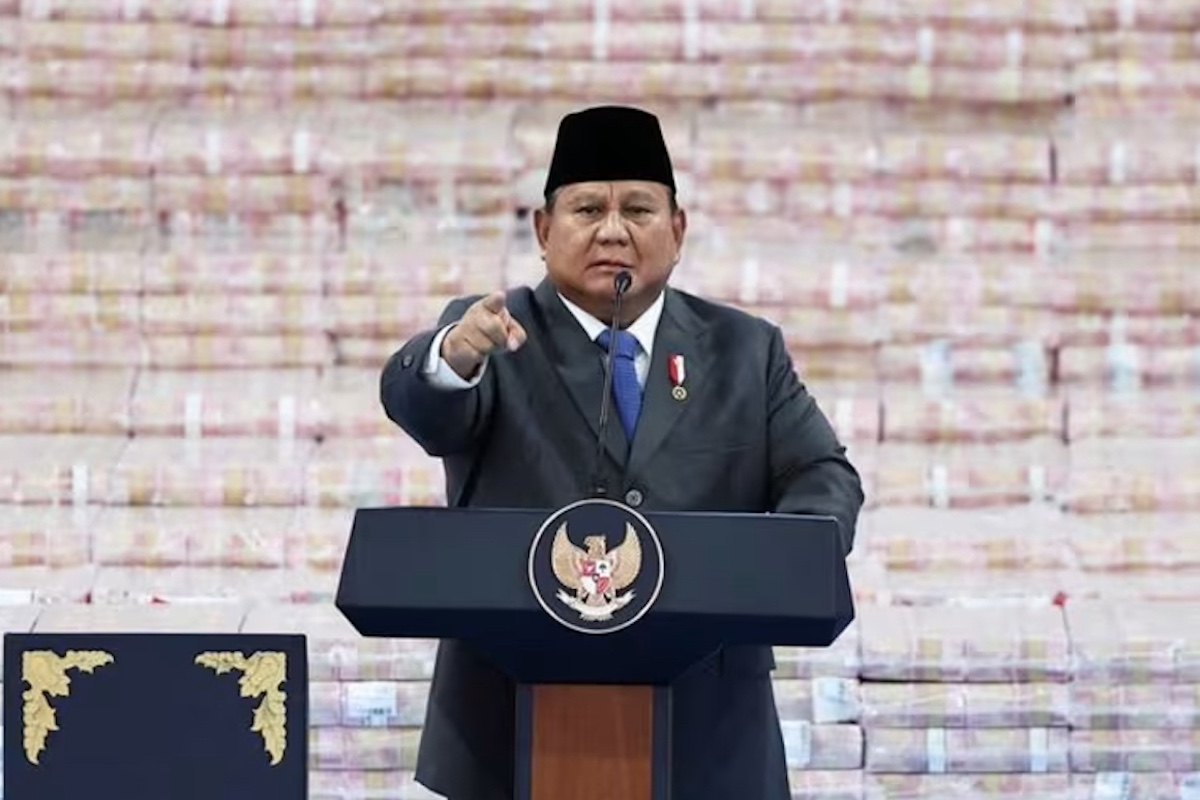
Indonesia’s leaders promise that the country will be a world power by 2045, the centennial of its independence. Yet when shares plunge or smoke drifts abroad, officials reflexively blame foreigners. That blame game asks nothing of those in charge. Who really owns our listed companies? Who wins contracts through political connections? Who burns the peatland? It is easier to to point to an enemy abroad, or to brand critics antek asing, “foreign agents.” Investors do not hate Indonesia. They want rules they can verify. So is the world against us, or has fear of foreigners become a shield for powerful insiders? Reflex xenophobia Under President Prabowo Subianto, the list of supposed foreign enemies keeps growing. When students marched under the banner Indonesia Gelap (Dark Indonesia) in February 2025, Prabowo asked whether they had been paid, pointing without evidence to the US aid agency USAID. In June, he claimed that foreign powers fund NGOs to divide Indonesians. During the August 2025 riots, he labeled protesters antek asing, while his staff described the unrest as a foreign-planned “color revolution.” In February 2026, he said critics were controlled from abroad. The Jakarta Post reported that pro-Russia and pro-China accounts helped spread the antek asing narrative. Researchers warn that crying wolf this often may let a genuine foreign campaign slip by unnoticed. Some of the claims border on farce. In September, Ulta Levenia, a deputy government communications minister, wondered aloud whether a US research project called HAARP made six volcanoes erupt the day after Prabowo met Russian President Vladimir Putin. She conceded she had no proof. The latest foreign scapegoat is MSCI, whose stock indexes guide global funds. On October 16, the Jakarta Composite Index fell 11.57%, its worst day since 1998, after MSCI said it might drop Indonesia from its emerging market category. Foreign investors have pulled a net US$5.1 billion from the stock market this year. Prabowo said MSCI wanted to frighten Indonesia. A former trade minister accused Singapore’s state investors, Temasek and GIC, of pushing MSCI so that foreigners could buy our assets cheaply. Both denied it. MSCI’s reasons are plain: suspected coordinated trading, weak punishment and a low free float, the share of a company’s stock the public can trade. Over 200 firms have a free float below 15%. MSCI first raised its concerns in January, and the head of the financial regulator, Mahendra Siregar, resigned as a result. Prabowo himself called it “idiocy” that MSCI’s letters went unanswered. Global shocks are real, from war in Iran to US tariffs. Jakarta has balanced the major powers, signing a deal with US President Donald Trump that cut US tariffs to 19% and promising to buy $19 billion of American products despite its BRICS ties. Yet MSCI’s warning, not these shocks, drove the market selloff. A downgrade to “standalone” status would place us beside Nigeria and Zimbabwe. Smoke on the border At the same time, Indonesia is battling its worst wildfires in 11 years. Singapore is enduring its worst haze in a decade, its pollution index reaching 181, while Malaysia has closed schools. The smoke has reached the Philippines and Timor-Leste, disrupting nearly 2,000 flights. Malaysia and Brunei have agreed to raise the issue at ASEAN, and Singapore warned seven Indonesian companies. For a would-be regional leader, the episode has been deeply damaging. The human cost, meanwhile, is heavy and mounting. The research group CELIOS estimates losses of up to 123 trillion rupiah, with 17.4 million people at risk of respiratory illness. Four people have died fighting the fires, and protests have spread nationwide. Rather than punish those who set the fires, officials have turned instead on Singapore. Syahganda Nainggolan, the government’s communications chief, joked that when Indonesia isn’t sending smoke, it sends oxygen. Singapore’s senior minister, K. Shanmugam, replied that the haze comes from companies breaking Indonesian law. The anti-foreign tension has reached the energy sector. On October 23, Jakarta cut pipeline gas exports to Singapore by 9%, with Energy Minister Bahlil Lahadalia declaring Indonesia is “in survival mode.” Singapore urged suppliers to honor their contracts. Squeezing a leading foreign investor is a strange way to try to win back lost capital. Flagging popularity With Prabowo’s approval rating falling below 50%, raising foreign bogeymen offers a convenient distraction. Labeling critics as foreign agents protects insiders, while small investors and children breathing smoke pay the price. Four steps are needed to restore official credibility. First, fix the stock market before MSCI decides in June 2027. Publish the true owners of every listed company, enforce the 15% free-float rule without exception, prosecute market cheats regardless of their connections and answer MSCI’s letters on time. Second, punish those behind the fires. Publish maps showing who holds the burning land, take the offenders to court and cancel permits when the evidence is clear. Prabowo’s order must result in real penalties. Third, treat neighbors as partners, not adversaries. Instead of oxygen jokes, share fire data with Singapore and Malaysia, help their courts pursue the companies involved and invoke the ASEAN haze agreement that Indonesia ratified in 2014. Honor the gas contracts. Reliability matters more than winning an argument. Fourth, retire the antek asing label. Real foreign interference demands credible evidence, not a hollow accusation hurled at students, journalists and index providers. A country confident in its 2045 future should welcome scrutiny, fix what it exposes and stop blaming foreign phantoms. Muhammad Zulfikar Rakhmat is the director of the China-Indonesia and MENA-Indonesia desks at the Center of Economic and Law Studies (CELIOS). Bhima Yudhistira Adhinegara is the executive director of CELIOS.
Chasing foreign phantoms in Prabowo’s embattled Indonesia
Full Article
Original Source
Read the full article at Asiatimes →KhanList aggregates and links to publicly available news content. We do not host full articles from third-party sources. Always verify important information with original sources.