
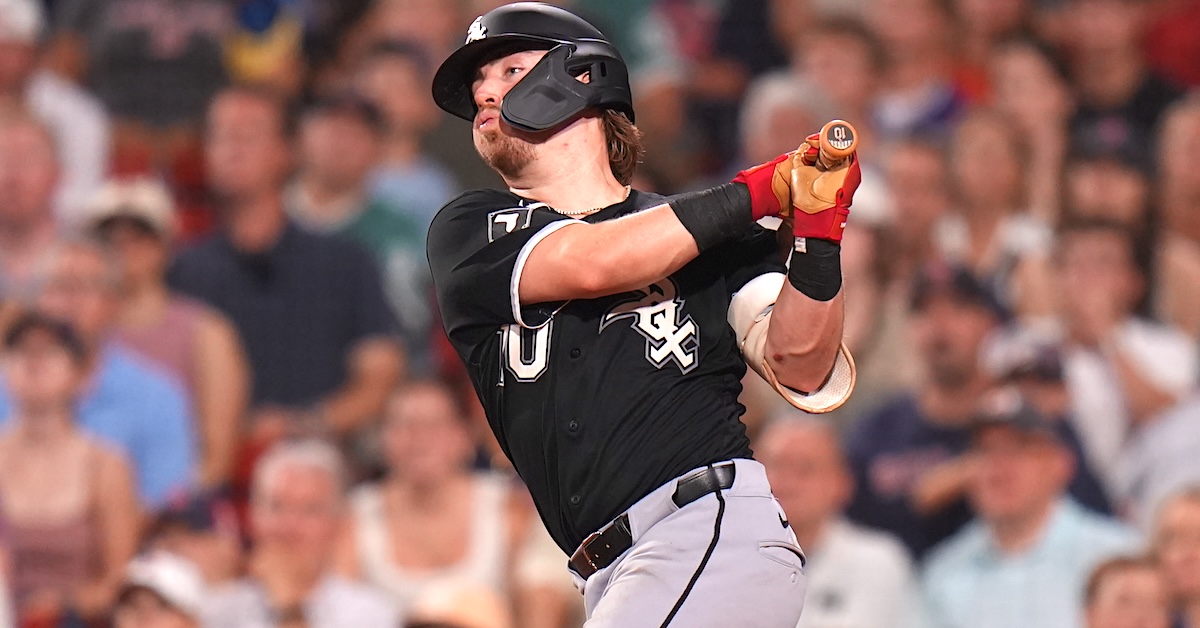
David Butler II-Imagn Images Did you see Chase Meidroth’s 2026 season coming? If you expected Meidroth to launch 15 home runs, to put up a four-win season, to be a top-30 position player, then by all means, stand up and take a bow, invest in some Powerball tickets, try your hand at writing horoscopes. When he debuted last year, patience was his calling card. No qualified batter swung less often at pitches in the zone, and because he had the fifth-lowest bat speed, pitchers threw the ball over the plate and invited him do his worst. I mean that almost literally. When Meidroth swung at a pitch in the zone, he ran a .278 wOBA, which ranked 293rd out of 308 batters (minimum 1,000 total pitches seen). When those swings resulted in balls in play, his .295 wOBA ranked 229th out of the 237 (minimum 250 BIP). But let me share with you some wisdom courtesy of C.S. Lewis: “You are never too old to set another goal or to dream a new dream.” What a sad world it would be if everybody just repeated their rookie season until they retired, if nominative determinism (or, in the case of most ballplayers named Chase, the opposite) were real. Meidroth came into spring training with a new dream. “Just shortening up my swing a little bit,” he told James Fegan for Sox Machine back in February. “Just shortening up the leg kick a little bit. It got a little high last year.” He also opened up his stance and moved up in the box. The goal, Chicago’s hitting coaches explained, was not necessarily to make Meidroth’s already extremely short stroke even shorter, but to help him put the ball in the air a bit more often. The dream came true. Meidroth is hitting more fly balls and line drives and fewer groundballs and popups. This year, he has exactly tripled his 2025 total of five home runs, he’s exactly doubled his .067 ISO to .134, and he’s, well, OK, he’s improved his 87 wRC+ all the way to 112, which is a huge deal, but only an increase of 28.736%. I never promised you all the numbers would be round. The weird thing is that Meidroth is both swinging the bat and hitting the ball softer than ever. His bat speed dropped from 67.4 mph to 66.9 mph, which moved him from the fifth- to fourth-lowest qualifier. His fast-swing rate dropped from 1.6% to 1.1%. His average and 90th-percentile exit velocities dropped, as did his hard-hit rate. And yet he’s literally doubled his ISO. These contrasts are all over the place. As you’d guess, Meidroth tripled his home run output by pulling the ball in the air more. To do that, you need to meet the ball farther out in front of the plate, which carries a cascading series of effects. You have to start your swing earlier to meet the ball farther out in front, which means less reaction time, which means a reduced contact rate. That part’s happening to Meidroth, and as a result, his strikeout rate has jumped by nearly eight points. He went from running one of the better strikeout rates in baseball to right around the league average. He just up and lost 80 points of on-base percentage, he’s overcoming all that and improving his overall offensive line by way of BABIP and slugging. But remember, meeting the ball farther out in front will make your bat speed grade out faster, because bat speed increases throughout the swing and Statcast measures it where it intercepts the ball. So two identical swings would have different measured bat speeds if one met the ball farther out in front. As we know, the opposite has happened. Both Meidroth’s bat speed and EV have decreased despite meeting the ball farther in front, which means that his bat speed drop is even bigger than the numbers make it look. Lastly, softer swings usually come along with a drop in swing rate, because aggressive approaches tend to lead to aggressive swings, but Meidroth is actually swinging more both inside and outside the zone. He’s still one of the choosiest players in baseball with one of the very softest swings, but he’s striking out and slugging way more. He has traded contact for power, but in a way that we’re not used to seeing. Somehow Meidroth decided to shorten up his already short swing, and now everything we know has turned itself inside out. The less powerful swing has massively increased his power. I think I have at least part of an explanation, but before we unravel this mystery, I need to show you one other thing. We need to talk about platoon splits, because they tell nearly the entire story of Meidroth’s season. Last year, he had fairly standard platoon splits, with an 82 wRC+ against righties and a 99 mark against lefties. This year, he’s at 89 against righties and 171 against lefties. That’s right, bring in a lefty against Meidroth and you’re very nearly turning him into Yordan Alvarez. Against left-handed pitching, Meidroth is the seventh-best qualified hitter in baseball! It’s mostly about slugging, too. His strikeout rate against lefties is nearly identical to what it was last year, which means that whole huge jump in his strikeout rate has come against righties: from 13% last year to 24% this year. Against lefties, he’s raised his walk rate by a few percentage points, but his ISO has jumped from .064 to .217 (and in case you’re wondering, yes, his bat speed and EV are down specifically against lefties). Left-handers are throwing Meidroth more changeups and fewer four-seamers this year, so as you’d expect, his heat maps against them show fewer pitches high and inside and more low and away.You Aren't a FanGraphs MemberIt looks like you aren't yet a FanGraphs Member (or aren't logged in). We aren't mad, just disappointed. We get it. You want to read this article. But before we let you get back to it, we'd like to point out a few of the good reasons why you should become a Member. 1. Ad Free viewing! We won't bug you with this ad, or any other. 2. Unlimited articles! Non-Members only get to read 10 free articles a month. Members never get cut off. 3. Dark mode and Classic mode! 4. Custom player page dashboards! Choose the player cards you want, in the order you want them. 5. One-click data exports! Export our projections and leaderboards for your personal projects. 6. Remove the photos on the home page! (Honestly, this doesn't sound so great to us, but some people wanted it, and we like to give our Members what they want.) 7. Even more Steamer projections! We have handedness, percentile, and context neutral projections available for Members only. 8. Get FanGraphs Walk-Off, a customized year end review! Find out exactly how you used FanGraphs this year, and how that compares to other Members. Don't be a victim of FOMO. 9. A weekly mailbag column, exclusively for Members. 10. Help support FanGraphs and our entire staff! Our Members provide us with critical resources to improve the site and deliver new features! We hope you'll consider a Membership today, for yourself or as a gift! And we realize this has been an awfully long sales pitch, so we've also removed all the other ads in this article. We didn't want to overdo it. In case you didn't read all that, here's the short version. Membership includes:✓Ad-free browsing✓Unlimited FanGraphs & RotoGraphs articles✓Historical & platoon projections✓Leaderboard & player-page stat heatmaps✓One-click data exports✓Customizable player-page dashboards✓Dark & Classic site modes✓Weekly Members-only mailbag✓FanGraphs Walk-Off, your year in review✓Optional homepage photo removal✓Gift articles to non-members But Meidroth isn’t interested in those low, outside pitches. He’s more focused on the inner third. Here’s the part that I find really interesting, and it’s going to bring us back to the mystery. Below are Meidroth’s spray charts against left-handed pitchers this year and last year. Watch what happens to the red line drives, then watch what happens to the blue fly balls. Last year, Meidroth tended to hit line drives at the right fielder. Just like a classic contact hitter, he’d let the ball travel deep and shoot it the other way, hoping to drop it in front of the right fielder. Now he’s pulling line drives down the line, where the doubles live. Last year, the blue fly balls tended to go to center field, where fly balls go to die. Now he’s either pulling them over the wall or lifting them down the right field line. xwOBA appreciates the new Meidroth, but only to a point, because it ignores spray direction, which isn’t all that predictive. While Meidroth’s wOBA on balls in play (his wOBACON) has jumped from .298 to .383, his xwOBACON jumped a much smaller amount, from .303 to .331. Maybe this is just a bit of randomness, but the spray chart sure makes it look like a real trend. Meidroth is indeed getting his foot down earlier as he planned back in February, and he’s now pulling the ball when he makes solid contact. Statcast’s new miss distance stats are informative here too. As you might expect with all this extra lift, Meidroth’s swing is a bit steeper than it was last year. But the interesting thing is that he’s only hitting fastballs in the air more often. His launch angle against soft stuff has dropped, and the bat tracking metrics say his bat is underneath soft stuff more often than it was in 2025. The way I interpret all this is that Meidroth is making sure that he’s on time for the fastball in a way that he wasn’t last year. The way it normally works is that gearing up for the fastball causes you to be way too early against soft stuff, but Meidroth seems to have avoided that trap by just swinging really slowly. Somehow, it seems like his preternatural feel for contact is helping him game the system. Check out his bat speed distributions, courtesy of Baseball Savant. Last year, Meidroth’s average swing was 67.4 mph, and he swung faster than that roughly as often as he swung slower. This year, 67.4 mph still represents the peak of his distribution graph, but he’s swinging softer than that much more often than he’s swinging harder. I pulled every ball Meidroth put in play over the past two years, and because I was curious about the relationship between his bat speed and his results, I calculated the correlation between the bat speed and the run value of each swing. Last year, the correlation coefficient was a nonexistant .01. This year, it’s .05. That’s still very weak as correlation coefficients go, but it indicates that this year, on the rare occasion when Meidroth muscles up, he’s getting his money’s worth for the big swing. He may be swinging softer more often, but those were never the swings that were going to do damage anyway, so it’s worth it if it means getting more value out of the faster swings. When Baseball Savant first started publishing bat tracking data, I wrote about how Yandy Díaz led the league in a particular stat. He was great at turning all his fast swings into hard contact (blasts, in the Statcast parlance). “My first thought was that maybe Díaz has this whole thing figured out,” I wrote. “When he sees a pitch that he can really crush, he swings out of his shoes, and when he doesn’t, he does his best [Luis] Arraez impression, throttling down and finding a way to put the barrel on the ball.” I think maybe Meidroth is doing a little bit of that. He’s got a talent for the inside-out swing that turns inside pitches into flares over the right side of the infield, and now he can turn on the ball and send it down the left field line for a double. Those two skills ask very different things of a hitter, but if you can do both, then you have a lot of options. I wish I could tell you that this new Meidroth is here to stay, but I think it’s too early to say that. Spray angle tends not to be sticky, and the same goes for line drive rate. And it’s one thing to trade contact for power, but it’s another entirely to do so when you’re not actually hitting the ball harder. Even if Meidroth keeps most of those changes, he’s likely to see his batted ball luck regress to the mean, as the 40-point jump in BABIP and huge gap between wOBACON and xwOBACON attest. All the same, he is doing some very real stuff differently, and the results are, if nothing else, a very fun puzzle.
Chase Meidroth Is Swinging Even Softer and Carrying a Bigger Stick
Full Article
Original Source
Read the full article at Blogs →KhanList aggregates and links to publicly available news content. We do not host full articles from third-party sources. Always verify important information with original sources.