
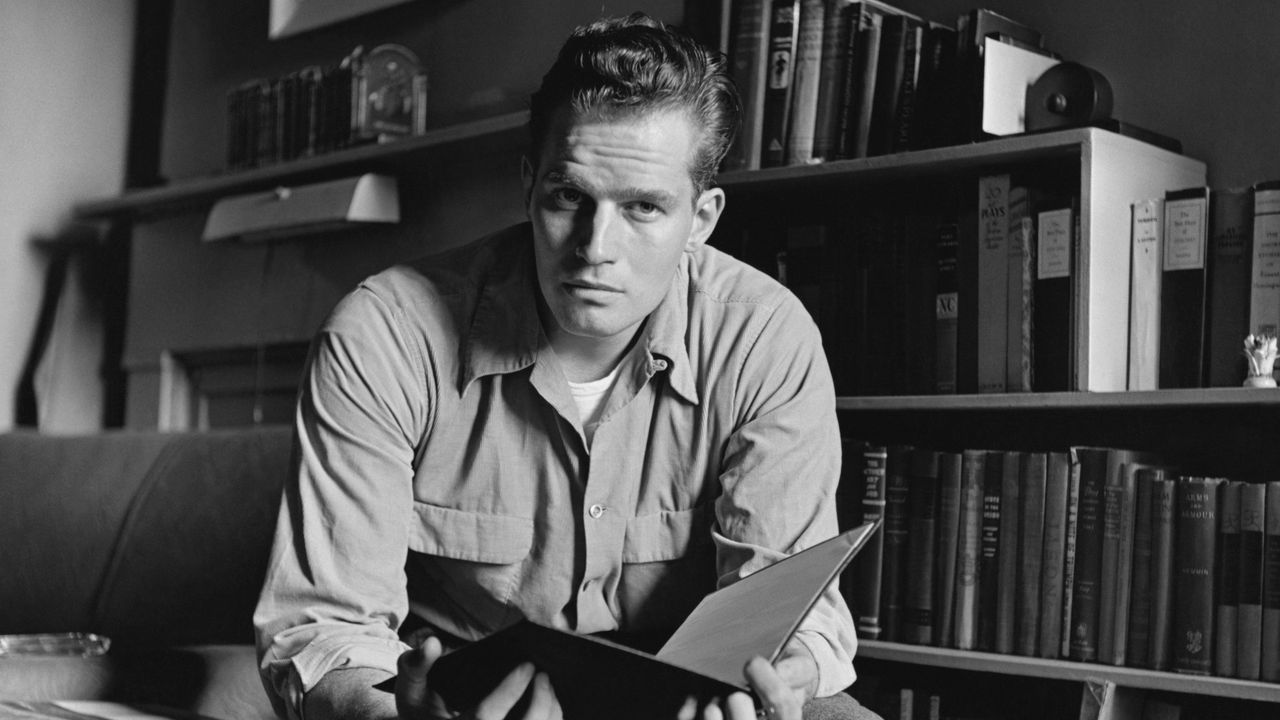
Charlton Heston did extraordinary things onscreen—from parting the Red Sea as Moses in The Ten Commandments to playing the fictional prince Judah Ben-Hur in Ben-Hur, a role that earned him an Oscar. Early on in his career, he even considered the movie set a kind of sanctuary. “The studio was where I lived, really…where the work was,” he wrote in his 1995 memoir In the Arena.Yet amid the dazzling highs of his Hollywood career, Heston cherished something much quieter: time alone at home. “Making films or plays is inescapably a collective undertaking, and many of the people who do it are designated public property,” he wrote. “Still, you need time alone, all by yourself. As a guy brought up in the Michigan woods, I really need it.”Born in 1923 in Evanston, Illinois, Heston was raised in the “backwoods” of the Great Lakes State before becoming an actor and making homes for himself in New York City and Beverly Hills.Below, we’ve rounded up 10 photos of Charlton Heston’s dwellings, including the sprawling California estate he called home for decades until his death in 2008.The actor and his wife in their Hell’s Kitchen home. Photo: George Torrie / New York Daily News via Getty ImagesNew York state of mindHeston married Lydia Clarke in 1944. The couple kept an apartment in New York City’s Hell’s Kitchen, where they’re pictured here in 1951. In his memoir, Heston described the place as a “nineteenth-century railroad flat: four flights of walk-up to two tiny rooms and an alcove for the bed, with two narrow windows in the street wall. There was no heat, but in cold weather the gas oven heated our small space pretty well (in the summer you were out of luck).” He also called it a “steal” at $30 a month and joked that the “cockroaches [were] thrown in for free.”The couple doing dishes in 1951. Photo: George Torrie / New York Daily News via Getty ImagesFeeling thriftyHeston furnished the Hell’s Kitchen apartment with several secondhand items. In his memoir, he wrote that they bought “some cheap linoleum” for the kitchen and outfitted the front room with preowned carpeting. The actor crafted some of the furniture himself. “I built a bed frame into two sides of the alcove, a closet in one corner of the kitchen, and bookshelves along one wall in the living room,” he wrote in his memoir. The couple bought the rest of their furniture from the Salvation Army, an organization for which the actor later recorded commercials. “The fundraising tapes I’ve done for the Salvation Army ever since leave me still in their debt,” he wrote. “They helped us set up a livable space to start off in.”Heston and his wife taking in the city from their window. Photo: George Torrie / New York Daily News via Getty ImagesMovin’ upHeston and Clarke didn’t live in Hell’s Kitchen for long. The famed filmmaker Cecil B. DeMille cast the actor in what would be his breakthrough role, Brad Braden in the 1952 hit The Greatest Show on Earth. So, toward the end of the ’50s, they got a major upgrade. “We’d moved across Manhattan to an awesome penthouse apartment across from the UN,” he wrote in his memoir, “with a tiny kitchen, a huge living room with a fireplace, and a 20-foot ceiling, two bedrooms, two terraces, and a good view of the East River.” And while the place was much nicer, the price was still affordable, at “never more than $480 a month.”Baby Fraser appeared onscreen as Moses. Donaldson Collection/Getty ImagesAnd baby makes threeHeston and Clarke welcomed their first child and only son, Fraser Clarke Heston, in 1955. Fraser followed in his father’s footsteps very early in his life and booked his first acting role as baby Moses in The Ten Commandments. DeMille, who was directing the feature, suggested Fraser for the role. “Months before, when DeMille heard that Lydia’s pregnancy would prevent her coming with us to Egypt, he asked her when the baby was due,” Heston wrote in his memoir. When she responded that the baby was due in February, DeMille said, “Just three months after that, we shoot the Baby Moses scenes…If your baby’s a boy, he could play the part.” After Fraser was born, they received a telegram from DeMille that read: “Congratulations. He’s cast in the part.”The Hestons at the table in 1959. Photo: Richard C. Miller/Donaldson Collection/Getty ImagesFamily manIn 1961, Heston and Clarke welcomed their second child, Holly Ann Heston, through adoption. “We brought Holly home on the second day of her life; she was instantly and forever ours,” he wrote in his memoir. The actor also cheekily reflected on being a father of a boy and a girl. “A father loves his son partly responding to a chromosome identity,” he quipped in his memoir. “You want your son to be you—also himself, and better. But I think a man loves his daughter with a kind of helpless male devotion. I think Holly began to understand that when she was four days old.”The couple embrace at home. Photo: Courtesy Everett CollectionA move to CaliforniaAs he was wrapping up filming the 1958 film Big Country, Heston realized that his family needed more space. “I needed a house,” he wrote in his memoir, adding, “I wanted room for Fray to run in—what I’d had in the Michigan woods.” He ended up finding the perfect spot: “a little ridge of less than three acres, only seven minutes from the Beverly Hills Hotel.” It was surrounded by 800 acres of land, which was home to raccoons, hawks, and deer. The star was so taken with the Coldwater Canyon landscape that he decided to build a house there from the ground up. “I bought it the day I saw it,” he wrote.Heston in the director’s chair at his LA property. Photo: Eric Robert/Sygma/Corbis via Getty Images“The house that Ben-Hur built”In this 2002 photo, Heston and Clarke are pictured at their California home, which was designed by Bill Beckett. In his memoir, Heston wrote that Beckett brought over “several dozen issues of Architectural Digest one evening for our comments” and then “spent a day and a night in a sleeping bag on our ridge to study the light and the land.” According to the Wall Street Journal, construction on the home began while Heston was away filming Ben-Hur and ended as production wrapped. Fraser once shared that his father “always said it was the house that Ben-Hur built.” The estate featured a main house that included four bedrooms, staff quarters, and a two-story library. The property also boasted a screening room, a photo studio, a swimming pool, and a tennis court.The star signs a Ten Commandments poster. Photo: Eric Robert/Sygma/Corbis via Getty ImagesAlone time at “the ridge”Heston’s Beverly Hills estate was his favorite place to get away from the hustle and bustle of the industry, and he cherished his solitude. “That’s why I love my ridge so much,” he wrote in his memoir. “There are a couple of hundred acres of canyon around me still close to the way God made them. Most of the people I want to see, the things I want to do, happen right here.” He particularly loved the home’s amenities. “Pool, tennis court, Jacuzzi, gym, library, screening room—I’ve done TV interviews by satellite from here, linking me to London, live,” he continued. “The only time I really have to leave is for a very serious meeting…or when you’re actually doing the work…a film or a play. I like that.”Heston at home in 2004. Photo: Gilles Mingasson/Getty ImagesEarning his keepIn this 2004 photo, Heston is pictured lounging at his California home in front of a vintage French-language poster of his 1958 film, Touch of Evil. In his memoir, he wrote about how having two children at home and needing to maintain “the ridge” inspired him to work even harder. “The delights of our completed family and the ridge where we would raise our children deepened my determination to make it all secure,” he wrote. “For me, it meant reading a lot of scripts.”Heston died of complications of pneumonia. Photo: Michael Caulfield/WireImage/Getty ImagesForever homeHeston lived at the Beverly Hills home until he died in 2008. Per the Wall Street Journal, it was listed for $12.25 million in 2015. Fraser told the outlet that choosing to sell the home was “a difficult decision.” He also shared that his mother, who died in 2018, had no longer lived there and that the family felt it was “the right time” to part ways with the estate. French film director Luc Besson bought the house and, in 2020, put it back on the market for $14.9 million. In 2025, the home’s undisclosed seller listed it for $10.5 million.
Charlton Heston at Home: 10 Photos of the Star Through the Decades, From a Tiny NYC Pad to a Rambling California Paradise
Full Article
Original Source
Read the full article at Architecturaldigest →KhanList aggregates and links to publicly available news content. We do not host full articles from third-party sources. Always verify important information with original sources.