
This is not the first time Haiti’s crisis has been handled in foreign offices. The Caribbean country has hosted more than 10,000 NGOs and received about a dozen international missions over half a century. Many have pinned their hopes on international cooperation, given the country’s political instability, while others have criticized constant foreign interference that has yielded little. The latest chapter was the arrival of 2,000 Salvadoran soldiers, sent to rescue four compatriots who were part of a U.N.-led military mission. But pacifying the country has become Nayib Bukele’s latest obsession, and he has vowed to “liberate” Haiti as he swears he did with his own country. How he intends to do that remains largely unknown. What does seem clear is that he will attempt it with scant coordination with the other four forces operating in the country. While much of the local population applauds him — including Haiti’s prime minister — the promise to replicate the “Bukele model” in the country has alarmed activists and human rights organizations.Although the Salvadoran soldiers arrived with the blessing of Prime Minister Alix Didier Fils-Aimé, nothing of the agreement between the two leaders has been made public. The duration of the stay, its objectives, and who will oversee operations on Haitian soil have not been disclosed. For now, the troops answer to Bukele, who has a well-documented record of human rights violations.What has emerged is the poor coordination with the other four forces deployed in the Caribbean country: Haitian National Police, Haitian Armed Forces, the Task Force (an armed group linked to U.S. security firm Vectus Global) and the UN-led Gang Suppression Force (GSF). This lack of alignment could particularly affect the civilian population, which does not know where fire might come from or how close civilians are to each force’s targets. For Romain Le Cour, director of the Haiti Observatory at Global Initiative (GI-TOC), it is like “an orchestra without a conductor.” “If it’s not clear who is doing what, it’s also not clear who is accountable if something goes wrong.”Mwen salye angajman fòs salvadoryèn yo nan batay kont gang yo. Kontribisyon GSF, PNH, Fòs Lame Dayiti ak patnè entènasyonal yo pèmèt nou ranfòse operasyon sou teren an, reprann kontwòl teritwa a epi retabli otorite Leta. Chapo Prezidan Nayib Bukele @nayibbukele pou soutyen ak… pic.twitter.com/32ONNe1fmC— Alix Didier Fils-Aimé (@citoyendidier) November 10, 2026 Despite the praise Fils-Aimé has heaped on Bukele on social media — saying he “takes his hat off” to the Salvadoran president — his own popularity is plummeting, precisely because the population attributes recent military actions to Bukele rather than to him. There have been demonstrations in Port-au-Prince in support of the Salvadoran leader. Many people at a demonstration on November 17 said they would also march over state abandonment. It was the second protest in two weeks.Meanwhile, Fils-Aimé is working to create a de-escalation office to coordinate the efforts of all forces deployed on the island. It is the first organizational step in a larger plan that, according to Diego Da Rin, a Haiti analyst at the International Crisis Group, is designed to “avoid stepping on each other’s toes” and prevent friendly fire. The Salvadoran contingent, which includes members of the special forces, is the largest deployed since the end of the United Nations Stabilization Mission in Haiti (MINUSTAH), which was in the country from 2004 to 2017.From the singular to the pluralBukele’s narrative has been changing day by day. Just last Thursday, he announced Salvadoran forces would set up an operational base at Sylvio Cator Stadium — the country’s main stadium, which had been occupied by gangs since 2024 — and which was retaken “as part of a joint operation” with the Haitian National Police, the Haitian Armed Forces, and the Task Force. Sources close to the de-escalation office say that the use of the plural is not trivial and stems from an explicit request by Fils-Aimé, who also wants to be in the photo.Bukele’s tone is very different from late October, when he sent the first 200 soldiers and cast himself as Haiti’s pacifier. “We have already finished with the gangs in El Salvador, and we can finish with you too,” he wrote then on X, referring to what he calls a “mission from God” against “satanic gangs.” Or even as recently as Tuesday, when he celebrated in Creole having destroyed the house of Lanmò San Jou, a Haitian gang leader, and the headquarters of the 400 Mawozo gang. “Most fled without even trying to fight. What cowards!” he added.For those who have spent years documenting the Haitian conflict, the action is more symbolic than effective. The location was well known to all armed actors in the country, but it had not been attacked until it became a priority for the Salvadoran leader. According to Le Cour, this is not accidental. He says it is due to a “Salvadoran effect” in which Haitian authorities are mobilizing “more forcefully and more quickly.” The ongoing propaganda, he notes, has created a sort of “distorting mirror” in which it is unclear who is doing what. Bukele’s naming of targets gives some breathing room to a government with very low popularity and to a society tired of living in a country under siege. “Coordination seems to be starting to take shape. That is good news,” he concludes.“The cure could be worse than the disease”The protection of the civilian population is a concern shared by the four analysts interviewed by EL PAÍS: How will the gangs respond to a Bukele-style escalation? “We know these operations can intensify and begin to enter densely populated neighborhoods,” Da Rin explains. “And we also know that gangs have no qualms about using civilians as human shields. The drive for symbolic victories to broadcast them widely on social media cannot take precedence over the lives of Haitians.” One of the worst-case scenarios is that the gangs form an alliance to face a common enemy.Ana Piquer, regional director for the Americas at Amnesty International, fears the cure may end up being worse than the disease because of the free rein given to the Salvadoran troops and the opacity surrounding their actions. It is precisely El Salvador’s management of gangs — under a perpetual state of emergency and a plan of mass incarceration that has made it the country with the world’s highest rate of people deprived of liberty — that heightens her concern.“Bukele has adopted policies that have dismantled due process and the rule of law, and has committed acts that could amount to crimes against humanity,” Piquer says. “This is not what the Haitian population needs.” Nathalye Cotrino, senior researcher for the Americas division at Human Rights Watch, agrees and calls for long-term measures. “Beyond immediate changes in patterns of violence, how can a meaningful and sustainable transformation that respects and guarantees human rights be achieved?” she asks.Given Haiti’s weak institutions, replicating the “Bukele model” would, Piquer says, go beyond imprisoning people linked to gangs. “It would be a mass extermination. And it’s a short-term view. The situation in Haiti is far more complex and needs complex responses,” she said on a call. “What will happen when they realize that many who work with gangs are children? Because it’s a reality: they are forcibly recruited out of fear of refusing a gang leader or for economic necessity. They are victims of the gangs and could become victims of Bukele,” the lawyer argues. “We risk measures to pacify the country becoming the same human rights violations committed by these illegal groups. And, to date, there are no mechanisms to report those abuses.”Between March 2025 and January 2026, the U.N. recorded 3,497 deaths during security forces operations against gangs; 229 of them were civilians. As of August, Reuters reported that no investigation had been opened, not even into the deaths of 18 minors.Sign up for our weekly newsletter to get more English-language news coverage from EL PAÍS USA Edition
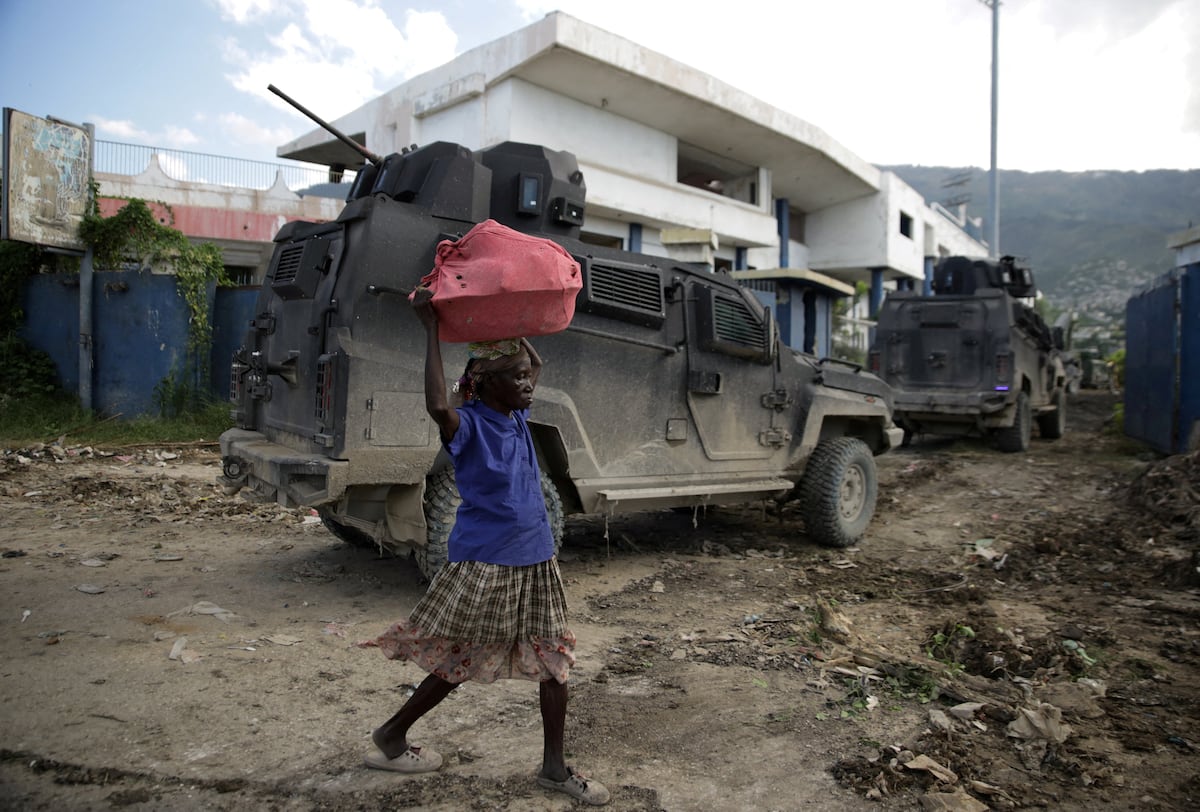
Chaos among the five armed forces operating in Haiti increases risk to the civilian population: ‘It’s an orchestra without a conductor’
Full Article
Original Source
Read the full article at English →KhanList aggregates and links to publicly available news content. We do not host full articles from third-party sources. Always verify important information with original sources.