
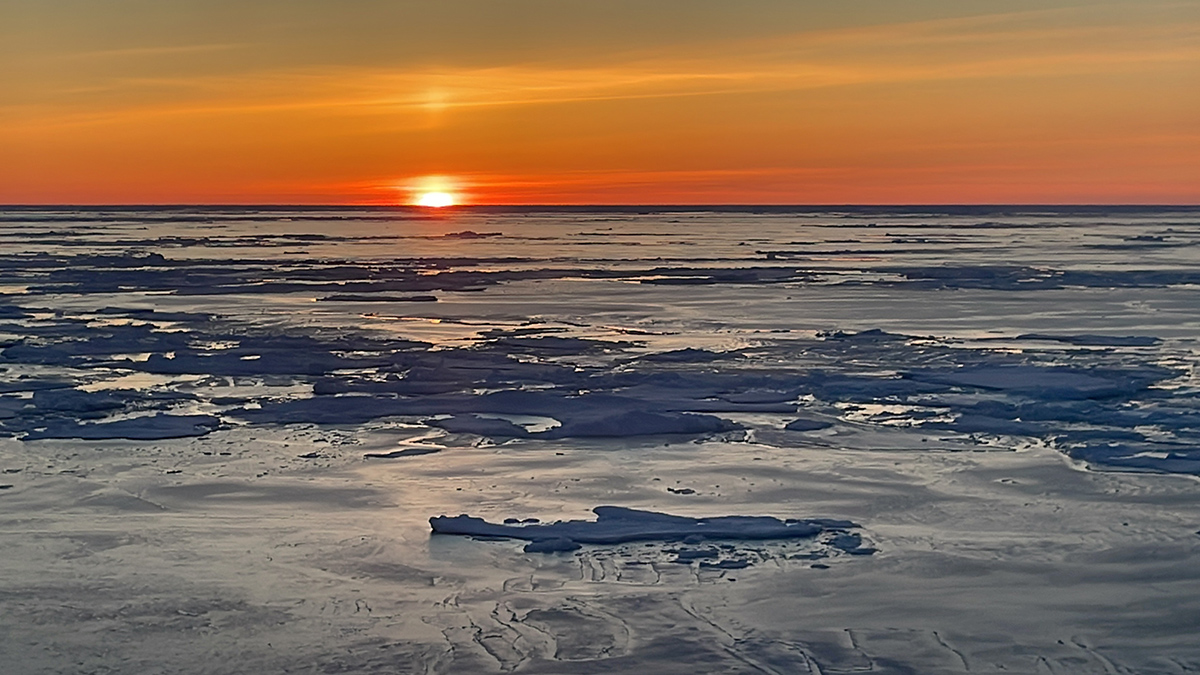
The Pacific Arctic is in transition. Rising temperatures, melting sea ice, and shifting food webs and nutrients mean that the area’s inhabitants—from tiny plankton to massive whales to the humans along the shores who depend on these creatures for sustenance—are affected by these changes. Since 2010, the Distributed Biological Observatory (DBO), an international monitoring program, has been tracking the changes in ice, temperature, and water chemistry across the Pacific Arctic. These long-term observations are extremely important for documenting long-term changes in the Arctic, where research can be expensive and limited by seasonal conditions. Several presentations at AGU’s Annual Meeting 2026 in San Francisco will draw on DBO data to examine how shifts in ocean chemistry and sea ice are affecting marine inhabitants from seafloor to surface. Changing Ocean Composition Sea ice influences the physical and chemical properties of Arctic seawater. When sea ice forms, it excludes salt, making the surrounding seawater saltier and denser, said Natalie Monacci, a chemical oceanographer at the University of Alaska Fairbanks who will present her research at AGU26 on 7 December. Sea ice coverage also affects how long the ocean is exposed to the atmosphere. “If there’s less sea ice, and the ocean is open, meaning it’s exposed to the air for longer periods of the year, it can now do that exchange with the atmosphere a lot longer, so it can absorb more CO2,” said Monacci. “We have direct observations for it, so that’s very helpful to all of our friends who are doing modeling studies and are predicting scenarios for all the biological implications later on.” When carbon dioxide (CO2) dissolves in seawater, it triggers ocean acidification—lowering pH and reducing the availability of carbonate ions. This change in chemistry makes it harder for plankton, clams, snails, and other organisms to build strong shells. Marine algae and other organisms take up CO2 through photosynthesis, so some of this burden is lessened in warmer months when primary production increases. “There’s a temporary relief of some of these conditions, because it’s gobbling up all that carbon dioxide out of the water,” said Monacci. But as organic matter is consumed and decomposed, that carbon is returned to the water, and CO2 rises. Understanding these seasonal changes requires research conducted outside the summer months, when much Arctic fieldwork takes place. Seawater collected in July, for instance, might have different CO2 levels from water sampled in winter. Through the DBO, Monacci and colleagues could collect measurements in November, capturing conditions that summer sampling might miss. “We were able to see that very late season, very high carbon dioxide respiration signal,” Monacci said. “We have direct observations for it, so that’s very helpful to all of our friends who are doing modeling studies and are predicting scenarios for all the biological implications later on.” Changes Across the Food Web Although sea ice coverage has increased since the late 2010s, questions remain about the ecosystem’s resilience. Changes in bottom-water conditions and the timing of seasonal production can have big consequences for the organisms living on the seafloor—and for the larger animals that depend on them for food. In some regions of the Arctic, amphipods like these ones are shrinking in size in the face of changing conditions. Credit: Jacqueline Grebmeier In another AGU26 presentation on 7 December, Jacqueline Grebmeier, a marine ecologist at the University of Maryland who has conducted more than 4 decades of Arctic research, will describe changes in the size and abundance of benthic organisms—bivalves, worms, and small crustaceans called amphipods. Grebmeier is also the recipient of the Rachel Carson Lecture award at AGU26 for her work studying the Pacific Arctic. Near Alaska’s St. Lawrence Island in the Bering Sea, for instance, clam populations have declined, and other species of amphipods are shrinking in size. Predators such as spectacled eiders need to eat more to get the same amount of energy. “You can’t get as much bang for your buck,” Grebmeier said. But changes aren’t occurring uniformly across the Arctic, explained Grebmeier. South of the Bering Strait, many benthic populations are declining. Farther north, earlier sea ice retreat and nutrient-rich waters are contributing to increased production and more organic matter reaching the seafloor. “What you’re seeing is the part of the system that’s the most nutrient rich is not necessarily supporting the amphipods that the gray whales eat. The breadbasket that used to be historically huge is contracted.” More production, however, doesn’t necessarily translate into more food. Gray whales are one of the largest creatures affected by these shifts in amphipod populations and have had to change their feeding grounds on the basis of available prey. At some sampling stations, small clams and other organisms have replaced the species that whales typically eat. “What you’re seeing is the part of the system that’s the most nutrient rich is not necessarily supporting the amphipods that the gray whales eat. The breadbasket that used to be historically huge is contracted,” Grebmeier said. The loss of traditional feeding grounds as well as sea ice has pushed gray whales farther north, causing them to spend more energy to look for food, she explained. The changes occurring in Arctic waters are also affecting Indigenous communities that depend on marine resources for food and cultural traditions. Shifts in sea ice, the distribution of marine animals, and the timing of seasonal conditions all affect where and when people can hunt for culturally important species such as walruses and bowhead whales. Shifts in sea ice conditions are affecting when coastal communities in the Arctic can hunt for species such as walruses and bowhead whales. Credit: Alaska Region U.S. Fish & Wildlife Service/Flickr, Public Domain “The communities that live in this region subsist on species that have shown negative impacts from ocean acidification,” said Monacci. “That could be plankton, because these are whaling communities, and they subsist on whales. Or benthos, which is what [Grebmeier] is studying. That’s what fuels the seals and the walrus and all the other things these communities are subsisting on.” For Henry Huntington, Arctic science director at the Ocean Conservancy, these effects on Indigenous groups represent one reason that long-term research at the DBO is crucial. When shared with communities, scientists’ observations can provide valuable information about the animals and land that Arctic residents depend on. “When it comes to the communities, it’s a question of both abundance and distribution, but also timing,” said Huntington, who was not involved with the research being presented at AGU26. “If we connect that with [Grebmeier’s] work of where the animals are, and whether that’s shifting, all those things can add together to really change the opportunities that people have.” —Rebecca Owen (@beccapox.bsky.social), Science Writer Citation: Owen, R. (2026), Changing Arctic waters reshape life from the seafloor to the coastlines, Eos, 107, https://doi.org/10.1029/2026EO260369. Published on 19 November 2026. Text © 2026. The authors. CC BY-NC-ND 3.0Except where otherwise noted, images are subject to copyright. Any reuse without express permission from the copyright owner is prohibited.
Changing Arctic Waters Reshape Life from the Seafloor to the Coastlines
Full Article
Original Source
Read the full article at Eos →KhanList aggregates and links to publicly available news content. We do not host full articles from third-party sources. Always verify important information with original sources.