
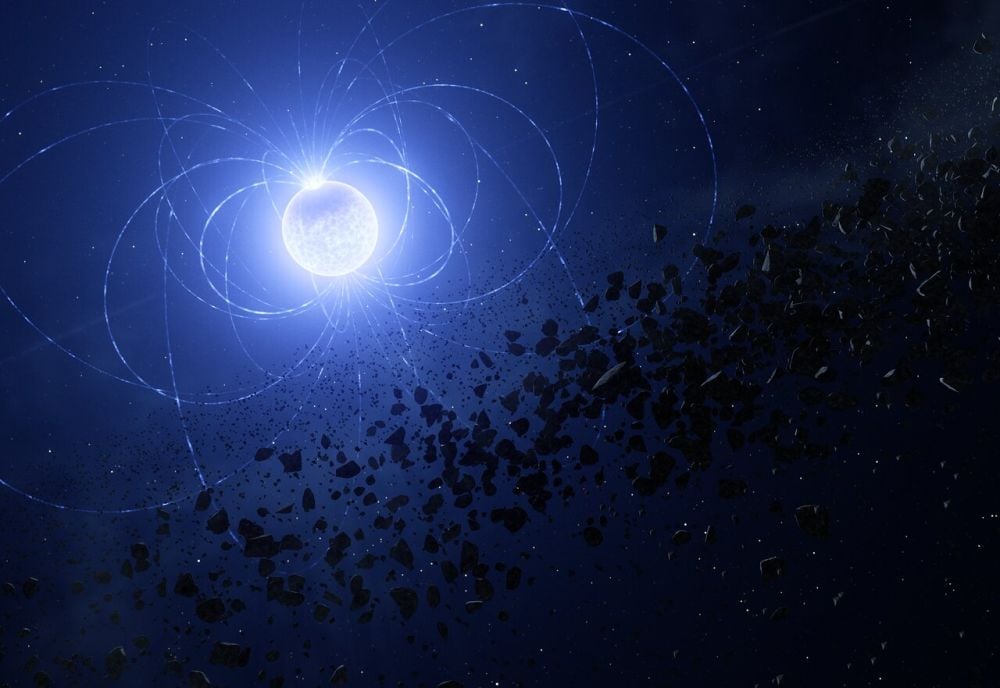
In the 1930s, Subrahmanyan Chandrasekhar placed a limit on stars. Using our understanding of relativity and quantum theory, Chandrasekhar demonstrated that white dwarfs could never have a mass greater than 1.44 suns. It didn't matter how they formed or whether they were mostly hydrogen or carbon. The very laws of physics forbid a greater mass. White dwarfs are the remains of smaller stars such as the Sun. When such a star runs out of fusable hydrogen, it swells to a red giant in a mad race to burn heavier elements. But without enough mass to achieve that reliably, the star soon collapses into a nuclear shell. Gravity wins the day, and the star can burn no more. Without nuclear pressure, the core collapses under its own weight until the quantum pressure of electrons can push back. The stable balance between gravity and electrons is what keeps the star from collapsing into a neutron star. Chandrasekhar was the first to prove that relativistic electron pressure can only counter gravity up to 1.44 solar masses. It became known as the Chandrasekhar limit. For decades this limit was thought to be rock solid. Theorists, forever bothered by limits, imagined ways a white dwarf might overcome this limit, but the observational evidence supported Chandrasekhar. This is part of the reason we can use Type Ia supernovae as a standard candle, since they are triggered by the collision of two white dwarfs. But then in 2003, the Supernova Legacy Survey observed a supernova that seemed to defy the Chandrasekhar limit. Perhaps the progenitor was rotating rapidly or hadn't fully collapsed when it exploded. As similar limit-defying supernovae were observed, the evidence began to chip away at Chandrasekhar's rock-solid prediction. But how could a super-Chandrasekhar white dwarf possibly form? This is the question explored by a recent publication in The Astrophysical Journal Letters. The study focuses on one way white dwarfs can break the limit: magnetic fields. If a white dwarf were to be highly magnetized, then the electrons would interact with the magnetic field in a way that gives them an extra boost. The magnetic field prevents them from settling down, meaning that they can push back more easily against gravity. In theory, such a white dwarf could be nearly 3 solar masses before collapsing. We know that neutron stars can be highly magnetized as magnetars, but they are formed from much larger stars. The key question is whether a Sun-like star could have such a strong magnetic field and still collapse into a white dwarf. To answer this question, the team ran simulations using a modified version of STARS, which is used by many researchers to study stellar evolution. They added the effect of magnetic fields into the mix and modeled how a magnetic star evolves from the main sequence to a white dwarf. What they found is that a sun-like star doesn't need to be highly magnetized from the get-go. Even though a dying star casts off much of its outer layers as it swells to a red giant, the magnetic field remains with the star. As the core collapses to a white dwarf, the magnetic field is concentrated with the core. This means a highly magnetic white dwarf can form from a fairly typical star. The study shows that magnetized white dwarfs may be more common than we thought. This study could help explain why some white dwarfs appear to be larger than their mass would predict, since magnetic fields would swell the star measurably. This could also explain events such as the 2003 super-Chandrasekhar supernova. Sometimes when you test the limits of astrophysics, you learn something new about the Universe. Reference: Zuraiq, Zenia, et al. "Super-Chandrasekhar White Dwarfs by the Evolution of Magnetized Main-sequence Stars: New Mass Limits from STARS Simulation." The Astrophysical Journal Letters 1010.1 (2026): L8.
Chandrasekhar Placed A Limit On White Dwarfs, But A New Study Finds This Limit Is Not Absolute
Full Article
Original Source
Read the full article at Universetoday →KhanList aggregates and links to publicly available news content. We do not host full articles from third-party sources. Always verify important information with original sources.