
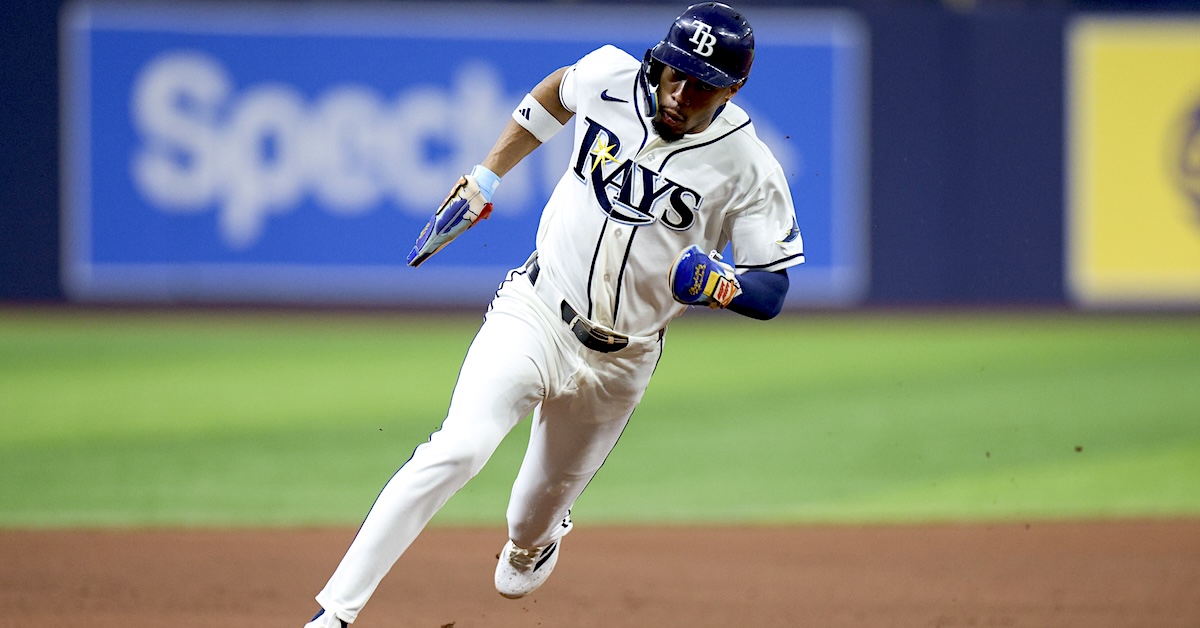
Nathan Ray Seebeck-Imagn Images A couple years ago, I wrote an article about Amed Rosario. Rosario was just coming off the best season of his career, a 3.1-WAR 2022 campaign in which he’d posted a 104 wRC+ and manned shortstop for the Guardians. He’d led the majors with nine triples, but I was interested in another category where he’d not only led the league but also left everyone else in his dust. Statcast credited Rosario with 369 competitive runs. That was nearly 70 more than any other player in 2022, and it’s still the highest single-season total ever recorded. As there’s no reason for you to remember what a competitive run is, let’s start with a refresher. In order for Statcast to do a good job of measuring a player’s average sprint speed, it needs to pick the right plays, when they’ll be running hard and reaching their maximum speed. If you hit a routine groundout to the shortstop and run down the baseline at a businesslike 80%, that’s not really a reflection of your top speed. You’re not running competitively. Statcast only assesses sprint speed on plays where a batter is running to first after a “topped” or “weakly hit” ball, or plays where they run two or more bases (except when they score from second on an extra-base hit). Those are competitive runs, and I’m going to quote from my old article to explain why I think they’re worth writing about: I don’t know about you, but I think this is incredibly fun. Competitive runs is an incidental statistic. It’s just scaffolding for another stat, but there’s one person who plays baseball like competitive runs is his own personal pinball machine. The other reason I love it is that even though competitive runs exists only to serve a higher master, it’s still a descriptive stat in its own right. A player’s competitive runs total tells you plenty about the way they play the game. In order to lead the league in competitive runs, you need to put the ball in play a lot, which means no striking out and, to a lesser extent, limited walking. You need to hit the ball weakly and on the ground, but you also need to reach base a lot so that you can make all those first-to-thirds and second-to-homes. Your offensive game needs to revolve around speed and ground-based contact. I’ve left out one other prerequisite, but already, it’s starting to sound like I’m describing one player in particular, right? A month ago, I broke down Chandler Simpson’s swing in some detail, because it is truly unique. There is no one else who hits like Simpson. He’s got the fastest home-to-first time in baseball, and his swing is designed specifically to put the ball in play on the ground. He puts less of his body into his swing than anyone else, which obliterates his power but makes his swing supremely adjustable. Because he swings so slowly and has one of the flattest hacks in baseball, his bat stays in the hitting zone and on plane with the baseball forever. It’s the reason he can put up the third-highest contact rate in baseball and the reason he never hits it in the air. Some players come to the plate focused on putting the ball in the air. More think about hitting a line drive. Simpson is explicitly thinking “low line drive, hard groundballs.” Simpson has spent the playoffs showing a national audience what he’s capable of: laying down picture perfect bunts, stealing bags, running down fly balls, and forcing opposing infielders to hurry themselves into errors. Even more than Rosario’s in 2022, Simpson’s game seems like it was designed in a lab to maximize competitive runs. His entire approach is focused on giving him opportunities to showcase his legs, and he’s been so successful at it that he led the AL in steals and came close to winning a batting title. It should come as no surprise that he led baseball with 359 competitive runs this season. But earlier I mentioned that I’d intentionally omitted one of the prerequisites for leading the league in competitive runs. It’s the reason that Rosario still holds the single-season record rather than Simpson. Here’s the single-season leaderboard for competitive runs.You Aren't a FanGraphs MemberIt looks like you aren't yet a FanGraphs Member (or aren't logged in). We aren't mad, just disappointed. We get it. You want to read this article. But before we let you get back to it, we'd like to point out a few of the good reasons why you should become a Member. 1. Ad Free viewing! We won't bug you with this ad, or any other. 2. Unlimited articles! Non-Members only get to read 10 free articles a month. Members never get cut off. 3. Dark mode and Classic mode! 4. Custom player page dashboards! Choose the player cards you want, in the order you want them. 5. One-click data exports! Export our projections and leaderboards for your personal projects. 6. Remove the photos on the home page! (Honestly, this doesn't sound so great to us, but some people wanted it, and we like to give our Members what they want.) 7. Even more Steamer projections! We have handedness, percentile, and context neutral projections available for Members only. 8. Get FanGraphs Walk-Off, a customized year end review! Find out exactly how you used FanGraphs this year, and how that compares to other Members. Don't be a victim of FOMO. 9. A weekly mailbag column, exclusively for Members. 10. Help support FanGraphs and our entire staff! Our Members provide us with critical resources to improve the site and deliver new features! We hope you'll consider a Membership today, for yourself or as a gift! And we realize this has been an awfully long sales pitch, so we've also removed all the other ads in this article. We didn't want to overdo it. In case you didn't read all that, here's the short version. Membership includes:✓Ad-free browsing✓Unlimited FanGraphs & RotoGraphs articles✓Historical & platoon projections✓Leaderboard & player-page stat heatmaps✓One-click data exports✓Customizable player-page dashboards✓Dark & Classic site modes✓Weekly Members-only mailbag✓FanGraphs Walk-Off, your year in review✓Optional homepage photo removal✓Gift articles to non-Members✓Full postseason coverage Single-Season Competitive Runs Leaders Source: Baseball Savant Simpson ranks fourth, even though everyone else on the list got way more plate appearances than he did. The prerequisite I left out is that you need to be a good enough hitter (or play on a bad enough team) to play everyday and hit at the very top of the lineup. Competitive runs is a counting stat, after all. All of the other players on this list spent at least a plurality of their time batting first or second. Simpson made a plurality of his plate appearances in the five hole, and he spent nearly as much time batting sixth as he did in the leadoff spot. That has cost him a significant number of plate appearances. The meritocratic tyranny of the batting order is very real. Awhile back I calculated that even if they never got pinch-hit for, it would take an average nine-hole hitter 26 more games than the leadoff hitter to qualify for the batting title. That’s why the nerds have succeeded in getting nearly every team to move its best hitter into the two-hole. To be clear, Simpson isn’t blameless here. The Rays sometimes sit him when facing lefties because he has just a 76 wRC+ against them across his two years in the majors. He ran an overall wRC+ of 93 this season. If he’d been at 104, as Rosario was in 2022, he likely would’ve spent the whole season batting leadoff. Because the Rays had one of the league’s better offenses, he would’ve gotten up over 700 plate appearances, and he would’ve outrun the competitive run competition. If we turn competitive runs into a rate stat, Simpson would be first on that list rather than fourth. He averaged 0.59 competitive runs per plate appearance. When he comes to the plate, there’s a nearly 60% chance that you’ll get to see him running full tilt. The good news is that Simpson is still in just his second year in the majors. We can’t guarantee that he’ll continue to improve at the plate, but he’s 25 and has plenty of time to keep developing. As Baseball America’s JJ Cooper has noted, Simpson wasn’t just going for a batting title this year; he was trying to become the first player ever to win one in college, the minors, and the majors. Because his speed adds so much value to his overall offensive profile, he wouldn’t need to improve all that much at the plate to have an undeniable case as Tampa’s everyday leadoff man. Simpson just notched the fourth-highest competitive runs total ever recorded while spending most of his time batting fifth and sixth. If he does ever spend a whole season in the leadoff spot, he’s going to blow the doors off Rosario and everybody else on that list. Davy Andrews is a Brooklyn-based musician and a writer at FanGraphs. He can be found on Bluesky @davyandrewsdavy.bsky.social.
Chandler Simpson Could Be the King of Competitive Runs
Full Article
Original Source
Read the full article at Blogs →KhanList aggregates and links to publicly available news content. We do not host full articles from third-party sources. Always verify important information with original sources.