
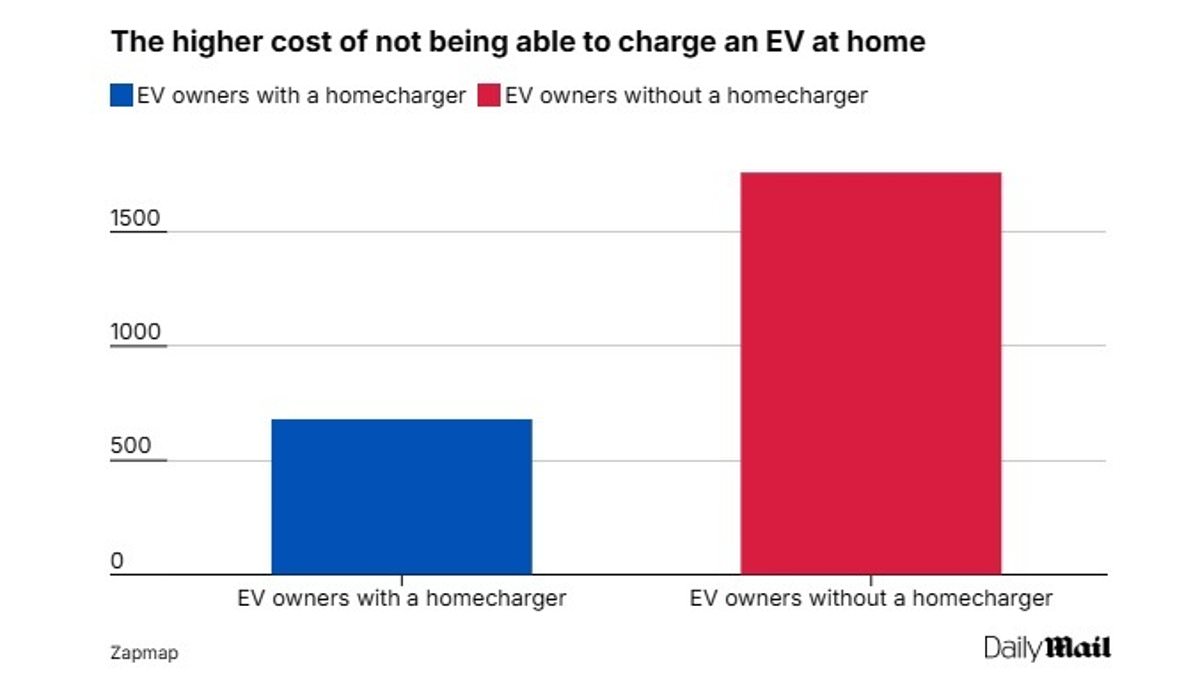
Labour's plan to tackle higher public charging costs for electric car drivers without off-street parking will barely dent a £1,000-a-year cost gap between motorists who can charge at home and those who cannot, experts warned in the wake of the Budget.Chancellor John Healey today pledged £100million towards reducing the cost burden for EV owners who are unable to plug in at their properties between 2027 and 2029.The measure, due to be introduced from next spring, is expected to save the average EV driver without a home charger around £150-a-year.However, it will do little to narrow the so-called 'driveway divide' facing electric car owners across Britain.For the estimated nine million people living in properties without a driveway, the additional cost of relying on public charging instead of home charging exceeds £1,000 a year.Currently, motorists covering 10,000 miles annually and charging primarily at home spend around £680 a year powering an EV. In contrast, an owner without access to a home charger pays about £1,760, according to Zap-Map data. Chancellor John Healey today pledged £100m towards reducing the cost burden for EV owners who are unable to plug in at home. But it will fail to narrow the £1,000-a-year differenceLabour says the funding announced on Wednesday will act as a stopgap while it establishes a taskforce to explore allowing drivers to pay the same rate they would at home when using slower public charging points in the future.The Chancellor's pledge also does little to soften the blow for campaigners, after the Government opted not to reduce VAT on public charging to match the lower rate paid on domestic electricity, in what EV experts have branded a 'missed opportunity'.The Government's estimate of a £150 annual saving is based on charging costs of 6.4p per mile, assuming average EV energy consumption of 0.303kWh per mile and annual mileage of 8,000 miles.The £100million funding will be split across two financial years, with £50million allocated in 2027-28 and a further £50million in 2028-29.The move follows a report by independent energy expert Philip New, which highlighted the stark inequality between EV drivers who can charge at home and those forced to rely on public infrastructure.Among his recommendations was a proposal to allow EV owners to 'port' their domestic electricity tariff, enabling them to access the same rates at lower-powered public charge points.However, because such a scheme would take time to implement, the £100million commitment is intended as a short-term measure to reduce costs for drivers without driveways.Even so, the savings will barely scratch the surface of the price gap. Based on average charging costs recorded in September, drivers with home chargers typically pay around 8.9p per kWh to power their electric cars.By comparison, the average pay-as-you-go rate at a slow-speed public charging point rated between 3kW and 49kW is 54p per kWh, around six times higher.In a further blow to drivers without driveways, Healey confirmed that the temporary removal of VAT on domestic energy will be extended until July 2027, benefiting households able to charge EVs at home.He also announced legislation clarifying that electricity supplied through publicly accessible and workplace EV charge points will remain subject to 20 per cent VAT and will not qualify as domestic energy use for Climate Change Levy purposes, further disadvantaging motorists without off-street parking.The decision comes despite months of campaigning by motoring organisations and EV groups calling for VAT on public charging to be reduced to match the lower rate applied to domestic electricity.Join the discussionIs it fair that EV owners without driveways pay so much more to charge their cars than those who can charge at home?What's your view?Shane Brennan, chief executive of ChargeUK, said the Budget announcements 'will do serious damage to the EV transition'.'Instead of listening to the call of EV drivers for fairness on VAT the government has slammed the door shut on ending a rank unfairness between at home and out of home charging.'Brennan also dismissed the £100million funding package and the proposed taskforce as 'too little, too complex and too slow to make a meaningful difference'.Dr Vicky Edmonds, chief executive of Electric Vehicle Association England, said: 'Electric cars are already delivering cheaper motoring for many drivers across the UK. But for people who cannot afford the upfront cost or don't have a driveway to charge at home, those savings are currently out of reach.' More details of electric car pay-per-mile tax The Budget document has also clarified further details of the Electric Vehicle Excise Duty (VED) (eVED) pay-per-mile tax being levied on drivers of battery-powered cars from April 2028.This will see EV owners charged 3p for every mile they drive, while plug-in hybrid vehicle owners will also be stung 1.5p as the Treasury looks to recover lost income from traditional fuel duties as more drivers switch to low emission cars.It confirmed today there will be a new tool that allows EV owners to estimate and declare their mileage at the beginning of each fiscal year.Alternatively, it is outlining a means for drivers to automatically share their cars' mileage to ease the process rather than having to estimate at the start of the year.The Treasury also committed to developing an automated refunds model by 2030, making refunds easier and available in more circumstances, such as when a motorist overestimates their mileage or sells their car.According to the Office for Budget Responsibility, eVED will add some £2billion to VED revenues by the 2031-32 fiscal year.
Chancellor's bid to tackle higher public EV charging costs fails to plug a £1,000-a-year 'driveway divide'
Full Article
Original Source
Read the full article at Dailymail →KhanList aggregates and links to publicly available news content. We do not host full articles from third-party sources. Always verify important information with original sources.