
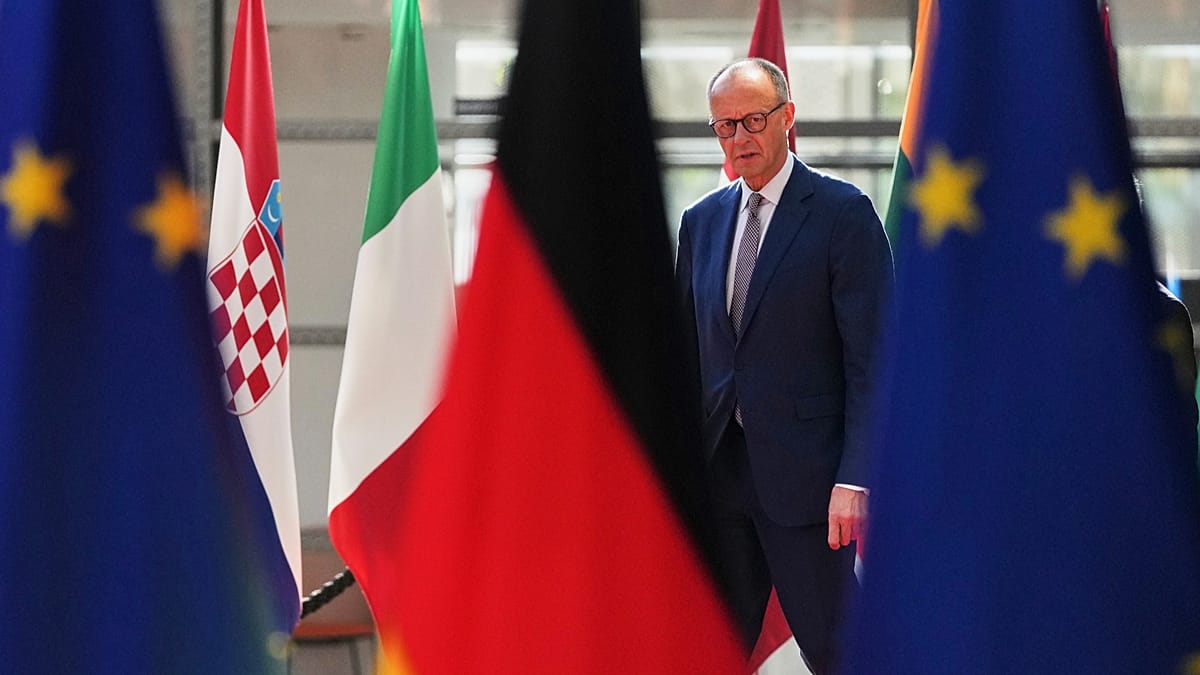
"Yesterday's result has changed not only Saxony-Anhalt, but Germany as a whole," the downtempo chancellor told reporters in Berlin on Monday afternoon as he attempted to pick up the pieces of a disastrous election in the country’s east. "There will have to be consequences," he said. ADVERTISEMENT ADVERTISEMENT As a reminder: The far-right, anti-migration Alternative for Germany (AfD) won 43.8% of Sunday’s regional vote, which is more than double its showing five years ago. That was far ahead of Merz’s party, the centre-right Christian Democratic Union of Germany (CDU), which polled 17.2% — losing about half its support — and winning 15 seats. The rest of the seats were divided between the centre-left Social Democrats, Greens, the Left Party and BSW. In short, this was a mammoth loss for Merz’s party and his leadership, while serving as a major victory for the AfD. Former German government spokesperson Béla Anda just told Europe Today that it is going to be “very hard” for Merz to regain control of the political situation going forward. Watch. As my colleagues Luca Bertuzzi and Vincenzo Genovese write in this must-read analysis, this landslide victory for the AfD may mark the first real crack in the power structure that has held European politics together since World War Two. For Germany, however, the result raises major questions about who can best govern Europe’s largest economy, as it struggles with sluggish growth and an increasingly divided population. No comment: The EU executive would not comment on the results at Monday’s midday press conference in Brussels. European Commission President Ursula von der Leyen was also asked this question point blank in Greenland while trumpeting a €200 million partnership deal with the autonomous Arctic territory. “There is a golden rule in the Commission. Never to comment on national elections, and thus also regional elections,” she said, smiling. This has not stopped the capitals, however, from weighing in, with Polish Prime Minister Donald Tusk writing on X, “In Poland, only idiots or traitors could rejoice the AfD triumph in Germany.” Russian presidential envoy Kirill Dmitriev went the other direction by stating the victory was “historic” for the “pragmatic AfD that will put migration under control”. Movers and shakers: The Mayor-President of Ceuta Juan Jesús Vivas will be in Brussels today to attend a European Parliament committee on civil liberties, and will later meet with the EU’s migration boss, Magnus Brunner. Vivas is expected to fire off some spicy comments about the migration crisis in the Spanish enclave in July, which saw 80,000 individuals originating from Morocco storm the territory, leading to a national political crisis and calls for Spanish Prime Minister Pedro Sánchez to resign. One EU official, speaking on condition of anonymity, told my colleague Vincenzo that Madrid doesn’t want the European Commission to meddle too much in migration affairs. This feels a little bit rich, considering Spain requested extra financial assistance to deal with the widening humanitarian crisis in the territory, as well as boosted support from Europe’s border and coastguard Frontex. We were told, however, to watch a clash brewing ahead of October’s European Council summit, where the migration drama is expected to widen among heads of state. It's your funeral: The convicted Bosnian Serb war criminal Ratko Mladić was given a pompous funeral in Belgrade yesterday, with government ministers among those paying their tributes. This is despite authorities earlier saying he would not be laid to rest with military or state honours, and warnings from the EU that any glorification of his death would be incompatible with the bloc’s “values”. As Mared Gwyn reports, the images coming out of Belgrade on Monday show a hero’s funeral attended by thousands of bystanders, officiated by the Patriarch of the Serbian Orthodox Church, Porfirije. Mladić, also known as the Butcher of Bosnia, had his coffin draped in the Serbian flag with war veterans in uniform standing guard. “Any glorification of war criminals, genocide denial and revisionism contradicts the most fundamental European values,” European Commission spokesperson Christian Wigand said when hit with a barrage of questions by reporters. The Commission could not confirm whether the EU chief von der Leyen would visit Serbia later this year on a trip through the Western Balkans, or whether it would be postponed. This was the case for the EU’s enlargement tsar Marta Kos. Death knell: The question underscoring this episode is whether the controversial funeral will seriously damage Serbia’s bid to join the bloc. It has certainly soured the country’s relations with Bosnia Herzegovina, with their ministry of foreign affairs announcing at a press conference on Monday that certain diplomatic staff would be recalled from their embassy in Belgrade. On top of this, there would be a suspension of bilateral meetings, and the reduction of communication with Serbia to the lowest possible level. The European Commission wasn’t safe from Bosnia and Herzegovina's spray, either, with the Sarajevo foreign affairs ministry blasting a range of top Brussels officials, such as von der Leyen and senior diplomat Kaja Kallas, in an online statement. “Your position on the funeral of a convicted war criminal is a disgrace to the entire European Union!” it says. Air defence: As Euronews’ NATO correspondent Shona Murray reports, a virtual meeting of the so-called Ukraine Defence Contact Group (UDCG) is taking place today. As a refresher: this is around 50 countries banded together aiming to give additional military support to Ukraine. Today’s meeting will focus on getting desperately needed air defences to Ukraine amid a global shortage. On the back of this, my Ukrainian colleague Sasha Vakulina reports that Washington is currently exploring whether Ukraine and Russia could take steps to reduce the intensity of the war over the winter. This follows an American delegation to Moscow over the weekend, attended by US envoy Steve Witkoff and Trump’s son-in-law Jared Kushner, aiming to kickstart negotiations but producing no breakthrough. Ukraine’s former economy minister Tymofiy Mylovanov just said on Europe Today that these are "serious attempts" to restart negotiations aimed at bringing Russia’s full-scale invasion to an end. But the situation isn’t cut-and-dry, as Russia’s terms are unacceptable to Kyiv. "This is a development, but a very limited one," he said. Watch. Von der Leyen tries to counter Trump with €200 million investment in Greenland The European Union will invest an additional €200 million in Greenland over the next two years to deepen economic ties and extract raw materials, Ursula von der Leyen announced on Monday during an official visit to the vast Arctic island. "We know that the Arctic has become one of the places where the tectonic plates of geopolitics collide, so we have a direct stake in what happens here," the president of the European Commission said in Nuuk. The financial package aims to expand the bloc's presence in the semi-autonomous territory, which has long been in US President Donald Trump's sights. Trump has rattled the transatlantic alliance with his push to seize Greenland from the Kingdom of Denmark. Tensions peaked in January, when he threatened to impose steep tariffs to pressure Denmark into relinquishing the territory. He later backed down amid backlash. But in July, Trump suddenly revived his ambition to annex the island, indicating the subject was still top of his mind. On Monday, he posted a map of the world that showed Greenland under American control. Von der Leyen used her trip to Nuuk to underline European support amid what she called "enormous pressure", though she did not mention Trump by name. Jorge has the Arctic-flavoured story. More from our newsrooms AfD victory exposes divisions in France’s far-right as National Rally stays silent France’s far-right responded in markedly different ways to the AfD’s sweeping victory in Germany’s regional elections, with the National Rally (RN) maintaining a conspicuous silence on Monday while Éric Zemmour’s Reconquête openly celebrated the result. Estelle Nilsson-Julien and Vincenzo have the analysis. Latvia bans Russian and Belarusian books, citing propaganda concerns The Baltic nation of Latvia has become the first European country to ban imports of Russian consumer goods including books and print media, framing the move as a defense against Kremlin disinformation and hybrid warfare. Simon Ormiston has more. UN rights chief warns how AI could pose ‘existential risk to humanity’ The United Nations human rights chief Volker Türk has warned that advanced artificial intelligence could pose an “existential risk to humanity”, calling for immediate action to make the technology safer. Doloresz Katanich has the details. We're also keeping an eye on European Commissioner for Trade Maroš Šefčovič meets with Germany’s Economy Minister Katherina Reiche and Germany’s Foreign Affairs Minister Johann Wadepuhl in Berlin. European Commission Vice-President Kaja Kallas meets Lithuania’s Foreign Affairs Minister Kęstutis Budrys and Lithuanian Defence Minister Robertas Kaunas in Vilnius. European Commissioner for the Economy Valdis Dombrovskis meets with the International Monetary Fund’s Managing Director Kristalina Georgieva in Brussels. European Commissioner for the Budget Piotr Serafin meets with various banking representatives in Seoul, South Korea. European Commissioner for the Mediterranean Dubravka Šuica meets with Spanish Minister of Foreign Affairs José Manuel Albares in Brussels, Belgium. European Commissioner for Enlargement Marta Kos meets with senior female parliamentarians from the Rada of Ukraine. That’s it for today. Sasha Vakulina, Jorge Liboreiro, Vincenzo Genovese, Shona Murray and Mared Gwyn contributed to this newsletter.
Chancellor Friedrich Merz: The sick man of Germany?
Full Article
Original Source
Read the full article at Euronews →KhanList aggregates and links to publicly available news content. We do not host full articles from third-party sources. Always verify important information with original sources.