
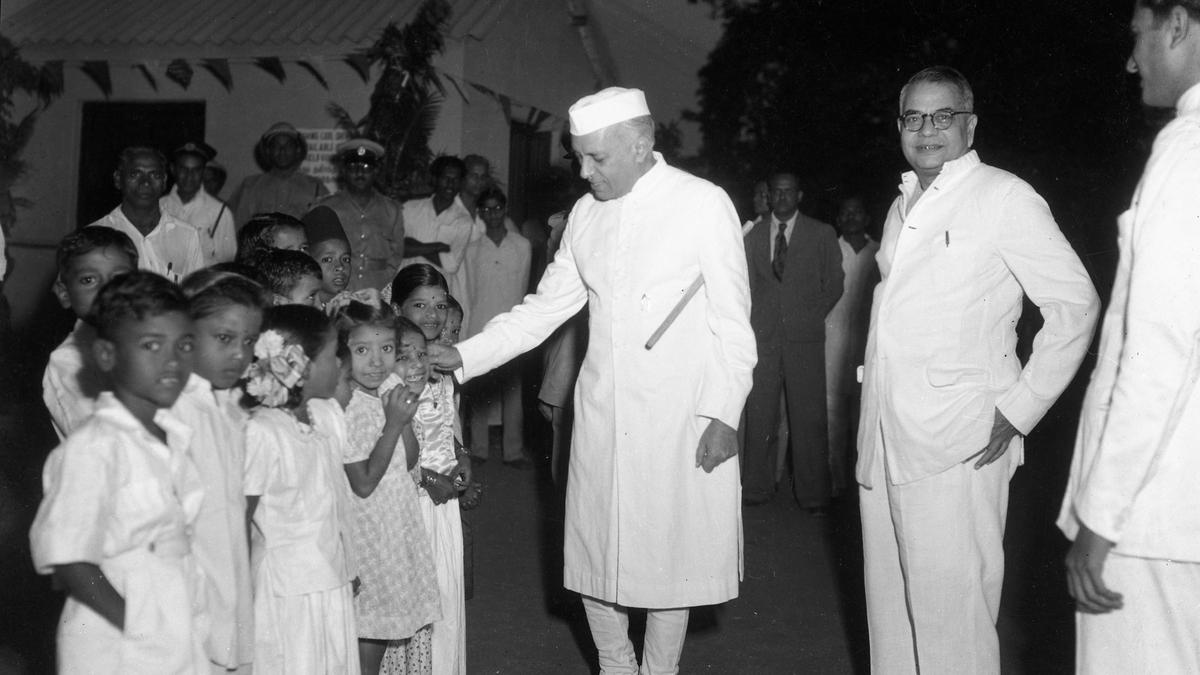
Whether it is through school celebrations, sweets, or speeches, Children’s Day is celebrated every November 14th to honour Jawaharlal Nehru — independent India’s first prime minister — on his birth anniversary. Nehru loved children and believed they were the torchbearers of India’s future, and that the nation should do what it takes to care for and educate them. Prior to shaping India, he lived a sheltered life, worked as a lawyer, and read a lot of great works. Nehru with his family. | Photo Credit: SPECIAL ARRANGEMENT Early lifeAs a child, Nehru was educated at home by private tutors and governesses. He later went to study in Harrow School in England. He graduated with a degree in natural sciences in 1910 from Trinity College, Cambridge. During this time, he also studied politics, economics, history, and literature. He then studied law in London’s Inns of Court, the professional associations for barristers in England and Wales, and became a barrister (a lawyer who argues cases, researches the law and gives legal opinions) in 1912. In this image, he is seen with his family.Nehru had the nationalistic spirit while he was still young. These feelings were further intensified by the Second Boer War and the Russo-Japanese War. He wrote in his autobiography, Toward Freedom, about the Russo-Japanese War, stating “Japanese victories stirred up my enthusiasm. ...Nationalistic ideas filled my mind. ... I mused of Indian freedom and Asiatic freedom from the thraldom of Europe.” Nehru with Gandhi in 1942. | Photo Credit: THE HINDU ARCHIVES Venturing into politicsNehru was not too keen on his practice of being a lawyer. He would later quit his profession and focus on patriotic politics instead. In 1916, he met Mahatma Gandhi for the first time during the Lucknow Session of the Congress. Gandhi greatly influenced his perspective on the freedom struggle. He became a part of his satyagraha politics. The 1919 Jallianwala Bagh massacre further fuelled his immersion in political agitation. He played an influential role in the non-cooperation movement launched in 1920. By this time, he was fully immersed in the fight for freedom. Nehru celebrating Holi with some children. | Photo Credit: THE HINDU ARCHIVES He became General Secretary of the All India Congress Committee in 1923 and helped lead the Congress organisation on a national scale. He was then elected President of the Allahabad Municipal Corporation in 1924 and worked on education, healthcare, and sanitation.He became an advocate for complete independence. In 1929, he presided over the Lahore Session of the Indian National Congress where the party adopted Purna Swaraj (complete independence) as its goal. He was leading Congress during crucial phases of the nation such as the Civil Disobedience Movement. He was also imprisoned many times for his political activities. He began to be seen as the natural successor to Gandhi.Nehru was not afraid to express his desire for democracy and freedom. Even in prison, he insisted that the mind must remain free. For him, freedom was not only the end of British rule; it was the ability to think, read, question, and live with dignity. Such a thought was highlighted in his autobiography, Toward Freedom. “Therefore, it was with the intense joy of mental and spiritual deliverance from an intolerable burden that I watched the actual outbreak of such an inner explosive force, as that which actually occurred when Mahatma Gandhi spoke to the heart of India the mantram — ‘Be free! Be slaves no more!’ — and the heart of India responded. In a sudden movement her fetters began to be loosened, and the pathway of freedom was opened.””An excerpt from Toward Freedom Jawaharlal Nehru signs India’s Constitution at the final session of the Constituent Assembly on January 24. 1950. | Photo Credit: Special Arrangement Building a nationNehru became prime minister on August 15, 1947, just a few hours into the country’s independence. From then on, as PM, he helped guide India through its year after Partition.His government established the Planning Commission in 1950 and launched Five Year Plans to guide India’s economic development. Throughout his tenure, he supported public-sector industries, and large infrastructure projects as foundations of self-reliance. He also promoted scientific temper, and invested in higher education and research institutions such as the IITs, IIMs, and AIIMS.Nehru was all for using scientific thought judiciously and wisely. In Glimpses of World History, he explains the good and bad that scientific thought has done to mankind. While it expanded the world and gave it new technologies, like the telegraph, telephone, and airplanes; it made man want to control nature, and man couldn’t control himself. And so he misused it. ““A tool is a good thing; it helps to lighten work. But of course a tool may be misused. A saw is a useful tool, but a child may hurt itself with it. A knife is one of the most useful things you can have. Every scout must have it. And yet a foolish person may kill another with the knife. It is not the fault of the poor knife. The fault lies with the person misusing the tool. In the same way modern machinery, good in itself, has been and is being misused in many ways. Instead of lightening the burden of work on the masses, it has often made their lot even.””An excerpt from Glimpses of World HistoryHe also helped establish bodies such as the Lalit Kala Akademi and Sahitya Akademi, reflecting his belief that education should include art and culture. Sri Jawaharlal Nehru with children. | Photo Credit: The Hindu For childrenNehru’s affection for children reflected in his policies. He believed that every child had a right to compulsory education, and so his Five-Year plans ensured free and compulsory education for children across the country. In 1955, he established the Children’s Film Society of India to make films specially for children. He also established the National Bal Bhawan in 1956, to provide opportunities for creative pursuits to children in the age group of 5 to 16 years. Nehru died in office on 27 May 1964 from a heart attack at the age of 74, remembered as the architect of modern India.
Chacha Nehru: The man who fought for tomorrow
Full Article
Original Source
Read the full article at Thehindu →KhanList aggregates and links to publicly available news content. We do not host full articles from third-party sources. Always verify important information with original sources.