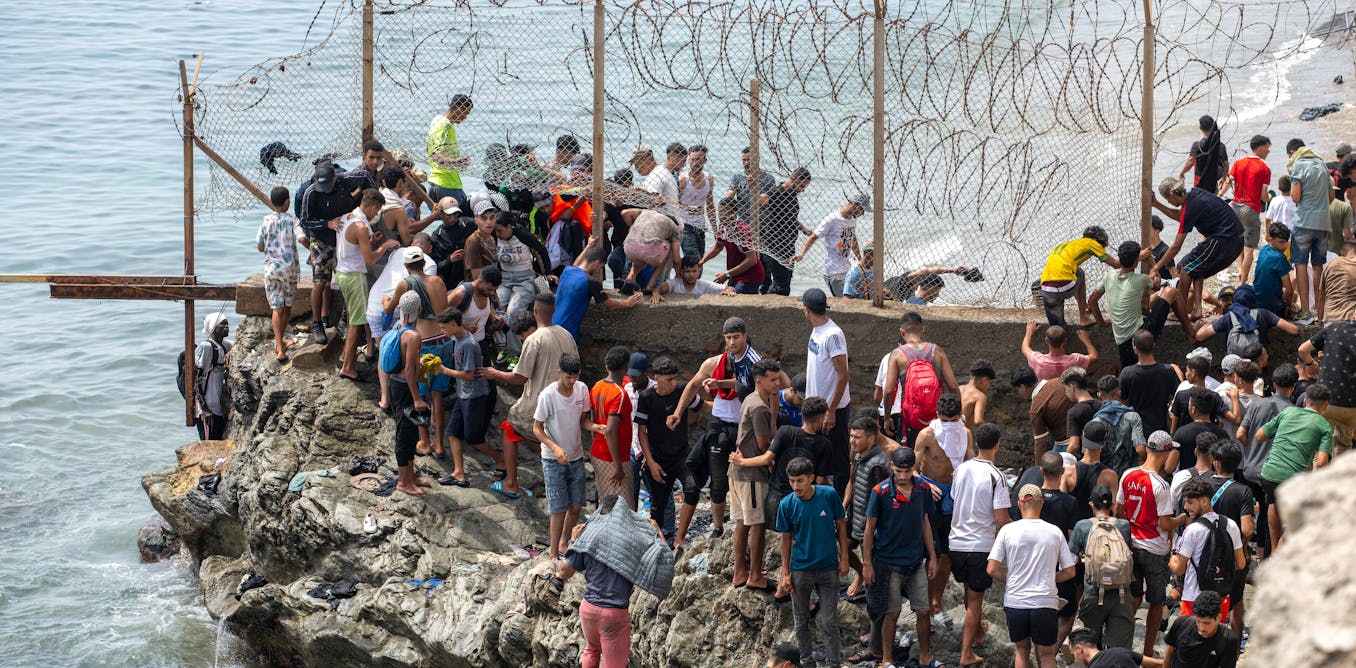
According to a European Parliament resolution adopted in June 2021, Moroccan police temporarily eased controls at the border of Ceuta, the Spanish enclave of about 83,000 people on the North African coast, and failed to stop thousands of people from entering. The resolution described how roughly 9,000 people entered Ceuta that May, including at least 1,200 unaccompanied children, days after Spain admitted the leader of the Polisario Front for medical treatment. Brahim Ghali leads the movement seeking independence for Western Sahara, the former Spanish colony Morocco considers part of its territory and treats as its foremost diplomatic priority. Morocco considered it a Spanish betrayal and recalled its ambassador from Madrid. By March 2022, Spanish Prime Minister Pedro Sánchez reversed four decades of Spanish neutrality and endorsed Morocco’s autonomy plan for Western Sahara. These events are the closest we can come to understanding what happened at the same border a few weeks ago, on July 31, 2026. New influx of Moroccans That day, tens of thousands of people arrived by sea and land from Morocco into Ceuta. Spain estimated 50,000 arrivals, Ceuta’s regional government 60,000 and Morocco 40,000. Spain said at least 72 people died, most from drowning. Morocco reported 11 deaths, while the Moroccan Association for Human Rights said nearly 130 died. United States President Donald Trump called the crossings an “invasion.” Online commentators, meanwhile, theorized that the U.S. and Israel had encouraged Morocco to punish the Spanish leader, whose government has become one of Israel’s harshest critics in Europe. An Associated Press fact check found no evidence for the claim. Most of those who crossed quickly went back. Within a few hours, Spain said 48,300 people had returned to Morocco, and most of the rest followed within days. The EU migration commissioner, Magnus Brunner, said none had reached mainland Europe. The more useful question is why this keeps happening in Ceuta. Read more: How the Ceuta border crossing incident immediately played into the hands of Spain’s far right Spanish enclaves in Africa Ceuta and Melilla, also on the northern African coast, have been under Spanish control for centuries. Spanish scholar Xavier Ferrer-Gallardo’s research shows how Spain treated the enclaves as its territory rather than colonies. He argues that this distinction helped Spain hold onto the territories after France relinquished its control of Morocco in 1956, when it became a sovereign state. The territories remain under dispute. A 2025 study in the Journal of Immigrant and Refugee Studies describes the enclaves as an unresolved colonial issue. Morocco has also repeatedly tried, without success, to have them added to the United Nations list of territories awaiting decolonization. Migrants run on Spanish territory after crossing the fences separating the Spanish enclave of Melilla from Morocco in June 2022. (AP Photo/Javier Bernardo) ‘Migration diplomacy’ and Western Sahara A territorial dispute doesn’t disappear because it cannot be settled in court. It can take other forms. Some scholars have referred to this as “migration diplomacy:” using control over migration to gain political concessions. Ceuta is especially vulnerable to this strategy. Spain relies on Morocco to police its European border, even though Morocco claims the territory on the other side of that border. Few other European borders work this way. Morocco’s main territorial dispute is not over Ceuta or Melilla. It’s over Western Sahara, a former Spanish colony that the United Nations still lists as a territory awaiting decolonization. Since 2007, Morocco has proposed giving the territory autonomy under Moroccan sovereignty. Algeria backs Western Sahara’s independence. Read more: Western Sahara: why Algeria supports the Sahrawi’s right to govern themselves But Morocco’s position has gained growing international support. Trump recognized Moroccan sovereignty over Western Sahara in December 2020. Spain backed Morocco’s autonomy plan in 2022, while Israel recognized Moroccan sovereignty in 2023. In October 2024, French President Emmanuel Macron said in front of Morocco’s parliament that the territory’s future should be linked to Moroccan sovereignty. The United Kingdom followed suit in 2025. On Oct. 31, 2025, the UN Security Council adopted Resolution 2797, backing talks based on Morocco’s plan and calling autonomy under Moroccan sovereignty the most feasible outcome for Western Sahara. Morocco declared the date a national holiday. Read more: After Ceuta, Europe is once again mired in migration chaos of its own making What was different in 2026 So what led to the events of July 31? Earlier in the month, Spain’s Supreme Court ruled that people intercepted at sea while swimming towards Ceuta could not be immediately sent back. Each person had to be assessed individually. The ruling did not give anyone the right to stay in Ceuta. On TikTok, Facebook and WhatsApp, however, there were false rumours that the border was open and papers were easy to obtain. These rumours were based on Spain’s April regularization program, which applied only to people already residing in the country. In December 2019, Morocco closed the Bab Sebta border crossing near Ceuta, ending informal trade that had supported thousands of people around the community of Fnideq. Moroccan customs estimated the trade was worth 550 to 750 million euros a year. More than 9,000 people depended on it, and unemployment in the M'diq-Fnideq district was already at 18 per cent. A new free-trade zone was meant to replace it, but only 55 companies had signed up to be included in the zone by the end of 2023. People walk on a beach after attempting to cross from the Moroccan northern town of Fnideq to the Spanish enclave of Ceuta, on July 31, 2026. (AP Photo) Obscuring the real issues Because Ceuta is in Africa, it’s not part of the Schengen free-movement area. During the crisis, the European Commission made clear that “irregular” arrivals to Ceuta could not simply leave for mainland Europe by boat or plane. Calling the crossings an “invasion” therefore hides the more important questions. It shifts attention from Ceuta’s disputed status, Fnideq’s economic crisis and Spanish regularization policies to fences and security. As Dutch scholar Hein de Haas has argued, dramatic accounts of migration can obscure its real causes. What’s more, in the first half of 2026, irregular crossings into the EU were down 37 per cent — hardly the numbers of an invasion. The crisis also raises questions Europe has not asked. Why is a European border located on African soil? And why has the dispute about Ceuta and Spanish colonization remained unresolved for so long? What happened in July was not an invasion. It was the result of a disputed border, a damaged local economy and false rumours about Spanish policy. Dozens of people drowned in the gap between those facts and the word used to describe them.
Ceuta’s border crisis is about geopolitics, not just migration
Full Article
Original Source
Read the full article at Theconversation →KhanList aggregates and links to publicly available news content. We do not host full articles from third-party sources. Always verify important information with original sources.