
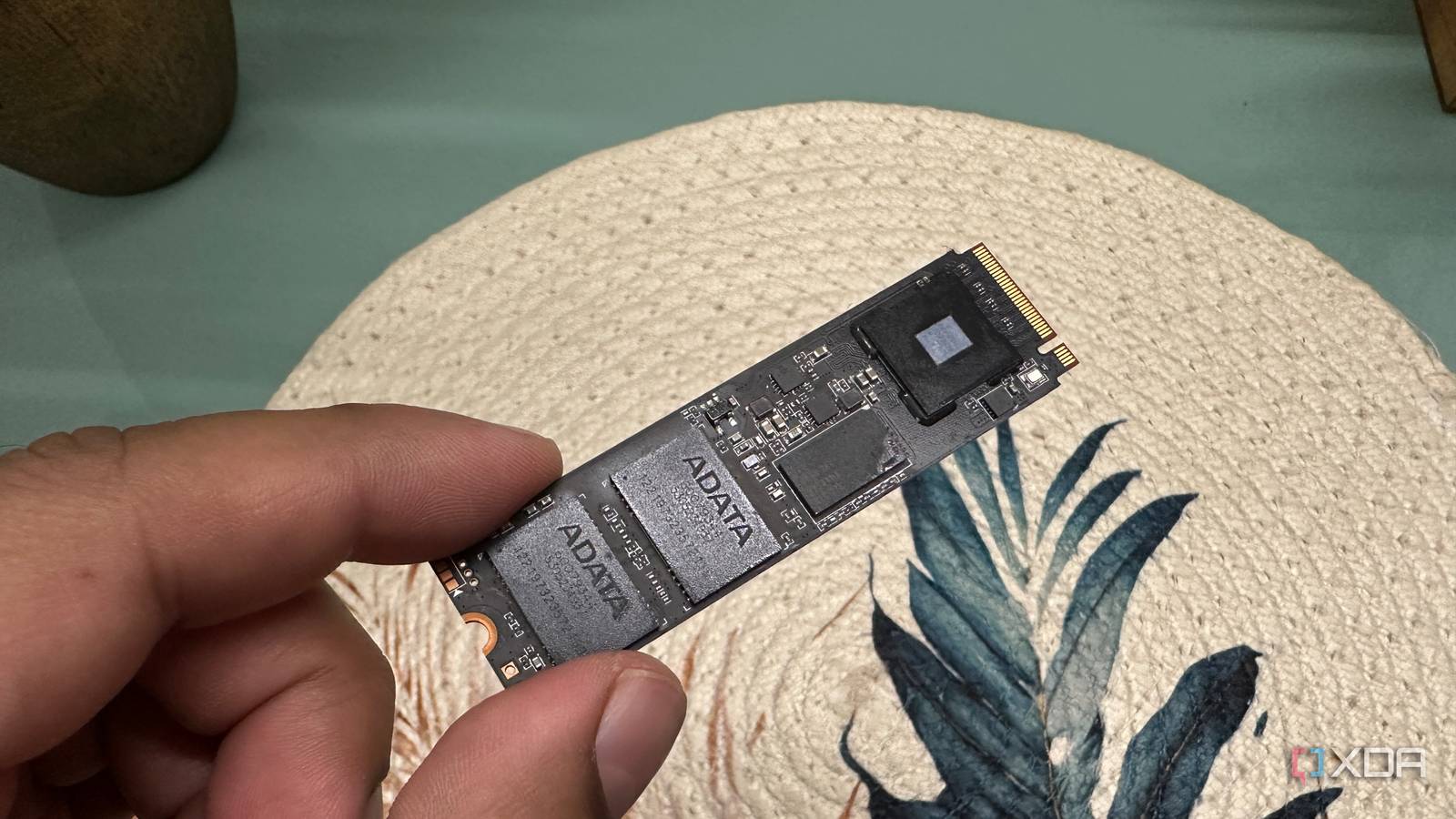
Published Sep 5, 2026, 4:30 PM EDT Abhinav pivoted from a career in banking to pursue his first love in writing. Even while working full-time, he continued contributing as an editor-at-large, a role he has held for more than 7 years. A lifelong tech enthusiast who has built three gaming and productivity powerhouse PCs since 2018, his passion for technology keeps him closely following the semiconductor industry, from NVIDIA and AMD to ARM. His MSc dissertation explored how artificial intelligence will reshape the future of work, reflecting his curiosity about the wider social impact of emerging technologies. The Consumer Electronics Show has, historically, been a home to the technology that I like but would probably never buy. Ridiculously fast SSDs, enormous monitors with unrealistic refresh rates, laptops that rival my 4070 Ti Super-equipped workstation, among other massively impressive things, and this year's CES was no different. Except one of the more interesting storage announcements this year wasn't particularly exciting. Phison unveiled a new PCIe Gen 5 SSD controller called the E37T, and it had one rather conspicuous omission, which was the DRAM cache. Almost nine full months after the announcement, I'm increasingly convinced that it was a warning sign about what we should buy before the economics of storage change again. There's a reason why the Phison E37T caught my attention And everyone seemed to miss why it was an important announcement Credit: Phison. Phison unveiled the E37T at CES this year as a four-channel, DRAM-less PCIe Gen 5 x4 SSD controller built on TSMC's 6nm process. Now, unlike the company's flagship E28, which uses eight NAND channels and dedicated DRAM, the E37T was designed around lower cost and power consumption, with single-sided M.2 designs targeting mobile devices like laptops, handhelds, and other compact systems like mini PCs. What came as a surprise, nonetheless, were the specifications, and particularly how impressive they were for a controller that left out the DRAM cache. Phison rated the E37T for up to 14.7GB/s sequential reads, 13.0GB/s sequential writes, and 2 million 4K random IOPS along with power consumption below 2.3W at the time of launch, although the firm did update the random IOPS figure to 3 million later. One might wonder as to why I think this move is a departure from the ordinary SSD trajectory, and if so, they'd be asking the right question. Dedicated DRAM has been a part of every high-performance SSD for a little more than a decade now, and many enthusiasts often see it as a non-negotiable for their storage. It was this very omission that was, therefore, a little more captivating than the performance numbers. The DRAM crunch is getting more prominent, and more silent And if you've been watching the market, it checks out Perhaps the more interesting development that underpinned this announcement had been in motion for years before the E37T was unveiled. At Computex 2026, Phison's Director of Technical Marketing, Chris Ramseyer, told TweakTown that the company had been closely watching the DRAM capacity be increasingly allocated to the AI infrastructure as early as 2024, and had anticipated that it would inevitably put pressure on cost and availability of memory for consumer hardware. The E37T, therefore, was a part of a response to the changes in the DRAM economy. In retrospect, a DRAM-less controller designed to bring Gen 5 performance into cheaper SSDs makes perfect sense. The market also seems to have caught up with that reasoning. In a February 2026 report, TrendForce examined the memory price outlook and projected conventional DRAM contract prices would rise by 90–95% quarter-over-quarter in Q1 2026, up from its previous 55-60% forecast. Its NAND Flash forecast was similarly revised from 33–38% to 55–60%, attributing the worsening imbalance to persistent AI and data-center demand. As such, the business case for the production of DRAM-less alternatives in storage is stronger than it has ever been before, and that may be concerning to consumers. HMB is great, but it isn't a replacement for DRAM cache And that's why I'm convinced I should buy more DRAM-equipped SSDs now There's a reason why DRAM-equipped SSDs have remained the enthusiasts' favorite for so long. The alternative, which is Host Memory Buffer (HMB) has narrowed the gap between performance considerably over the years, but it is far from being eliminated, and it has ways of being reflected under heavier workloads. The reason for that has everything to do with the underlying architecture of the modern SSD itself. HMB gives DRAM-less drives access to a part of system memory to hold the FTL mapping tables, but it is hardly the same as having a dedicated DRAM chip on the drive itself. While DRAM-equipped drives can maintain a tangible advantage in demanding random I/O and sustained mixed workloads, DRAM-less drives suffer more once the SLC cache is exhausted. The difference isn't night-and-day in everyday use, but large file transfers and sustained writes are examples of where the variance can become much more perceptible. That gives more reason for me to buy more DRAM-equipped SSDs now. The main drive in my rig is a DRAM-cached PCIe Gen 4 NVMe from Crucial, and the kind of workloads I dabble in actually benefit from the DRAM advantage, such as loading multi-gigabyte local AI model files and long sustained transfers of AAA games (which, in 2026, can be expected to be as huge as hundreds of gigabytes) from one drive to another. These PCIe Gen 4 SSDs are still available at reasonable prices today, but given what Phison is signaling about its roadmap, and what industry analysts are projecting with regard to DRAM contracts in the near future, I'd rather buy as much as I need now than find out what the prices look like a year from now once the trend catches on further. Storage industry is experiencing a silent shrinkflation If there's anything to be gathered from this retrospective analysis, it's the fact that storage is experiencing similar kind of shrinkflation as the rest of consumer hardware components amidst the DRAM crisis. Most average users would miss its impact, but that's exactly because the compromises are becoming harder to spot on spec sheets. That's precisely why these developments are worth keeping an eye on, and why now might be the last comfortable window to buy the tier of storage you want.
CES 2026 convinced me to buy one type of SSD before it disappears, so I'm buying now
Full Article
Original Source
Read the full article at Xda-developers →KhanList aggregates and links to publicly available news content. We do not host full articles from third-party sources. Always verify important information with original sources.