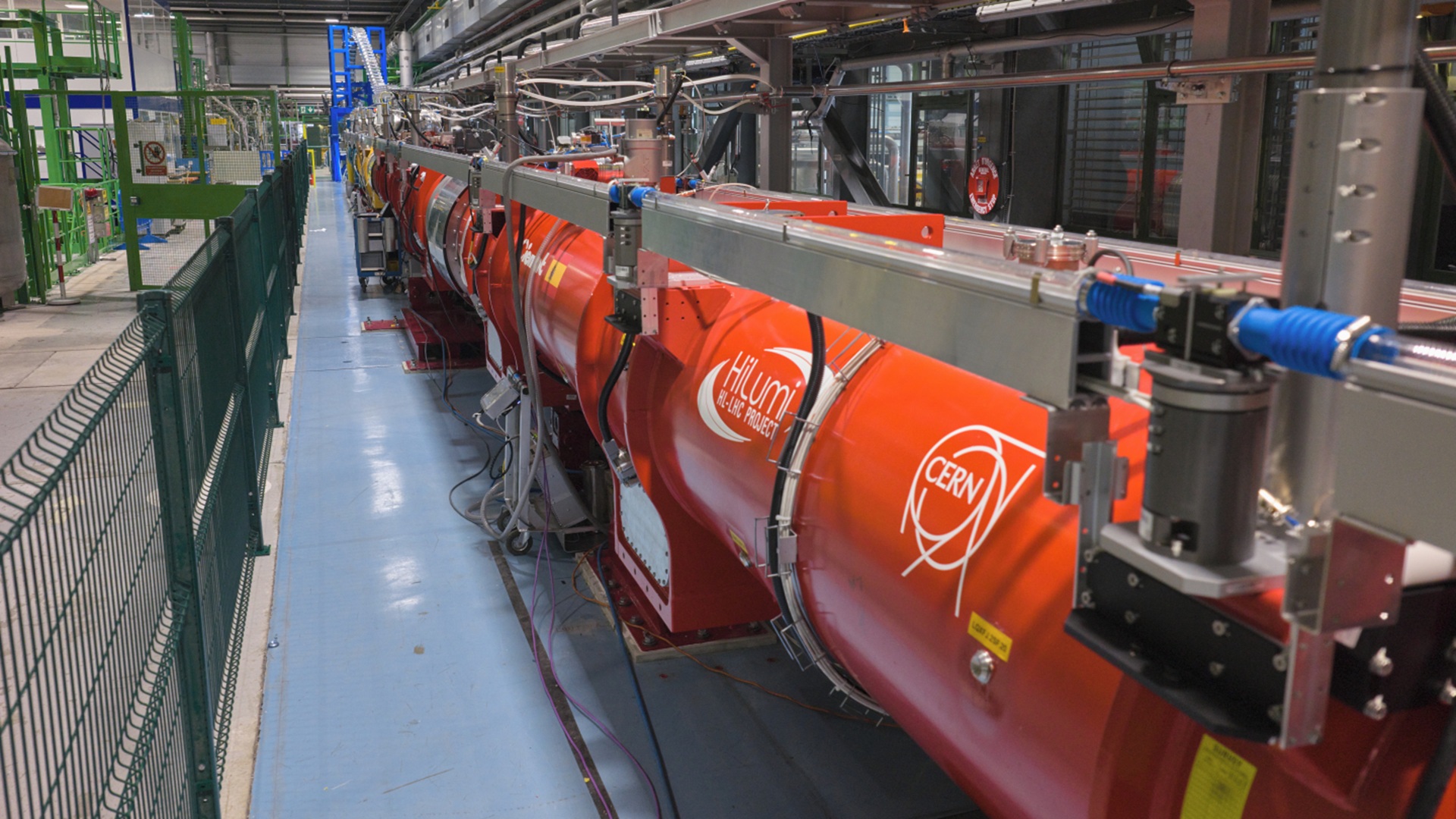
The new quadrupole magnets developed for the HiLumi LHC are operating at full power in the test facility.CERN CERN has just upgraded the world’s largest particle accelerator after successfully powering a new generation of superconducting magnets to their full operating current earlier this month. The European Organization for Nuclear Research, and the world’s largest particle physics lab, revealed that the achievement is a big step for the High-Luminosity Large Hadron Collider (HiLumi LHC). HiLumi LHC is an upgraded version of the Large Hadron Collider (LHC). It took place on Wednesday, July 8. It is set to begin operations in 2030. The new accelerator will produce significantly more particle collisions. It will allow scientists to gather larger datasets and search for rare phenomena beyond the Standard Model of particle physics. The breakthrough took place at the Inner Triplet (IT) String test facility. There, the new quadrupole magnets reached their design current of 16,230 amperes (A). The magnets can focus proton beams more tightly before they collide. This increases the collider’s luminosity, or collision rate. Boosting collision rates The quadrupole magnets are a massive upgrade over the niobium-titanium inner triplet magnets currently used in the LHC. They use niobium-tin superconducting coils. This allows them to operate at magnetic fields of 11.3 teslas, which is about 35 percent higher than those achieved by the current generation. They also feature a much larger aperture, which has increased from 70 millimeters to 150 millimeters. The wider opening allows the magnets to focus particle beams more precisely and produce more collisions during experiments. Additionally, one of the most significant outcomes of the recent tests was that the magnets reached their full operating current without experiencing a phenomenon called quench. It represents a transition from the superconducting state to normal electrical conduction. As per CERN, superconducting magnets typically need repeated powering cycles, known as training, before they can reliably reach their design current. During this process, mechanical adjustments in the magnet often trigger quenches at lower currents. Over time, the internal structure stabilizes, allowing progressively higher operating currents. The new magnets retained their training, and demonstrated excellent memory. “Good memory is a key performance requirement for accelerator magnets, as it minimizes commissioning time, cryogenic consumption and operational delays,” Susana Izquierdo Bermudez, head of CERN’s Large Magnet Facility, emphasized. Designed for discovery The effort also validated the performance of the entire IT String test facility. CERN successfully powered all 17 electrical circuits to their operating currents. This also included the separation dipole magnet, which will steer the two particle beams apart after collisions inside the future HiLumi LHC experiments. The dipole met its target current after only a few training quenches. The corrector magnet circuits also achieved their design currents during both individual and combined operation. Meanwhile, the test also verified the magnet protection system. It safely released up to 38 megajoules (MJ) of stored magnetic energy into liquid helium kept at 1.9 kelvin (-456 degrees Fahrenheit) when needed. “The successful powering of all circuits marked the completion of the IT String hardware commissioning phase,” Samer Yammine, head of IT String operations, pointed out. “The campaign generated a vast amount of data that we are now analyzing to better understand how all the systems interact.” The ongoing analyses cover the superconducting magnets, cold powering system, power converters, quench detection and protection, cryogenics, vacuum, controls and alignment. The results will help optimize the HiLumi LHC’s commissioning and future operation. Further testing will resume in September. “This second operational campaign in September will primarily focus on validating the commissioning procedures and analysis tools, as well as demonstrating the reproducibility of the integrated system performance,” Marta Bajko, IT String facility head, said in a press release. Recommended ArticlesGet the latest in engineering, tech, space & science - delivered daily to your inbox.Based in Skopje, North Macedonia. Her work has appeared in Daily Mail, Mirror, Daily Star, Yahoo, NationalWorld, Newsweek, Press Gazette and others. She covers stories on batteries, wind energy, sustainable shipping and new discoveries. When she's not chasing the next big science story, she's traveling, exploring new cultures, or enjoying good food with even better wine.
CERN upgrades world’s most powerful particle accelerator with 11.3 tesla magnets
Full Article
Original Source
Read the full article at Interestingengineering →KhanList aggregates and links to publicly available news content. We do not host full articles from third-party sources. Always verify important information with original sources.